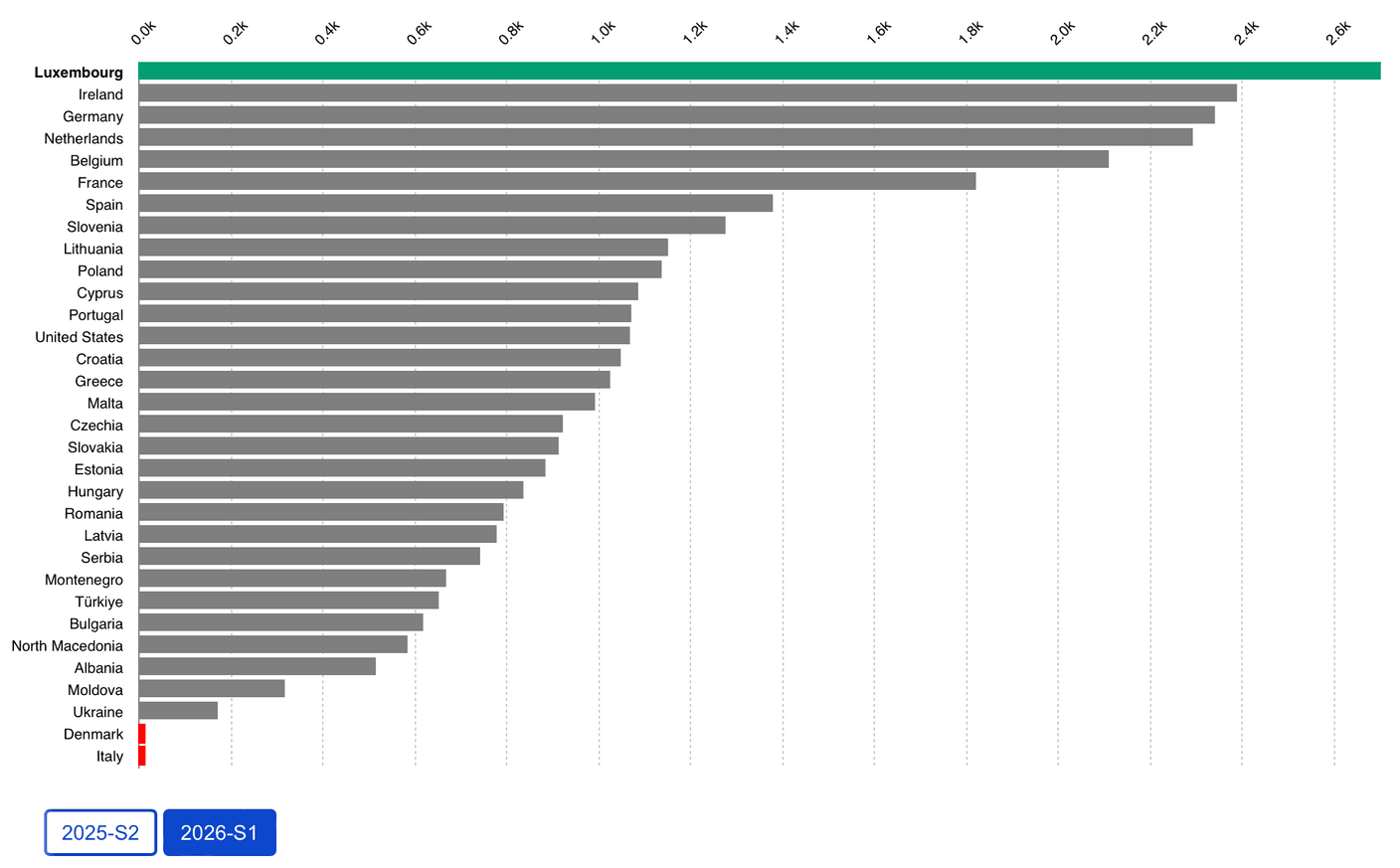
While Luxembourg has for several years been the “champion” of European minimum wages, currently at €2,704 gross, the disparities are considerably smaller after adjusting for differences in price levels. As a result, as it was already the case this summer, if we express these wages in purchasing power standards (PPS), Germany has the highest monthly gross minimum wage, with 2,157 PPS as at 1 January this year, just ahead of Luxembourg, which therefore sees its minimum social wage (SSM) rise to 2,035 PPS.
As a reminder, the PPS offers a fairer comparison by using an artificial currency that reflects what people can actually buy in each country, equalising real purchasing power against the strict terms of the euro value. On 1 January, 22 of the 27 EU countries had a national minimum wage. In contrast, the latter is non-existent in five EU countries: Denmark, Italy, Austria, Finland and Sweden.
Eurostat’s analysis also included the United States and the ten countries that are both actual and potential candidates for EU membership. Seven of these candidates have a national minimum wage (Montenegro, Moldova, Northern Macedonia, Albania, Serbia, Turkey and Ukraine), unlike Bosnia-Herzegovina, Georgia and Kosovo.