The belief that Luxembourg is too small to play a serious role in Europe’s defence effort remains widespread. Yet speakers at a panel discussion last night insisted that a defence industry already exists here—and that the country’s experience in finance and space can be transferred to defence.
LuxDefence, the new association of Luxembourg defence companies, aims to unite industrial players, promote innovation and build stronger cooperation with European partners. Its broader goal is to embed Luxembourg more firmly into a resilient European defence ecosystem.
Logistics as Europe’s blind spot
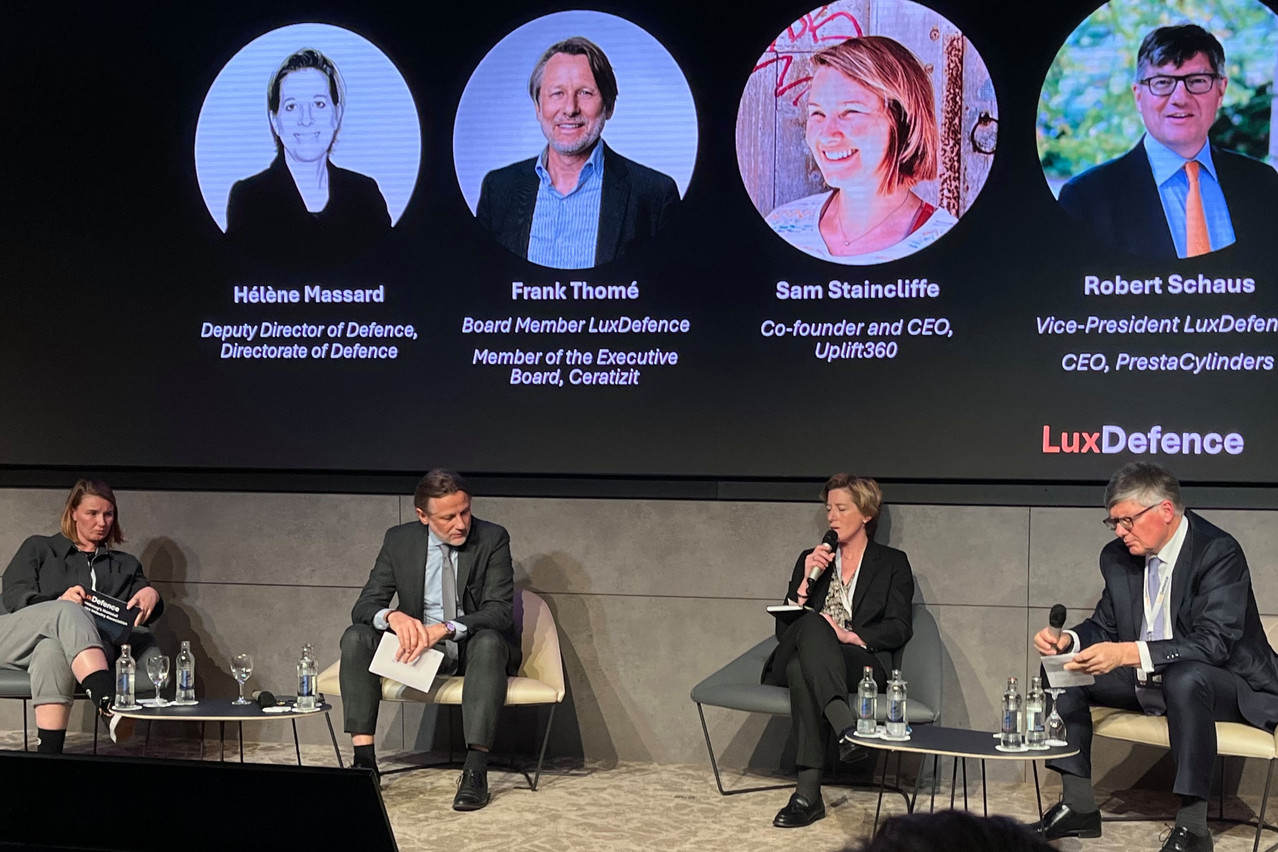
Robert Schaus, CEO of Presta Cylinders Sàrl and vice-president of LuxDefence, said his 15 years in Ukraine and Russia had left him “very, very scared”. Europe, he argued, had let its defence capability “rot for 50 years” and now faced the challenge of rebuilding it at speed.
“Amateurs talk strategy, professionals talk logistics,” he said. “Logistics is industrial capacity to produce what we will need to defend ourselves”.
Luxembourg, he added, could reprise its historical role as a platform or catalyst, helping the EU move beyond the “national prejudices” that still fragment industrial efforts. But public understanding remains muddied, he said, by “the four P’s of bureaucracy: promotion, projections, promises and plans”.
Industry capacity
Industrial representatives rejected the suggestion that Luxembourg lacks a defence base. “A defence industry already exists,” said Frank Thomé, executive board member at Ceratizit. His company describes itself as a high-technology engineering group specialising in cutting tools and hard-material solutions.
Thomé said Europe’s renewed strategic focus created opportunities for Luxembourg firms, particularly as EU member states move towards significantly higher defence spending.
Dual-use entry point
For most companies, he said, dual-use technology—designed for civilian use but adaptable to military applications—is the natural gateway. “Basically every player in the industry is a potential defence supplier.”
But defence is “a different ball game altogether”. Companies must harden their IT systems, secure facilities, comply with export controls and, in some cases, seek security clearances for staff. LuxDefence offers training to help firms navigate these requirements.
Suppliers in the game
Several Luxembourg-based companies already contribute to military supply chains. Goodyear produces specialised tyres for military vehicles; Euro-Composites manufactures components used in fighter jets, including the F-35; and Saturne Technology performs 3D metal additive manufacturing for parts in the Rafale’s engine.
SES, the country’s flagship satellite operator, runs GovSat for secure government-to-government communications. Ceratizit also produces and sources tungsten, essential for ammunition and ballistic penetrators.
A new dialogue
Hélène Massard of the Directorate of Defence welcomed the creation of LuxDefence, calling it a step that strengthens collective defence and deterrence. A “structured dialogue” between government and industry, she said, is now essential. Her organisation is in charge of the defence industry and economic return on behalf of the ministries of foreign and european affairs, defence, development cooperation and foreign trade, Luxembourg.
“We really need feedback from the field,” she emphasised. Such input allows the state to align policies with industrial realities and anticipate emerging technologies. Strengthening industrial capacity, she added, is “a top priority of the government”.
Startup survival risks
Representing the startup community, Sam Staincliffe, co-founder and CEO of Uplift360, a cleantech company developing chemical-based technologies to recycle and reuse advanced materials, deplored the failure of the media to reflect the extent of Luxembourg’s military-related activity, despite its long-standing roots.
She highlighted several innovative Luxembourg firms, including LMO Autonomous Space Systems, Rafinex—whose software uses advanced numerical modelling—and AM 4 AM, a developer of high-performance materials for additive manufacturing.
Dual-use business models, she argued, are essential in Luxembourg, allowing companies to maintain several market segments. But the economics are unforgiving. “Defence contracting can be chaotic; it can be slow,” she said. Cash-poor startups struggle to survive without substantial government backing—or Silicon Valley investors.