As a married or civil union couple, is it more advantageous to declare your taxes together or separately? This is the question posed by Michel-Edouard Ruben. In a paper published on Wednesday, 11 June, the Idea Foundation economist looks at the future tax reform, even if its contours are still unclear for the time being. In July, finance minister 
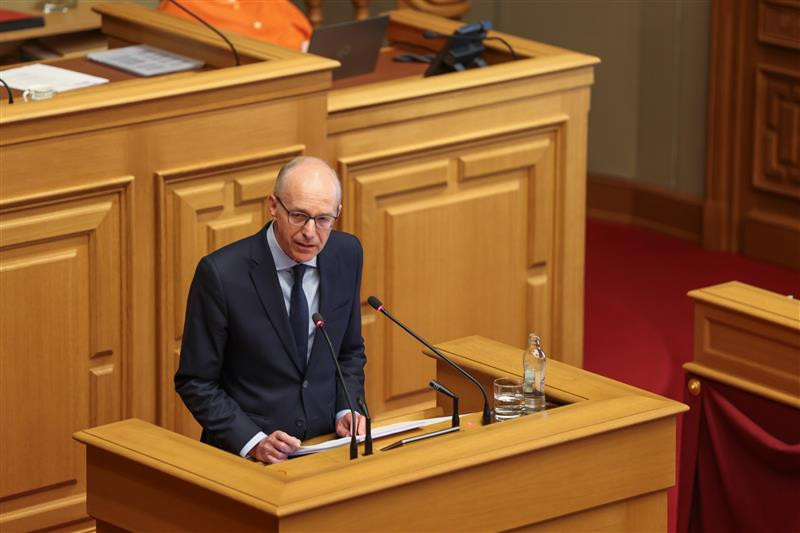
“One of the avenues being considered could be a new tax scale, close to the current class 1A, accompanied by an extended transitional phase for married or PACS taxpayers, so that they are not disadvantaged,” said prime minister Luc Frieden (CSV) in his State of the Nation address. “Assuming, for want of more information, that the extended transitional period (in class 2) would only affect those who were married or PACSed before a given date, there would then be a dual tax system for couples in Luxembourg,” says Ruben. “Depending on whether their union was legally recognised before or after the introduction of the single class, spouses and partners would be subject to either collective taxation (transitional period, old regime, class 2, splitting) or individual taxation (new regime, single class, scale close to that of class 1A).”
+96% for a couple earning €60,173
“We will have to look at how close (or not) the new scale that will be decided will be to that of the current tax class 1A, which underwent a substantial adjustment at the end of 2024 (Entlaaschtungs-Pak),” the economist continues. “As things stand, and contrary to what the prime minister’s remarks suggest, many couples would be better off being taxed separately in class 1A rather than collectively in class 2.”
When the Entlaaschtungs-Pak tax relief package was presented last July, the ministry of finance put forward a series of typical cases. For example, a couple with taxable income of €60,173, with income split 2/3 and 1/3 within the couple: under the current class 1A scale, this couple would pay €2,049 in tax, compared with €4,024 (+96%) under class 2. There is no difficulty in understanding that individual taxation in class 1A would be more advantageous, even for couples.
“Realising the potential opportunity cost, many couples eligible for the extended transitional period should--rationally--refuse to be taxed collectively under the old regime and demand to be taxed individually under the new one (single class, scale 1A) which proves(s) to be more favourable,” says Ruben. “Also, at a time when budget balances are no longer what they used to be, a single class with a scale (too) close to that of the current class 1A could cost the taxman--dearly--in that it will be synonymous with a tax cut for a large number of taxpayers (single people, double-income spouses) and risks opening the way to new tax demands from those (single-parent families, widowers, over-65s) who were previously the only ‘privileged’ ones in class 1A.”
Quasi-unanimous parties a single class
The current tax reform aims to individualise taxation to make it more neutral and fair. But according to the economist, this promise is likely to come up against unanticipated perverse effects, both in budgetary and socio-political terms. The opinions of the country’s political parties quoted by the Idea Foundation are mixed. The CSV said it was “open, in the medium term, to a debate on abolishing tax classes.” The DP announced that it wants to “introduce, in the medium term, a single tax bracket that treats all forms of cohabitation in the same way fiscally and thus leads to greater tax fairness.”
On the opposition side, the LSAP “advocates a gradual generalisation of individual taxation, going hand in hand with the introduction of a new single tax scale (and) in order to take account of child-related expenses, the introduction of a tax credit for each child in the household.” For Déi Gréng, meanwhile, we need to “implement the individualisation of personal income tax as part of a far-reaching tax reform (and) abolish the three existing tax classes and introduce a new single tax class for all, with a new tax scale.”
ADR goes against the grain
“The Pirates want to abolish tax classes,” says the Pirate party. “For us, it is unacceptable that our tax system still rewards one lifestyle model and penalises another. The aim is entirely individual taxation, where everyone is treated equally, regardless of their relationship status. Differences in taxation based on marital status, whether married, civil partnership or single, must be a thing of the past.”
“Déi Lénk proposes abandoning the approach of three tax classes (1,1A and 2) and introducing a single tax scale weighted according to household composition using consumption units,” says the party. “In this way, each person with no income who is dependent on the taxpayer’s income (partner, children) will reduce the same taxpayer’s tax by a coefficient. This will allow better account to be taken of the principle of ability to pay tax, eliminate the current inequalities relating to marital status (single, married, divorced, widowed), and take better account of the situation of single parents.”
Going against the grain, the ADR “does not wish to abolish the family through a complete individualisation of the tax system. The family, as the basic unit of society, must continue to be favoured fiscally.”
This article was originally published in French.