Their names are Amanda Qiu, from BR-YR Executive Search, or Shirly Shen, from Internship Union, according to the two cases named by MI5 on Tuesday, in an unusual warning alerting British MPs to attempted approaches made via Linkedin by individuals presented as headhunters, but suspected of being linked to the Chinese Ministry of State Security. The British services described deceptively harmless professional solicitations, with requests for paid analysis or advice, sometimes accompanied by attempts to obtain non-public information. China has reacted by describing these allegations as "pure slander", denouncing them as political manipulation.
The British government has decided to step up its response. In the wake of the alert, London has announced new security briefings for politicians and election candidates, increased cooperation with professional platforms, as well as further investment in modernising government communications tools and tightening up counter-intelligence arrangements. The authorities point out that the use of professional platforms is not new, but has become sufficiently systematic to justify an unusual public communication from MI5.
This method of contact, which falls under social engineering, was described as early as 2017-2018 in Germany. At that time, the domestic intelligence service (BfV) published a report warning of the use of hundreds of fake Linkedin profiles attributed to Chinese networks to approach German civil servants, researchers, diplomats and politicians. Since then, other procedures have been made public. In September 2025, for example, a former assistant to an AfD party MP was convicted of spying for China, a case with no direct link to Linkedin but illustrating the interest shown in political circles.
In Ireland, several journalistic investigations carried out between 2023 and 2024 described influential activities in academic and associative circles linked to bodies attached to the Chinese United Front. These investigations did not result in any convictions, but fuelled debate on approaches targeting sensitive sectors.
The UK had already seen a related case in 2022, when a London lawyer, Christine Lee, was singled out by MI5 as acting for the benefit of the Chinese Communist Party, a charge she disputed. She was not convicted, but the alert had highlighted the British authorities' heightened vigilance over foreign influence activities.
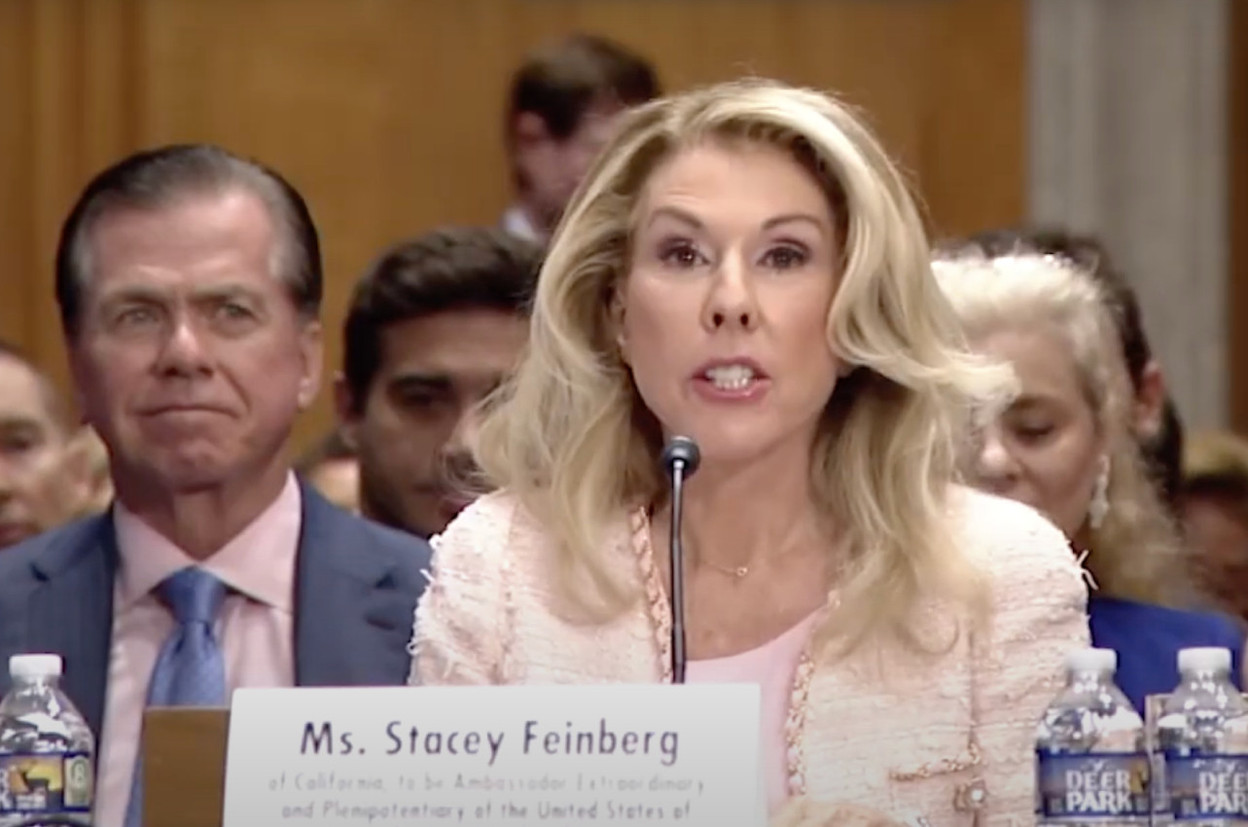
While this alert resonates in several European countries where security services have documented comparable approaches at different times, it has a particular resonance in Luxembourg in a very different context. On 1 August 2025, the Minister for Foreign Affairs, 


In its official response, the Luxembourg government states that it has taken note of the remarks made by the future US diplomat, while reaffirming the country's sovereignty, with Xavier Bettel specifying that Luxembourg "is the vassal of neither the United States nor China". The question targeted the elements of the then candidate for the post of US ambassador to Luxembourg concerning research and higher education. In its response, the government pointed out that the Confucius Institute at the University of Luxembourg, created in 2018 with Fudan University, is limited to language teaching and cultural activities, with no link to the institution's scientific work. As for the Chinese Student Association, it is described as a student club subject to the rules of the Student Life & Engagement Charter, in the same way as the other campus associations.
While London warns against using Linkedin as a vehicle for targeted outreach, most of the continent's states are trying to balance security vigilance, academic openness and maintaining stable diplomatic relations with Beijing, in a context where each new alert reshuffles, however briefly, the cards of this fragile balance.