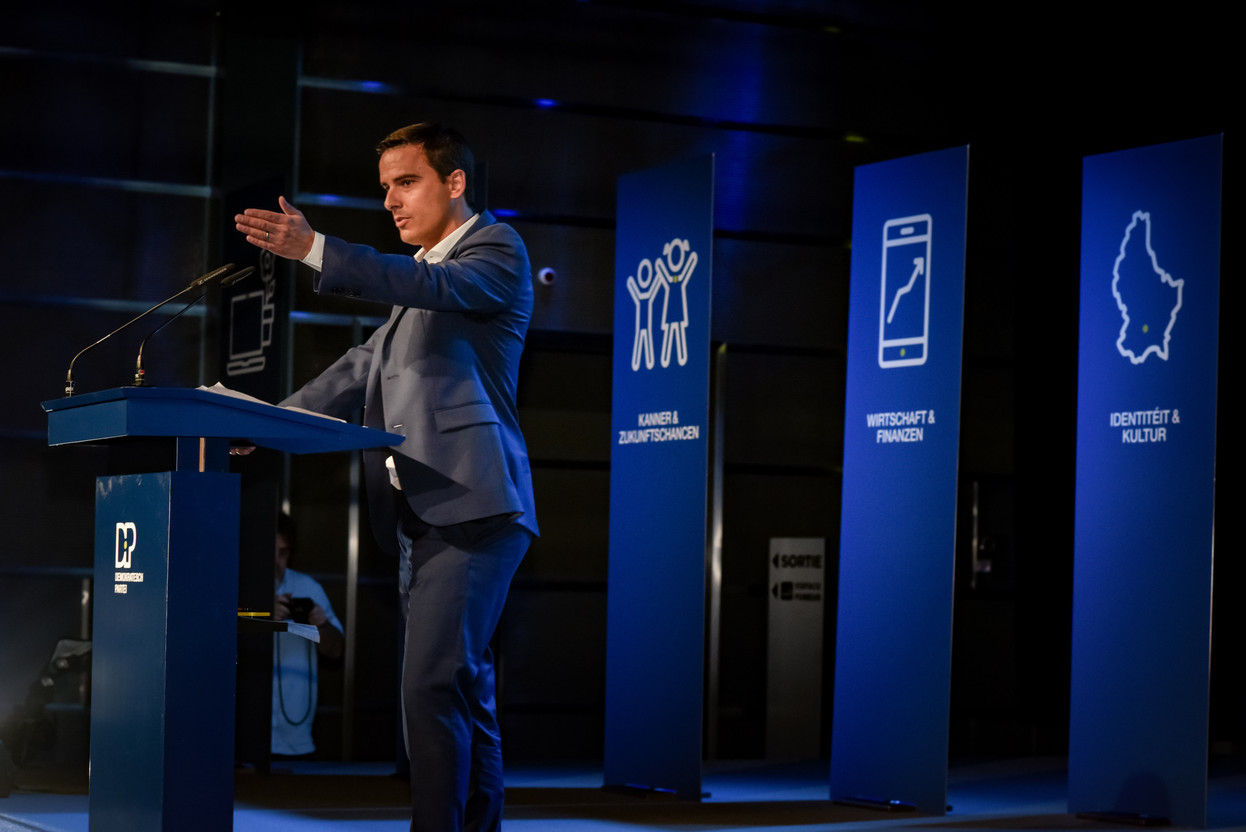
The budget bill tabled on 12 October by finance minister 

This is where the political ‘thing’ comes in. Mentioning the budgetary axes means mentioning priorities that can be seen as campaign ideas. In a way, this report also outlines what could be a tactical roadmap for the DP in 2023.
The law will be put to a vote by the political groups after the finance minister’s speech and debates, probably on Thursday 15 December.
Aurélie Boob: What will be the main changes in your report compared to the version tabled in October?
Max Hahn: Three parliamentary amendments were adopted on 28 November, following the objections expressed by the council of state in its opinion of 15 November, and articles were deleted because they required a specific law. In addition, a governmental amendment was introduced (new Article 8 of the 2023 budget): it excludes investments in natural gas and nuclear power from the tax advantage (subscription tax reduced to 0.01% for investment funds). This is to remain consistent with the grand duchy’s policy of energy and non-nuclear transition for several years.
My recommendations reflect this need for social cohesion and also support for businesses, particularly in construction.

The budget law is a very political exercise. The report mentions several times the notion of “better living together.” What does this mean to you?
It means living together in a more cohesive way. It means ensuring that the effects of past crises do not lead to a social crisis. It also means living in a more sustainable way, in particular by producing more energy in Luxembourg, and living in a more inclusive way: disabilities, internationality, intergeneration... I met 44 economic players from the financial sector, employers, trade unions, housing, social services, but also grassroots players, entrepreneurs. The exchanges were fruitful.
The role of the rapporteur is also to identify areas for improvement where there is a shortfall. My recommendations reflect this need for social cohesion and also support for businesses, particularly in construction, to avoid bankruptcies, and to maintain the increase in affordable housing. We need to ensure that companies can emerge from this new energy crisis by avoiding redundancies. They must be able to emerge stronger from this crisis and we must ensure that social cohesion and consumer purchasing power are preserved.
You also state in the report that there are other issues “that could not be dealt with in depth.” Which ones?
Health, I regret, could not have a large place in this report, especially support for primary caregivers. The first of my recommendations concerns the launch of a mobile application to geolocate people trained in first aid following an emergency call.
Sport and culture also, so that people continue to meet, even if much has already been done by the government and the municipalities in the framework of Esch 2022.
The role of the rapporteur is also to identify areas for improvement where there is a lack.

This expression of “better living together” already sounds like a guideline, on the eve of a major election year.
The role of the rapporteur is to give his or her thoughts on the budget figures on the one hand, and on the other hand on how to improve. I have chosen the theme of better living together to encompass the reflections, but these are not my ideas as a person for a possible electoral programme, because this is not the time. These are ideas that will be developed in the future and that have been discussed within my political group. I know that these ideas will be criticised and attacked, but I also hope that some of them will be realised.
What was the experience of being the rapporteur for the law?
I enjoyed the experience, even though I knew it was a lot of preparatory work and consultation. I prepared for these exchanges as one prepares for a long journey. You read, you get information and you meet a lot of people who enrich your thinking. In addition to the people I met as rapporteur, I also attended the other committees and had discussions with the ministers responsible. This gave me an insight into the concrete links between the various decision-making bodies within the government.
This story was first published in French on Paperjam. It has been translated and edited for Delano.