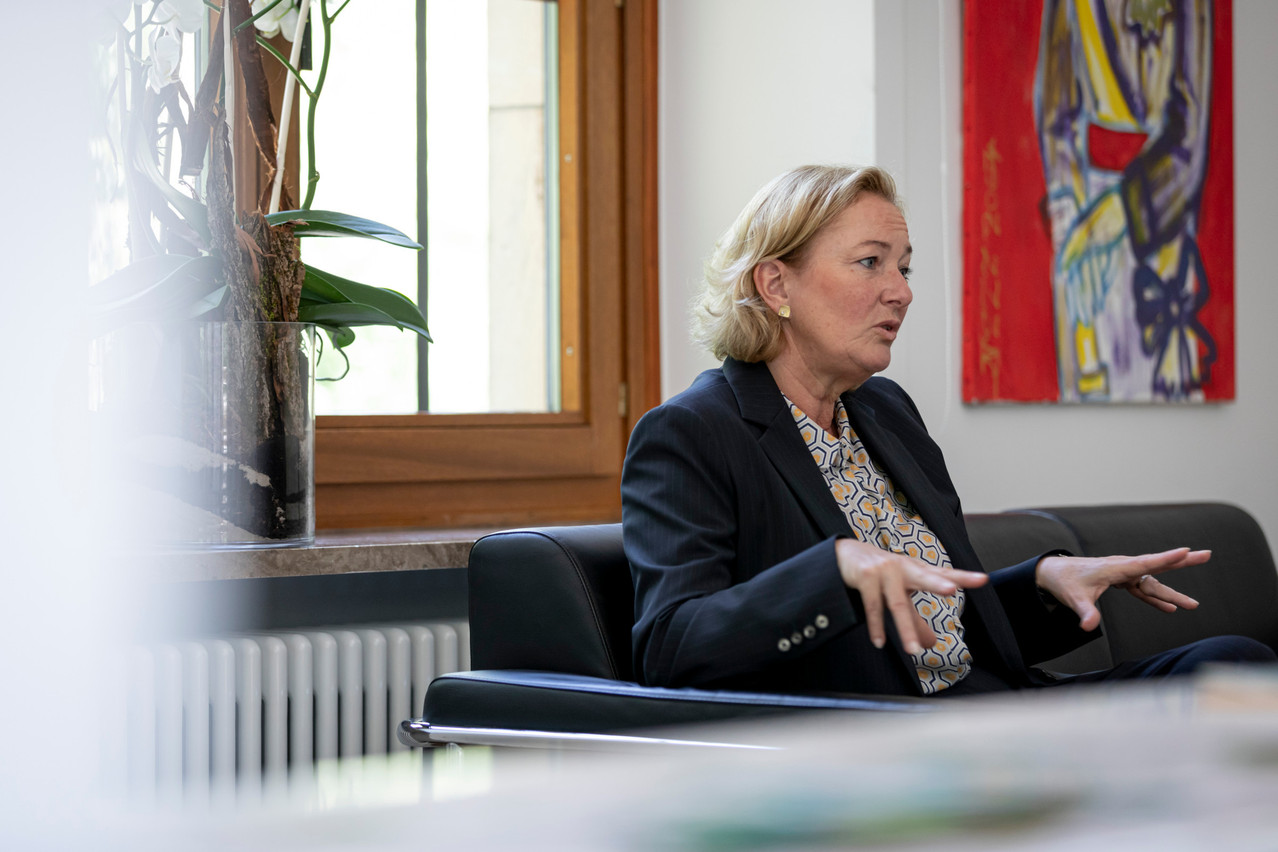
The government coalition, following recommendations from a group of experts, opened the door to compulsory vaccination for those aged over 50 and healthcare staff. However, the LSAP has been more cautious on the subject than its coalition partners, the DP and déi Gréng. In an interview with Delano's sister publication Paperjam infectious disease expert Gérard Schockmel criticised Lenert stating that she had “ignored the recommendations of experts in favour of compulsory vaccination”.
Speaking to Paperjam, Lenert said she was in favour of introducing compulsory vaccination as soon as possible, but pointed out that it would be necessary to wait until the bill was ready before assessing the need for such a measure, as vaccination rates could increase in the meantime. The assessment is expected to be completed by mid-February.
Lenert believes that it was reasonable to try to convince the population before enforcing vaccination and does not regret not having introduced such measures earlier.
Since the beginning of the vaccination campaign, you have made clear your reluctance to introduce mandatory vaccination. This was also felt during the debate in Parliament last week, when you agreed to compulsory vaccination for those over 50 years of age and healthcare staff. Are you in favour of such a measure?
Paulette Lenert. - I agree 100% with the analysis made by the panel of experts on the basis of our data. From the age of 50 onwards, the risk of hospitalisation is much higher. This is the risk group. I therefore fully understand that we need to work on this population, through a well-prepared compulsory vaccination, to try to increase this rate as much as possible.
In terms of of prevention from the start of the school year, this campaign must be deployed in order to have vaccinated a maximum number of people before then.

Do you think it is necessary to implement this obligation as soon as possible?
Yes, it's very clear, now is the time to act. We can't wait for a wave to arrive in autumn and only then to mandate a vaccine. So, it's obvious that in terms of of prevention from the start of the school year, this campaign must be deployed in order to have vaccinated a maximum number of people before then.
The idea is therefore to prepare a bill as soon as possible. We have set a maximum deadline of three months, which I think is reasonable. We may even be ready before then.
But during the debate in parliament, the LSAP repeated that this obligation should only be implemented “if the situation requires it”.
We are still in the middle of the vaccination campaign and our most stringent measures, especially in terms of work, have just come into force. The situation can therefore change by chance in the coming months. In fact, we are making progress, there are primary vaccinations every day.
We will evaluate the situation by mid-February at the latest to see where we stand. Obviously, if it still makes sense to work on those over 50, we will implement the obligation immediately. But we don't want to do it blindly. We will have to evaluate the situation once the project is ready.
I would have preferred not to have to discuss this vaccination obligation now, after two years of the pandemic, when everyone is tired and it is extremely polarising.

However, it is difficult to imagine, one year after the start of the vaccination campaign, and at the rate at which primary vaccination is progressing, that the situation will change in the next three months. And your caution can therefore be interpreted as reluctance.
We are talking about a law, so we need to be concrete in our arguments to go to the council of state regarding the proportionality and necessity of such a measure. To do this, we will have to evaluate the situation as it will be between now and then, be precise, come up with the figures, explain why, with this residue of unvaccinated people and with the incidence rate we know, this remains a risky hypothesis for our hospitals.
I think that this makes sense and that it will pass. And for me, it makes sense to target this population since 11% of the population is currently unvaccinated. But this will have to be discussed when the time comes. It's not possible to just say that it makes sense by looking at the past.
You said recently, in an interview with Télécran at the end of the year, that you wanted to be able to discuss compulsory vaccination calmly once the pandemic was over. Isn't this a sort of U-turn on your part?
It's still true, it's not optimal, it would have been better not to have needed it. I would have preferred not to have to discuss this vaccination obligation now, after two years of the pandemic, when everyone is tired and it is extremely polarising. No one wants to impose mandatory vaccination. But we have to be clear: if it's time to discuss it, we have to discuss it, and I'm not shying away from it.
To avoid the wave we are experiencing this winter, shouldn't vaccination have been made compulsory earlier?
Quite frankly, I think not. At the beginning of the immunisation campaign, there were many aspects that favoured a conviction approach. We were relying on voluntary participation, as most experts were saying, that we would need to reach a 75% overall vaccination rate to be able to stop the pandemic. This is what has been put in place in different countries and it was the government's position to achieve this on a voluntary basis. We now see that this has not worked and I believe that it is now time to prepare.
Moreover, in Luxembourg, we currently have a 90% vaccination rate for those over 60, which is really good. We have to go step by step, and I am convinced that it is important to try to convince people and then, if we do not manage to reach the right rate, to make it compulsory.
Introducing an obligation goes against the grain of current political trends.

From an epidemiological point of view, compulsory vaccination has made sense since the beginning of the vaccination campaign. What makes you more cautious from a political point of view?
For me, from a legal point of view, an ultima ratio (the use of constraint as a last resort, editor's note) does not correspond to the philosophy of the current public health policies, the aim of which is to put the patient at the centre of concerns, to involve him or her and to obtain his or her support. A great deal of effort is being made in this direction to emancipate the citizen and the patient. Introducing an obligation goes against the grain of current political trends.
And everything to do with health has a very strong link to fundamental rights, whether from an individual point of view--touching physical integrity is touching something very precious, the rights that are dearest to us--or from a political point of view, with the very strong obligation we have to ensure public health with all possible means.
But we are talking about an injection, which is not insignificant. So, legally and ethically, the argument and the proportionality test must be really convincing.
Crisis management can turn popularity around overnight.

You are very popular in the polls. Isn't your reluctance towards such an obligation linked to a fear of compromising your popularity by applying a divisive measure in public opinion?
I try to be balanced, to do what is best for the country and what is absolutely necessary to achieve the legitimate goal we have set ourselves. It is this eternal balance between the severity of the measures and the goals we set ourselves that has marked the policy of managing this crisis in Luxembourg, from the beginning until now.
Furthermore, we often had less incisive measures than in other countries. And we had to face up to the fact that if we were wrong, this could play against us. At times, the trend was the opposite when it comes to public opinion because crisis management can turn popularity around overnight. So that is not what should guide us. We have to be sure of what we are doing, what we are trying to achieve and the arguments we are going to produce.
Before the debate on compulsory vaccination, the DP and Déi Gréng, your coalition partners, came out quickly and clearly in favour of compulsory vaccination. LSAP announced its position at the last moment, with a much more cautious stance. Did this agreement come under pressure?
There were many opinions, seven or eight, which arrived at the last minute, and I believe that it is a minimum of respect for the people who formulated these opinions at very short notice to take note of them and to be open, even if it means evaluating the different arguments until the last minute. I can assure you that I spent half the night reading them. In fact, we were quite quick to endorse them.
Prime minister Xavier Bettel recently took part in a podcast with Dr Schockmel, an infectious disease doctor at Robert Schuman Hospital (HRS), in which the latter directly criticised you and the health ministry. Is your partnership with Bettel which has worked well during the pandemic beginning to crumble?
No, frankly, not at all. We've had some very hard times together. It's going to be very difficult to move away from each other, I can guarantee you that!
There are just differences in temperament. The episode, exploring opinions on compulsory vaccination is a good example. Everyone has preconceived ideas in the beginning and some people are more inclined to display them right away. This is not my temperament. I prefer to hold back my opinion, stay open and read what everyone else writes. Then I settle down. It's true that this can set us apart. But there is no disagreement, we always agreed, and rather quickly at that, on the main lines.
Everyone imagines you as the LSAP's main candidate for the next legislative elections. This would make you an opponent of Bettel or of Déi Gréng's candidate. Aren't these dissonances the first signs of the upcoming legislative campaign?
I hope not, we are still far from it. I haven't experienced it yet, it's an experiment to be made. But there should be no doubt about it now. For me and Mr Bettel--and he is the first to say this--we are a team and we will be a team until the end of this legislature. That is clear to me.
This story was first published in French on Paperjam. It has been translated and edited for Delano.