The price of building land in residential areas is a major factor in the rise in housing prices. This is why the Observatoire de l'Habitat regularly monitors changes in land prices. In its analysis report No. 19, entitled "Changes in building land prices in 2023 and 2024", it highlights a decoupling between land and housing prices, as well as a stable price geography centred around the capital over time.
This stability allows the country to be segmented according to the price levels of building land in residential areas. This segmentation reveals six concentric zones arranged around the capital, the centre where prices are highest, with prices decreasing as one approaches the country's northern borders. The municipality of Luxembourg leads the way, with a median price of over 273,851 euros per are. The average price in the most outlying communes is 46,851 euros, while the average price for the Grand Duchy as a whole is 93,514 euros.
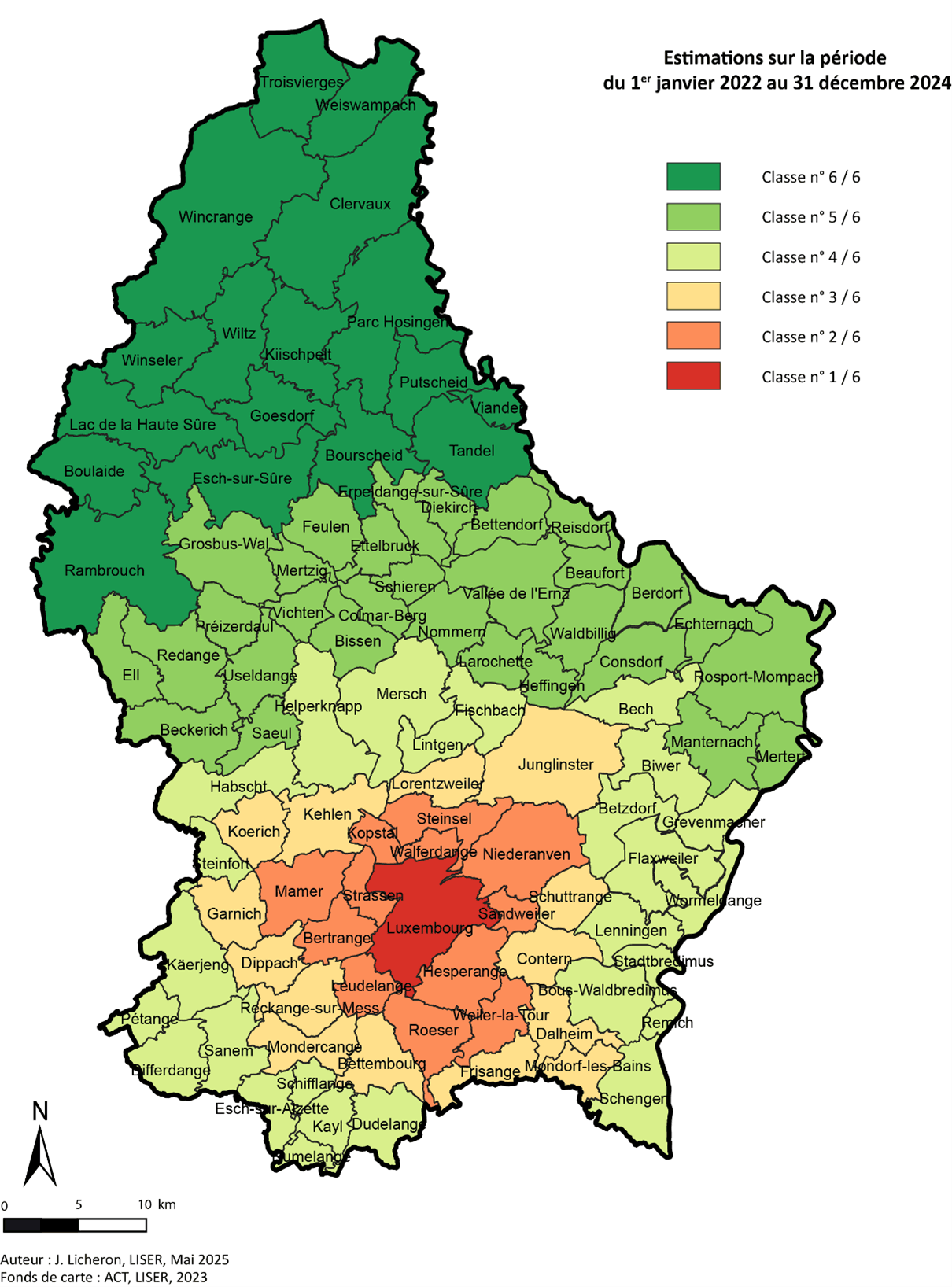
The segmentation of the country according to land price as calculated by the Observatoire de l'Habitat. (Illustration: MLOGAT - Observatoire de l'Habitat)
Based on this work, the Ministry of Housing has decided to adapt the maximum eligible amount (MME) for the purchase of building land for the construction of affordable housing to regional diversities based on actual regional land market prices, rather than a uniform national price. The announcement was made by Housing Minister 
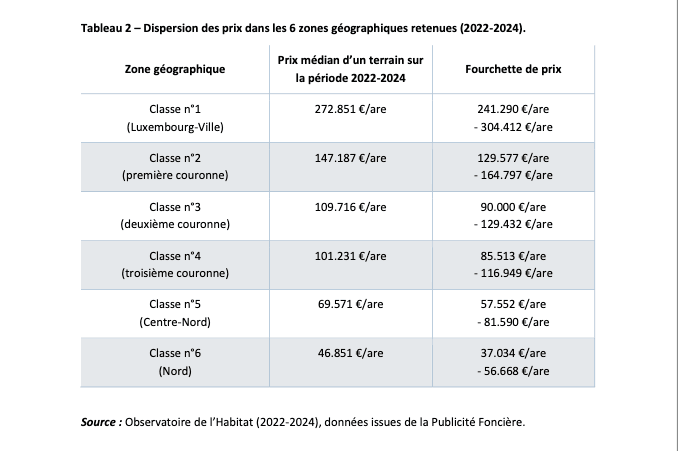
Land prices by geographical area. (Credit: Observatoire de l'Habitat)
The great decoupling
In its analysis report, the Observatoire de l'Habitat also highlights a marked decoupling between land prices and house prices. This phenomenon became more pronounced between 2010 and 2022. Over this period, the average annual rise in building land prices was +7.9%, representing a cumulative increase of 150.4%. In comparison, prices of existing homes rose by 'only' 139%, and those of homes under construction by 130.7%.
Finally, the construction price index, provided by Statec, rose by far less: +52.1% in total between 2010 and 2022, or just +3.6% per year. "This shows a strong disconnect between rising construction costs, on the one hand, and land and housing prices, on the other," details the Observatoire de l'Habitat.
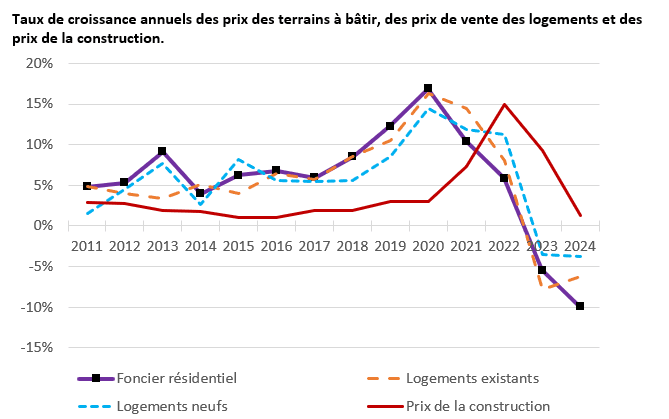
Changes in land and house prices. (Graphic: MLOGAT - Observatoire de l'Habitat)
With the turnaround in mid-2022, average house prices fell by 6.3% between the third quarter of 2022 and the first quarter of 2024. In the second quarter of 2024, prices stabilised. The fall was -13.5% for existing homes and -7.1% for flats under construction. For land prices - in an unprecedented context in which the number of transactions has been halved, from 731 in 2022 to just 326 in 2023, before a partial recovery in activity in 2024 with no return to the 2020 level - the fall amounts to 14.9%. "This fall in prices occurred relatively evenly across the country, including in the most dynamic cantons, such as Luxembourg and Esch-sur-Alzette, where declines reached 15.9% and 15.2% respectively," the Observatory details.
On the other hand, construction prices have continued to rise sharply over the same period, driven in particular by the rise in raw material costs: +10.6% between 2022 and 2024, with most of the increase recorded between 2022 and 2023.