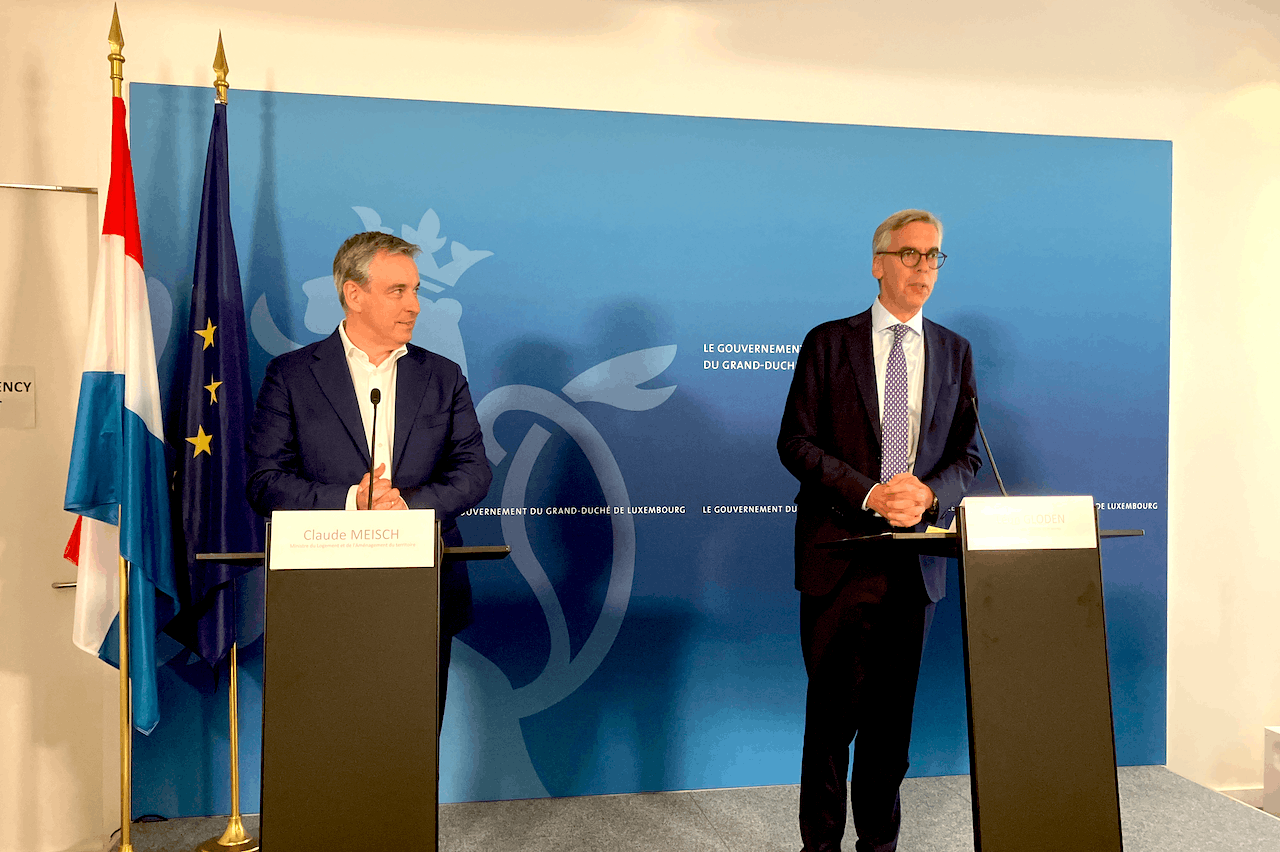
Home affairs minister 

Last week, the government submitted its amendments to a reform tabled at the end of 2022 by the then home affairs minister 
The opinion of the Council of State on the draft law on the exchange of information between the Luxembourg Inland Revenue (ACD) and the Land Registry and Topography Administration--which wants this draft to be attached to the one presented by the ministers--should not disrupt this timetable. “This opinion was issued on the day we submitted our draft to the Chamber of Deputies. We are looking with the finance ministry at how to satisfy the Council of State,” says Gloden.
Five years of reflection
The aim of the new land mobilisation tax is to build more and faster. “From now on, land on which nothing has been built for years even though it is classified as building land in the general development plan (PAG) will be taxed,” explains Gloden. Progressive taxation will begin in the fifth year of inactivity. A tax of €0.05 will be applied to each point of base value. Each year, this sum will increase, reaching €0.75 in the 11th year of inactivity, €2.50 in the 16th year and culminating in €4.50 after 20 years. These are sums to be paid each year. If a plot of land is sold but no building work is started, the counters will not be reset to zero.
If the timetable is adhered to, the first--modest--penalties will fall in 2035. That’s 10 years from now. And it’s a timeframe that contrasts with the urgency given by the government to the construction of sufficient housing. “This government is not making policy against the people, but with the people. In 2030, we will issue the first bulletins to make people aware of the situation,” the home affairs minister justifies.
Will the rates applied really encourage landlords to stop favouring the traditional retention strategy? Gloden thinks so. “After 10 years, the amounts become significant. They can reach several thousand euros.”
Graduated rates and exemptions
Exemptions are provided for. For example, the tax will not apply to land that is already partially built on in existing neighbourhoods. This exemption is justified by the desire to “allow owners to maintain existing buildings, developments and activities.” The child tax allowance has also been modernised and brought into line with current realities. The qualifying age has been raised from 25 to 35. No conditions have been set regarding the size of the land.
As with the reform of property tax, exemptions have been introduced for land owned by farmers. This is subject to the important proviso that they are not located in localities which--for spatial planning reasons--should be given priority for development. Conversely, the exemption from property tax enjoyed by real estate funds will disappear and will not exist in the land mobilisation tax.
Land tax: communes will be free to set their own rates
The major change in property tax is the disappearance of the framework for tax rates. This was a framework within which local authorities had to set their tax rates. That is, a rate of between 9% and 11%. This limit will disappear, which, according to Gloden, “whilst respecting and even strengthening communal autonomy, will allow greater flexibility for the communes.”
Less spectacular is the work that will go into adapting the basic values of property. In the current system, the values date back to 1941 and “no systematic updating of values has been carried out since then,” admits Gloden. These values are going to be recalculated--“revalued,” insists the minister--according to the following criteria: the building potential according to the PAG, the distance from the capital, the surface area of the plot and the services present in the locality concerned. “It’s a real paradigm shift. We’re going to move from taxation based on surface area to taxation based on the potential use of the property.” “The value of a property will be updated annually and will be largely automated,” insists the minister. This value will be expressed in points.
No increase in the tax burden
To the question of whether this mechanism for updating values will mean an increase in the tax burden, Gloden replies that “the aim of the reform is not to increase the tax burden. The tax will reflect the true value of the land and thus ensure that owners are taxed fairly.” He adds: “This tax must not be a burden on taxpayers.” Today, revenue from property tax fluctuates between €34m and €40m.
Under the new system, the calculation formula will be as follows: application of the municipal rate to the basic value of the property, from which various allowances will be deducted, including an owner-resident allowance of up to 2,000 points. The draft also provides for the introduction of a number of exceptions for the agricultural and wine-growing sectors.
The proceeds of property tax will remain available to the municipalities.
This article was originally published in French.