Luxembourg’s government said at a 27 March press conference that it would raise the social minimum wage by 3.8% from 1 January 2027, while compensating employers for part of the increase, after ministers approved the move at a morning cabinet meeting.
The increase will come on top of an indexation tranche expected before the summer. Economy minister Lex Delles said the combined effect would amount to a €170 rise for minimum-wage earners, made up of €65 from indexation and a further €105 from the January adjustment.
That gives the government a clear social measure to point to at a time when pressure on household budgets remains politically sensitive. But it also leaves ministers trying to reassure employers that a large rise in labour costs will not come at the worst possible moment for businesses already facing weak growth, stubborn energy costs and a far less forgiving economic climate than in earlier years.
Costs shared
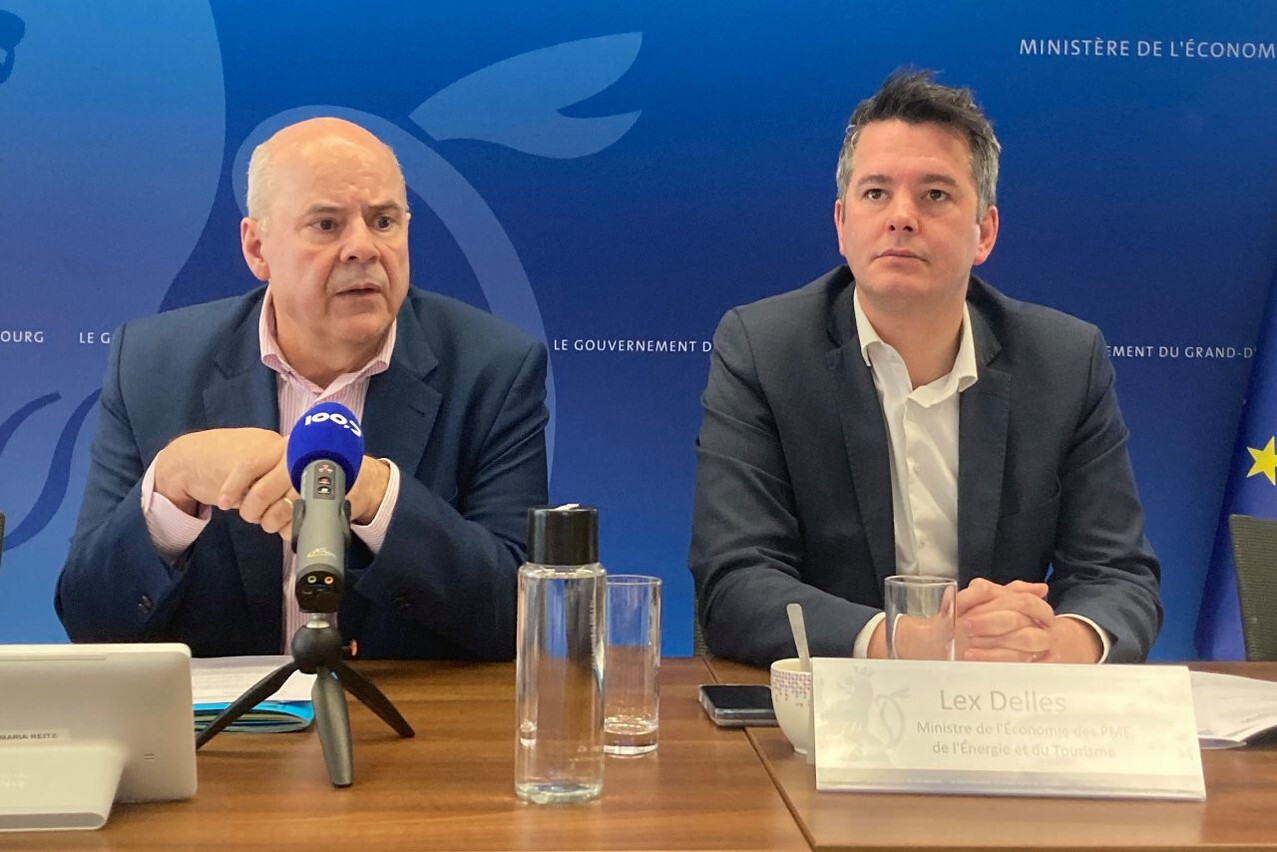
Delles said the government would compensate employers for 1.3 percentage points of the increase so that companies would feel a rise closer to 2.5% rather than the full 3.8%. “That is why we in the government have decided to compensate companies for 1.3% of the 3.8%, so that they do not have to pay the full 3.8%,” he said.
The mechanism and scope of that compensation are still to be negotiated with UEL, the main employers’ organisation. Delles said discussions would determine both how the measure is applied and how long it remains in place.
That uncertainty matters because it will determine the eventual burden on public finances. “We are in the order of magnitude of between €30 million and €50 million per year, depending on how you calculate it,” Delles said.
In effect, the government is trying to split the impact of the decision. Minimum-wage earners would receive the full increase, while employers would be shielded from part of the cost through a compensatory mechanism still to be worked out with business representatives.
Coalition pledge
Asked whether the move amounted to delivery of a coalition promise, Delles said the government was honouring its coalition agreement. “We are keeping our coalition agreement,” he said, adding that the increase was being paired with support for companies given weak growth and cost pressures.
He pointed to electricity prices, geopolitical uncertainty and a much more difficult environment for business than in earlier periods of stronger expansion. Growth in Luxembourg and Europe is expected to remain around 0.6% to 1% this year, he said, a long way from the stronger growth rates the country was used to in earlier decades.
“It is important that we have an attractive minimum wage here in Luxembourg and that people can also live on the minimum wage,” Delles said. “It is also important for the government that we have companies that will continue to exist here in Luxembourg in the future.”
Difficult balance
Labour minister Marc Spautz signalled that trade unions were unlikely to welcome the outcome, describing it as a compromise between inaction and a larger increase. “I assume that they will not be positive about this agreement either,” he said.
He added that “between doing nothing and 11%, there is something in between”, and argued that Luxembourg still needed functioning social dialogue despite tensions around wage-setting.
Spautz also pointed to separate measures aimed at low-income households, including the automatic granting of certain aids such as cost-of-living support and energy premiums once approved. Those measures, he said, should be considered alongside the wage increase when assessing support for the working poor.
Those include the high cost-of-living allowance, the energy premium and other aids that, from 1 January 2027, would be grouped together more systematically. Spautz said that once people had qualified for those supports, they should no longer have to apply for them repeatedly, making assistance more automatic.
Broader package
That point is important to the government’s wider defence of the package. Ministers are not presenting the minimum wage rise as the sole answer to low pay or in-work poverty, but as one part of a broader system combining wage policy with more automatic support for households on lower incomes.
The government also said the combined measures would bring the minimum wage to around 60.2% of the median wage by January 2027, based on its calculation method. That benchmark has become politically useful because it allows ministers to argue that the increase is not arbitrary, but tied to a recognised adequacy threshold.
Even so, the announcement leaves several practical and political questions open. The compensation model for employers is unresolved, unions are expected to resist the compromise, and the final balance between support for workers and relief for companies will depend on negotiations still to come.
But the central decision is now clear. The government has chosen to proceed with a rise in the social minimum wage, while using public money to soften the impact on employers in a weaker economic environment.