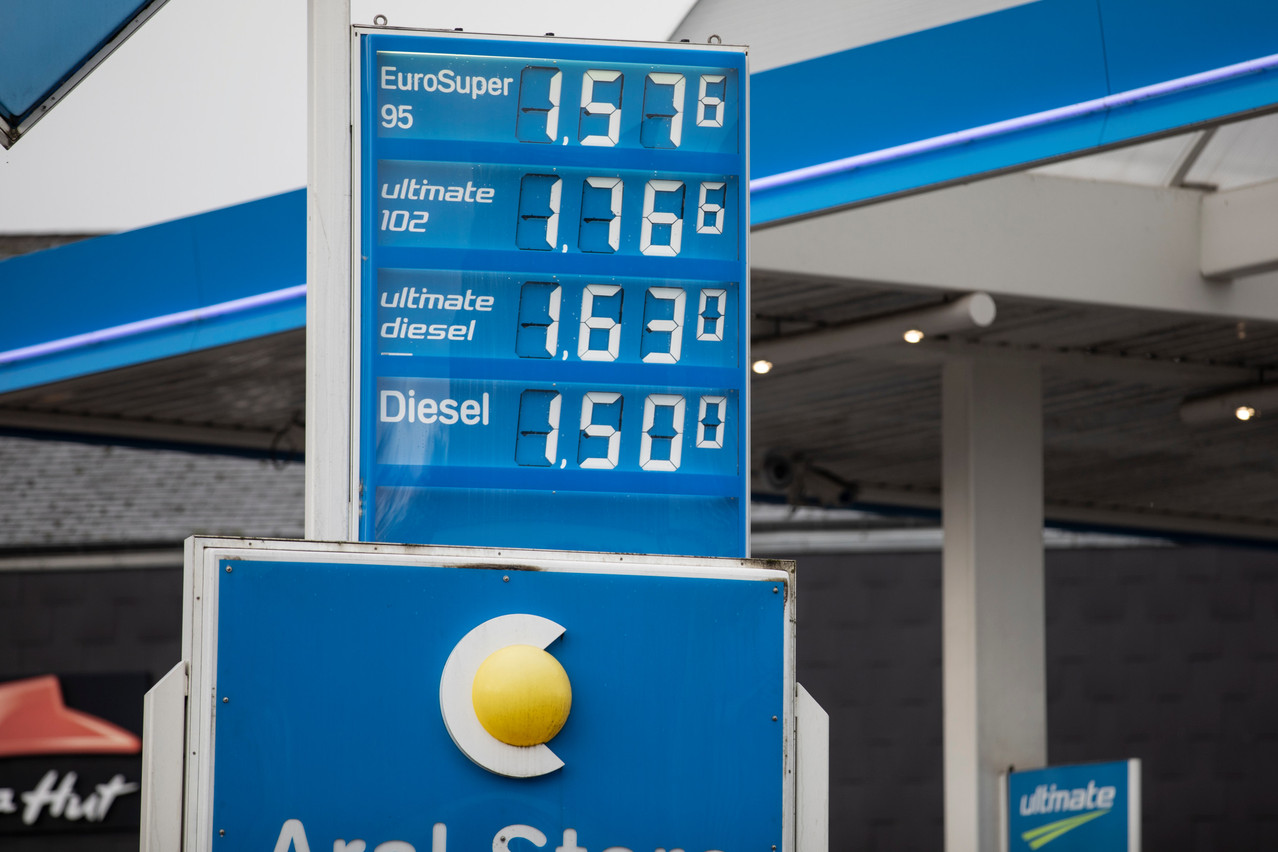
Since the beginning of the year, the price of diesel has increased by 25% in Luxembourg. Its price currently sits at €1.728 per litre for the regular fuel and €1.858 per litre for its premium version. It is now also more expensive than petrol 95, while fuel prices are edging towards the €2 per litre mark.
I have been working in the fuel sector for 25 years and I have never seen such a significant increase,

On the petrol side, the trend is also upwards. Since the beginning of the year, petrol 95 has increased by 12.4% and petrol 98 by 15.6%. The price of fuel oil passed the €1 per litre mark on 5 March for two of the four products on sale. “I have been working in the fuel sector for 25 years and I have never seen such a significant increase,” said Romain Hoffmann, president of the Luxembourg petroleum group (LPG) “If we look at the evolution of the last few days, it is not unthinkable that in the next few days we will reach €2 for a litre of diesel. This is an unprecedented situation and we must expect anything,” he added.
A reduction in excise duties would have a very slight effect
A situation that seems almost inevitable as distributors seem powerless to contain the surge in fuel prices. “We are dependent on the international market. The only thing that can be done is to reduce the state excise duty temporarily. But then again, the state is not free to do whatever it wants 100%. There are minimums set at European level for taxes. The Luxembourg government cannot go below them”, said Hoffmann.
In Luxembourg, the excise duty on 1,000 litres of diesel amounts to €416.54, or €0.41 per litre. The European minimum threshold is €330 for 1,000 litres, or €0.33 per litre.
We can say that we are losing money.

Moreover, distributors have a very low margin on a litre of fuel sold. “Theoretically, we have a margin of 10 to 11 cents. But because of the mechanism for calculating maximum fuel prices in Luxembourg, we are always chasing increases. And when they are this high, we can say that we are losing money,” said Hoffmann.
“In Luxembourg, the maximum selling price is regulated by the energy ministry taking into account the price of the barrel quoted in dollars on the stock exchange, the exchange rate with the euro, transport costs, storage costs, the margin for the oil company and taxes. The price of oil and the exchange rate change every day. In Luxembourg, the calculation of maximum fuel prices takes 2 to 10 days depending on the fluctuation of the absolute variation. This explains the slight difference with other countries when prices are increased. Last Saturday, the maximum pump price rose by 18.5 cents per litre. This is almost double the gross margin. This means that on everything that was sold on Friday, and maybe already on Thursday and Wednesday, the distributor will not have his theoretical margin of 11 cents because of this difference. And we can even talk about a sale at a loss”, says Hoffmann. He points out that the distributors' gross margin is used to pay salaries, infrastructure and investments. Moreover, “not every distributor has a large oil group behind him. And the higher the price of fuel, the lower the margin for the distributor in Luxembourg”, the LPG president points out.
Another indirect effect of the rise in fuel prices on distributors is the increase in payment costs. “A large proportion of fuel purchases are paid for with credit cards. Payment commissions are calculated on the basis of turnover. So the higher the turnover, the higher the commission,” said Hoffmann.
In Belgium, diesel is already priced at €2.084 per litre at petrol stations. Petrol 98 is displayed at €2.023 per litre and petrol 95 is at €1.951 per litre according to official figures published by the economy ministry.
This story was first published in French on Paperjam. It has been translated and edited for Delano.