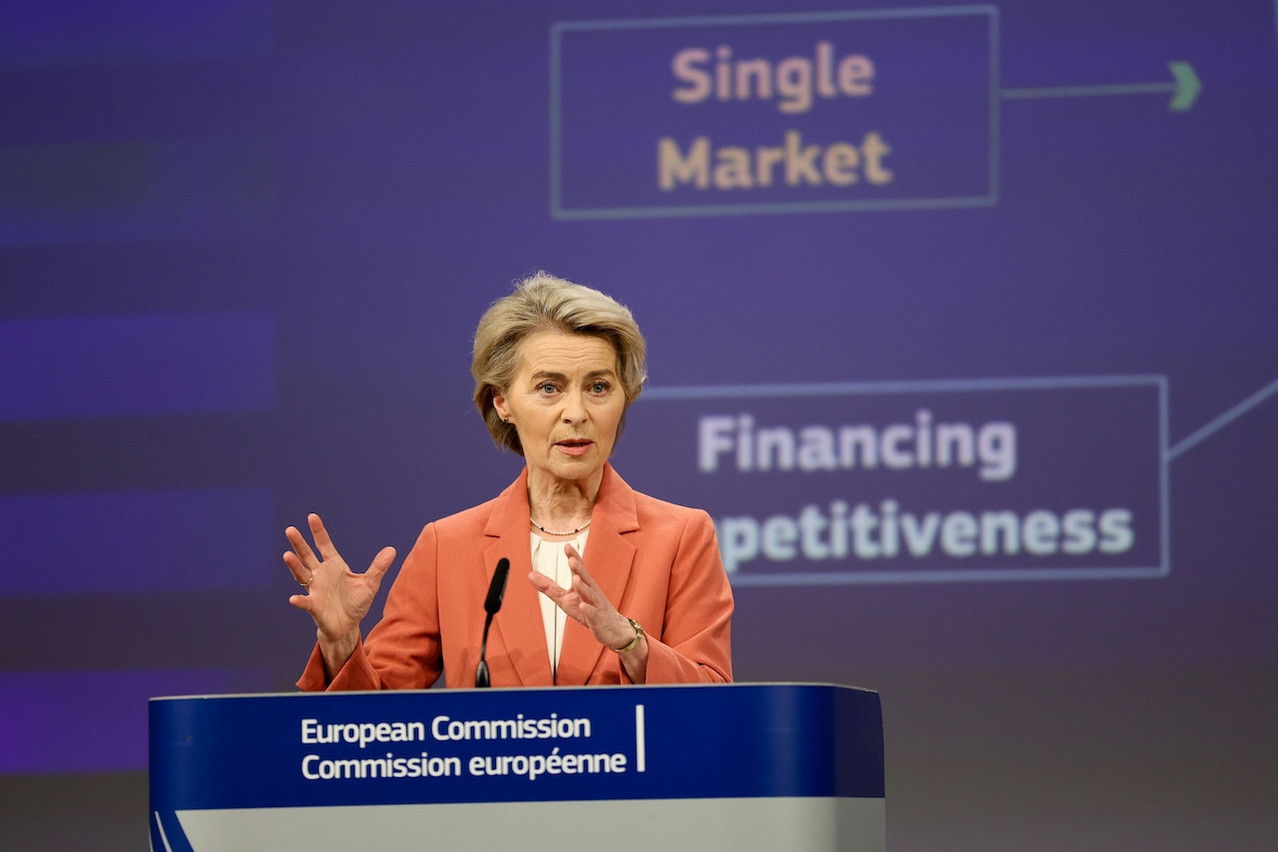
Spending more. Spending more. Better spending? This is not one of Europe’s ambitions, despite the fact that it assiduously monitors the state of member states’ finances. The aim of this “larger, smarter and sharper” budget is to deliver concrete results for Europe’s citizens, businesses, partners and its future, according to the president of the European Commission, Ursula von der Leyen. In order not to increase the financial contribution of member states, von der Leyen said that the plan includes a change in the way the EU raises funds--in other words, new common resources to finance this ambitious spending.
The draft budget places a strong emphasis on the EU’s economic competitiveness, a priority also stated from the outset by Luxembourg’s prime minister 
35% for green transition
Green transition also remains a cross-cutting theme of this financial framework. The European Commission is proposing to devote 35% of total expenditure to climate objectives and biodiversity--a level even higher than the current budget--in line with the commitments made in the European Green Pact. All the major programmes, whether they concern competitiveness, cohesion or agriculture, will have to contribute to the fight against climate change. In the agricultural sector, for example, new environmental conditions would be imposed in order to receive aid, with each country having to set appropriate green objectives in addition to common European targets.
Another key priority of this budget is to strengthen the EU’s defence and security. The funds allocated to defence and space policies will reach €131bn, five times more than in the previous period. This is an unprecedented leap, justified by the changing geopolitical context and the desire for a more strategically autonomous Europe. Part of this effort is aimed at supporting the development of a European defence industry and better protecting the EU against external threats. At the same time, the budget for border and migration management will be tripled, reflecting the need to better control migratory flows and ensure the security of external borders following the migratory crises of recent years. In concrete terms, more resources would be allocated to Frontex (the European Border Guard Agency), border control systems and asylum programmes, in order to better manage arrivals and protect the Schengen area.
Finally, the European Union firmly maintains the link between the funding of policies and respect for its fundamental values. Von der Leyen insisted that the rule of law, democracy and equality have not been forgotten: access to European funds will continue to be conditional on compliance with EU rules in this area. This “rule of law” conditionality, introduced during the previous financial framework, will be fully applied to ensure that European money benefits projects that are in line with shared values.
Massive and sustainable support for Ukraine
The proposal also devotes a significant proportion of the budget to support for Ukraine, in response to the war and reconstruction needs. An exceptional envelope of €100bn would be earmarked for Ukraine over 2028-2034. “We will continue to stand by Ukraine for as long as necessary,” said von der Leyen, underlining the EU’s unwavering commitment to this partner country. These funds would be used to finance the reconstruction of Ukraine’s infrastructure, economic support, humanitarian aid and support for reforms with a view to Ukraine’s European integration. This long-term multiannual support--which would extend and amplify the aid plan already in place for 2024-2027--sends a strong political signal: Europe’s security and prosperity are inseparable from those of Ukraine.
In addition, the external dimension of the budget would be simplified and strengthened. For its actions in the world, the EU would have a unified instrument called “Global Europe,” endowed with around €200bn for 2028-2034. This single framework would make external funding simpler, more flexible and targeted, by combining development aid, humanitarian action and the EU’s international cooperation. Support for Ukraine could form part of this strengthened external strand, whilst retaining its own visibility given its exceptional scale.
Agriculture and cohesion: reforming without cutting back
Whilst the new priorities will mobilise an increasing share of resources, traditional EU spending--notably agriculture and economic and social cohesion--will retain a significant place in the 2028-2034 plan. The European Commission plans to allocate amounts comparable to today’s, whilst undertaking structural reforms to modernise these policies.
The Common Agricultural Policy (CAP) would benefit from around €300bn over seven years, ensuring continued support for farmers and rural areas. However, Brussels is proposing to redirect these subsidies in favour of small farms and sustainable agriculture. In concrete terms, the proposal introduces for the first time a ceiling on direct aid at €100,000 per farm per year. Above this threshold, payments would gradually decrease (25% reduction above €20,000, 50% above €50,000, etc.) so as to limit the very large cheques paid to large agribusiness operators.
The stated aim is to correct inequitable distribution--it is estimated that 20% of beneficiaries currently receive 80% of aid--and to provide better support for family farmers and disadvantaged rural areas. The commission is also proposing to simplify the architecture of the CAP by merging the two current “pillars” (direct aid and rural development) into a single agricultural fund. This change, designed to make the CAP clearer and more targeted, is already attracting reservations from certain member states and the powerful European farming lobby, which are attached to the existing structures.
As far as cohesion policy is concerned, support for the EU’s least developed regions would be maintained at a substantial level, with around €218bn proposed. These funds will continue to support infrastructure, employment and transition projects in countries and regions whose development is lagging behind, particularly in eastern and southern Europe. However, the commission plans to update the criteria and conditions for using these funds to make them more effective. Whilst the details have yet to be worked out, we can expect a desire to link this funding more closely to economic performance and structural reforms in the beneficiary states--an idea that has already been debated in the past, and which could return to the table during the negotiations.
Towards intense negotiations between member states
With this ambitious budget plan, the European Union is embarking on a long-term negotiation. The multiannual financial framework requires the unanimous agreement of all 27 member states, as well as the approval of the European Parliament. Each country will be keen to defend its national priorities, making a prolonged tug-of-war likely over the next two years. The net contributor states (such as Germany, the Netherlands and Sweden) may consider the €2trn to be excessive and demand cuts or guarantees on the effectiveness of spending. Conversely, the countries that benefit from the cohesion funds or the CAP will be careful to preserve their envelopes and could oppose overly restrictive reforms of these traditional policies.
Several stumbling blocks are already emerging. The creation of the major €409bn competitiveness fund could be contested by some, who fear that it will be to the detriment of national programmes or other priorities (for example, France will be careful to ensure that the CAP does not indirectly finance this new fund, as some rumours have suggested). Similarly, the quantum leap in defence spending will need convincing: whilst many recognise the need for greater investment in security, others (such as certain neutral countries or the European Parliament) will want to ensure that these increased resources respect a common European approach and do not encroach on civilian funds.
Financing the budget will be another sensitive issue: the commission is counting on new own resources (carbon tax at borders, revenue from the carbon market, digital tax, etc.) and possibly joint financing mechanisms (loans) to bridge the gap, which will require the backing of the capitals. Some governments are reluctant to the idea of new European taxes or prolonged common indebtedness, which augurs complex negotiations on this chapter.
Two years of discussions are planned to adjust the amounts and conditions, under the rotating presidencies of the Council of the EU. The aim is to reach an overall agreement by the end of 2026 at the latest, so that the new financial framework can enter into force on 1 January 2028 without a hitch. This tight timetable will coincide with the renewal of the European institutions (European Parliament elections are scheduled for 2029), which could add some unexpectedness to the equation.
This article was originally published in French.