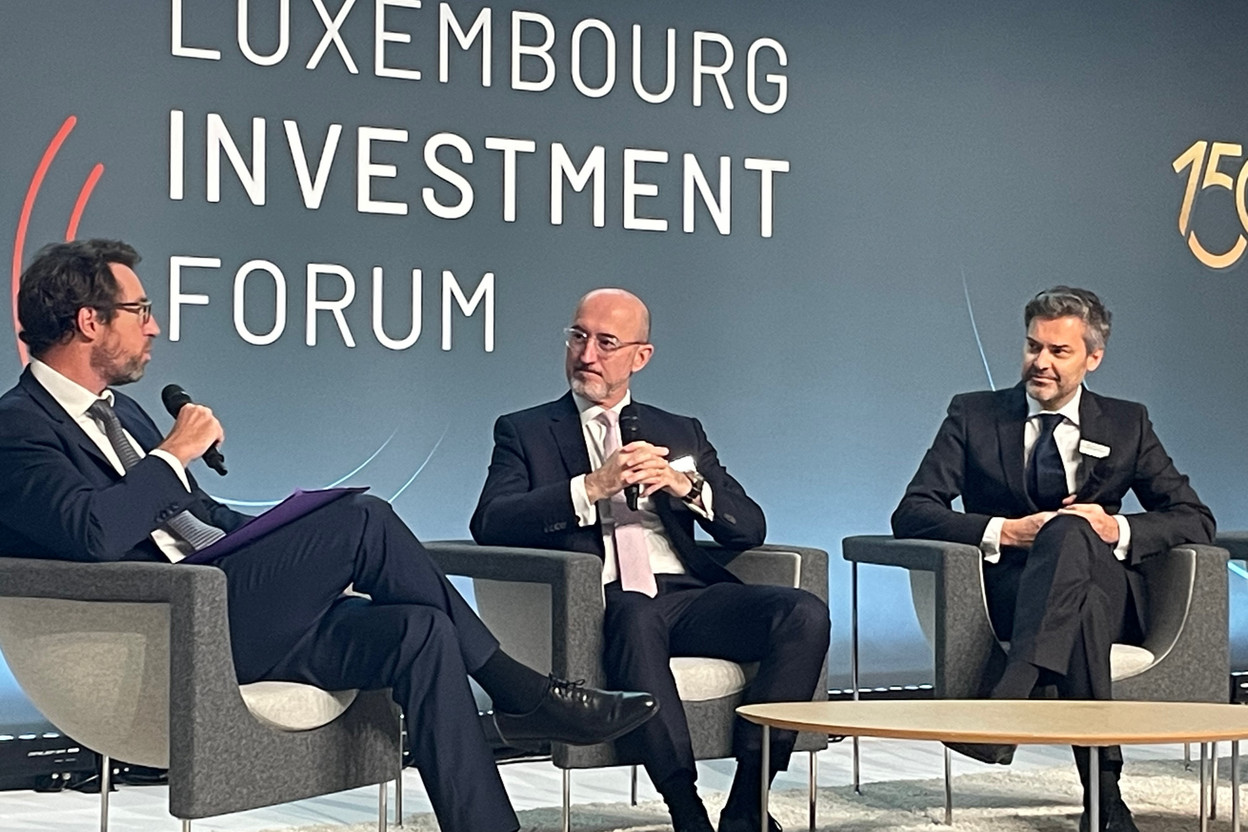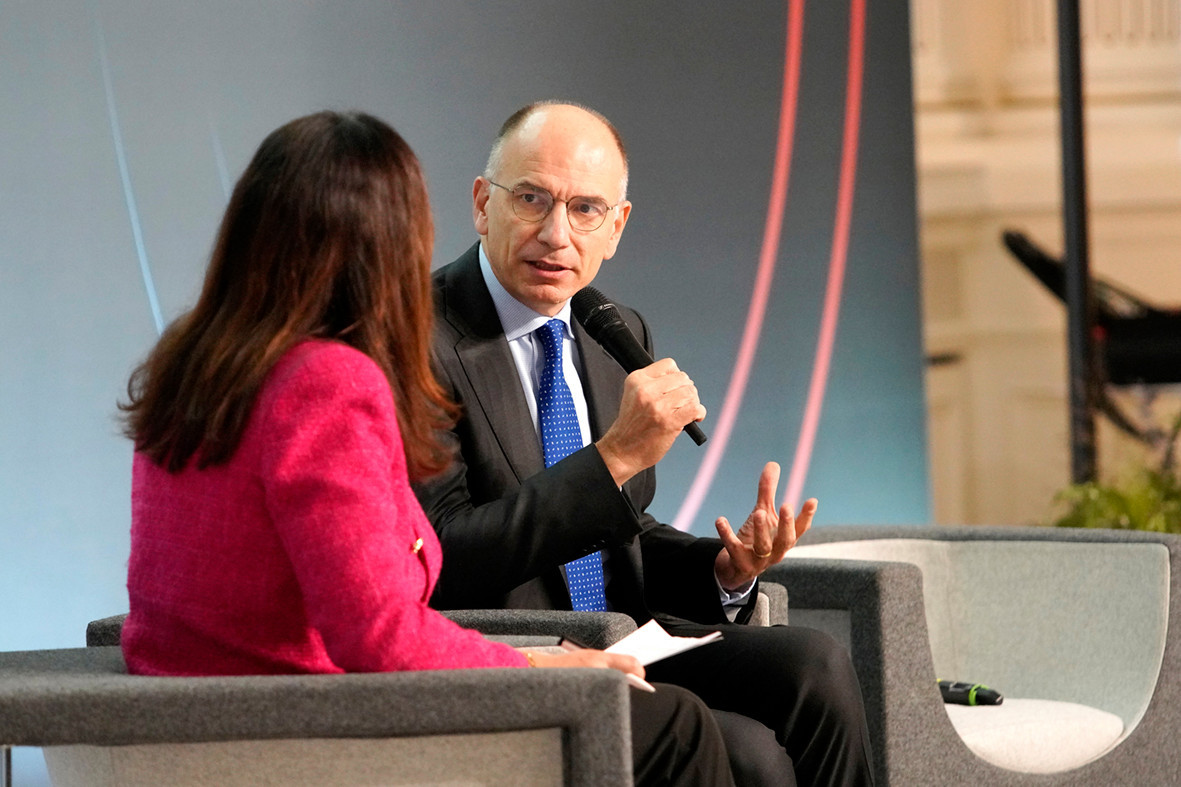
“The current challenges facing some European societies, paralleled in the United States, are underpinned by a powerful societal phenomenon: nostalgia,” said the president of the Institute Jacques Delors during the Luxembourg Investment Forum organised by Indosuez on 13 October 2025. This sentiment idealises a past era, such as France's Trente Glorieuses or Italy's miracolo economico, when these regions felt like the global centre of gravity. “France alone, when the single market was created, was more economically powerful than China and India put together.”
However, Letta thinks that this nostalgia is considered as “absolutely misplaced,” as data concerning health, life expectancy, and societal organisation suggests that current conditions are improved compared to those of that earlier period. Political slogans like “Make America Great Again” (Maga) and “Take Back Control” draw heavily on this longing for a time when things were perceived to be better.
A disunified European Union
Following extensive work, including 400 meetings across the 27 European member states—the travel was not exclusively by high-speed train--, Letta’s crucial diagnosis emerged: the European Single Market is fundamentally incomplete. A significant portion of the market remains ununified, which negatively impacts European competitiveness and security.
Key areas demonstrating deep fragmentation include:
1. Energy: The EU operates 27 distinct national energy markets, often lacking interconnection, such as the major gap seen across the Pyrenees.
2. Telecommunications: Letta considers the EU’s 27 fragmented telecom markets a “folly.” This structure results in every country having 4-5 operators while these are averaging only 5 million clients, starkly contrasting with 107 million in the US and 467 million in China, severely hindering investment.
3. Financial Systems: The presence of 27 separate financial systems, rather than one, causes, Letta thinks, European savings to flow predominantly to the US. This dynamic strengthens the American economy and allows US companies, funded by European capital, to acquire European businesses. Addressing this requires the successful establishment of a Savings and Investments Union (SIS), replacing the unsuccessful Capital Markets Union “to foster saving into financial products supporting the European economies.”
Should we have 27 Airbus, Boeing would win.

4. Defence: Although not a market component, the lack of an integrated, high-level defence industrial system leads Europe to purchase American equipment. While Europe is the second-highest global spender on defence after the US, Letta observed that this spending is largely wasted through duplication (e.g., multiple large member states performing the same military functions in the Mediterranean). This fragmentation had tangible consequences: “80% of the €140bn spent to aid Ukraine in the first two years was funnelled to create jobs in defence industries in countries like the US (Michigan, Pennsylvania) and Turkey,” because fragmented European defence industries could not immediately supply the necessary military means.
This persistent fragmentation is a core reason why Europe is vulnerable in contexts like commercial wars. In addition, Letta believes that the lack of strategic military autonomy rendered Europe beholden to US demands regarding trade because of the need for American assistance in the conflict in Ukraine.
The urgency of integration is paramount. It is not all gloom and doom. Letta noted that “when Europeans are joining forces, they win,” such as in the aeroplane industry. “Should we have 27 Airbus, Boeing would win.”
Letta remarked that Commission president Ursula von der Leyen set a concrete goal: to complete the Single Market integration by the end of 2028 – a deadline largely unnoticed by the media, according to Kan. Yet the date is intended to mobilise action similar to the launch of the “Europe of '92” initiative by Jacques Delors
Making the EU more agile
To increase the EU's agility and complete this integration, Letta suggested several actions:
• The 28th regime: This solution proposes creating an optional “28th fast track regime” in specific complex sectors (like corporate law or insolvency) that would simplify rules across the continent to encourage investment from abroad. This aims to dismantle the European administrative mille-feuille (layering of bureaucracy).
• Governance shift: To ensure uniformity and avoid national protectionism (“gold plating”), Letta suggested that the EU switch from using directives (which require 27 national laws for application) to regulations (which are immediately applicable throughout Europe).
• Political will: While institutional changes like federation or eliminating unanimity votes in all domains could be slow, Letta remarked that the majority of Single Market legislation already allows for majority voting. The challenge lies in member states' political unwillingness to use this voting mechanism. All European countries must recognise that they are globally “small” and cannot effectively negotiate individually with major powers like China or India.
• Stakeholder mobilisation: Letta stressed that private sector leaders must voice their demand for deeper integration to political figures, emphasising that national-level protection is inadequate against global competition.
Despite its challenges, Europe benefits from significant assets, including institutional stability and guarantees of freedom of expression and respect for the individual, values increasingly under strain elsewhere. However, Letta thinks that Europe suffers from a critical lack of storytelling, failing to effectively communicate crucial initiatives, such as the 2028 integration deadline or new defence plans, to the public.
Ultimately, Letta stressed that integration is an existential necessity to secure strategic autonomy and guarantee Europe's future. Europe's prosperity also depends on an open world market, making recent efforts to establish trade agreements with regions like Mercosur, Mexico, India, and Indonesia positive steps. “Europe needs an open market, not to protect it. The US is closing its own. Our prosperity depends on venturing into new markets.”