How is the ESG investment sector doing?
Étienne de Callataÿ. – “Not very well. We are facing headwinds, mainly from across the Atlantic--both political and financial. The political headwinds are not hard to identify. Just look at the Trump administration’s stance on renewable energies. Of course, responsible investment cannot be reduced to the environment alone, nor the environment to fossil fuels, but it is emblematic.
Today, what suffers most, at least in the media and in people’s minds, is the environmental dimension--with the difficulties faced by major European companies active in renewables such as Vestas, or the ‘drill baby drill’ mantra of Trump. We can also see it in the retreat from regulatory and transparency requirements on environmental matters. On top of this political dimension, there is a financial one: responsible indices underperformed traditional indices in 2024, and this has continued into 2025.
What explains this underperformance?
“There is no unanimous explanation. Some are very specific. For example, if you look at MSCI indices, MSCI did not include Nvidia in its SRI index (one of the first socially responsible investment indices, launched in 1990) until May 2024, and therefore missed most of the stock’s surge. Beyond company-specific cases, there are also sectoral dimensions. The defence sector, for example, is thriving.
Can we speak, as some do, of an “ESG winter”?
“Yes--as long as we remember that after winter comes spring. There are headwinds at the moment, but there is no reason to think they will be permanent. For now, we must weather the winter winds and prepare for the spring ahead. We will emerge from this winter.
Where do you see the future and rebound of ESG investments?
“In the recognition that failing to act on environmental issues is detrimental to medium- and long-term economic prospects. It is not just about pleasing others when we address environmental sustainability--it is also about safeguarding our own economic potential within the horizon of a single generation.
Environmental issues are not ‘rich kid problems.’

But given what seems to be setbacks from the US, China and India, is ESG in danger of becoming a European cultural peculiarity--and one that penalises its economy?
“At first glance, one might think so. But I wouldn’t put it that way. Environmental issues are not “rich kid problems.” As soon as living standards rise--which is the case in China and India--there is strong demand for a better environment. Look at the electrification of the Chinese car fleet. People are sensitive to this. That said, if Europe’s efforts slow down global warming, the Chinese, Indians and Americans will benefit without lifting a finger. But the benefits for Europeans alone are already sufficient to justify our action.
Are investors still willing to pay the price for ESG investments?
“In 2021, ESG indices were more expensive in terms of price-earnings ratios than conventional market indices. There was a premium for responsible companies. That premium has shrunk to the point of almost disappearing. I believe there are good reasons to pay more for responsible companies--because they are less risky and better prepared for a future that will undoubtedly be different. The ESG valuation premium will be rebuilt.
Can pensions be funded through responsible investments?
“Most certainly. And I would say it is highly recommended, because these are clearly investments with an intergenerational concern built into their DNA. They emphasise durability and sustainability. Such investments are more likely to remain relevant in ten years’ time than comparable conventional ones.
Many banks or asset managers are withdrawing from ESG initiatives such as the Net Zero Banking Alliance, including American banks and UBS. Do you see these as isolated events or the beginning of a trend?
“These are not isolated events. In the banking and asset management world, more than one player is tempted to do the same. These withdrawals are meant to flatter either short-term profitability or certain political powers. I find this disloyal and I judge such behaviour harshly. One can always change one’s opinion, but in this case no one can invoke new scientific evidence claiming that global warming does not exist. Unfortunately, this is a short-term and political positioning.
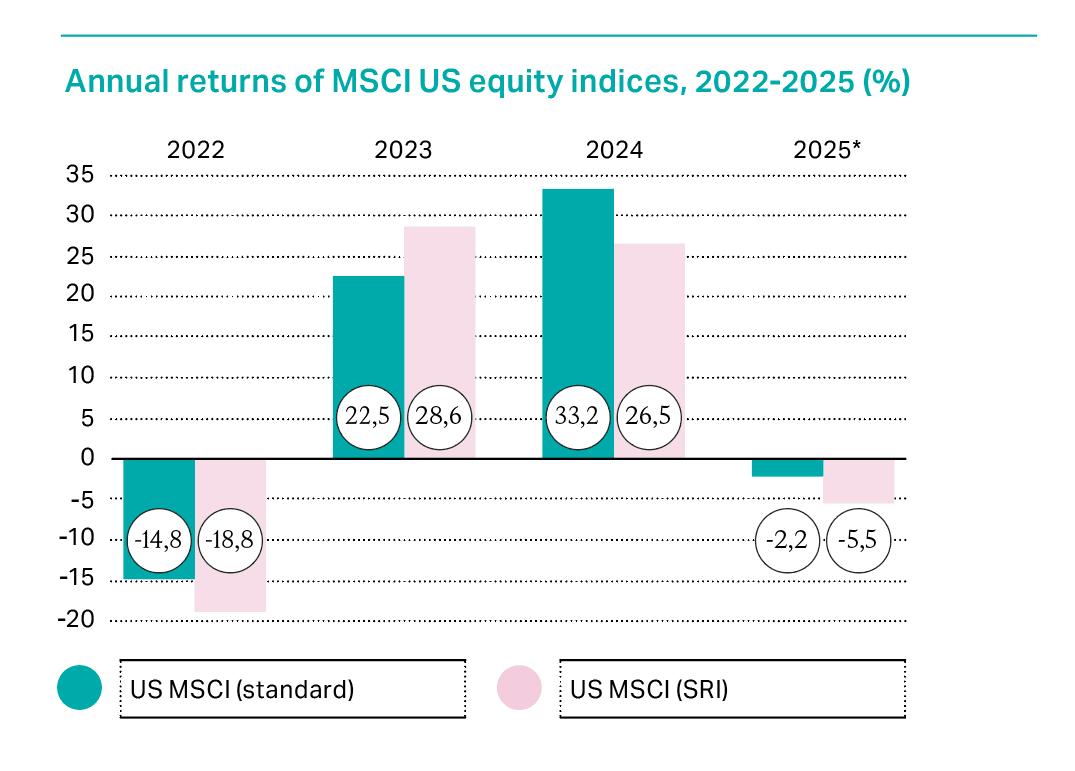
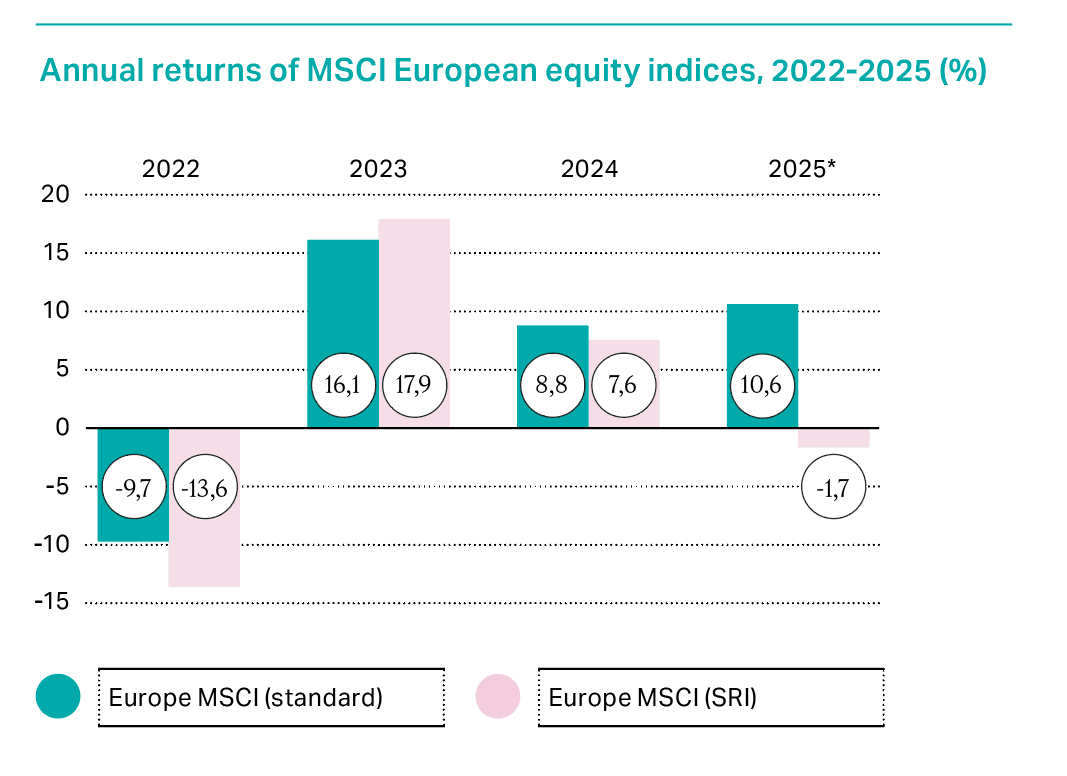
These charts show the annual returns of MSCI equity indices for the US and Europe, comparing standard indices and socially responsible investment (SRI) versions from 2022 to 2025. *As of 29 August 2025 (Source: Bloomberg)
Do these attitudes not influence regulators and politicians? In this context, what do you expect from projects to simplify CSRD, SFDR and taxonomy regulations?
“Unfortunately, this is where short- termism prevails. Who is against simplification? No one. But it is regrettable that we seek simplification almost exclusively in terms of environmental requirements. There are many other areas where simplification could be pursued--building permits, taxation, social security. These areas are ripe for simplification, yet nothing is heard. Do we hear the banking lobby calling for simplification of the tax advantages it enjoys for different savings products? Not at all.
The current discourse on administrative simplification is not credible. It is motivated by something else. The EU has estimated the benefit of administrative simplification at €6bn. Compared with the eurozone’s GDP, that is negligible. Dropping environmental requirements for this reason alone makes no intellectual sense.
Should we instead focus on redefining ESG investments, even if that means broadening or softening the framework?
“Absolutely. There is a logic to this. Some considerations may have been valid in the past but are no longer relevant. This is currently the case with the defence sector. If tomorrow we were to find a way to produce clean gas, then investments in gas should be allowed. Similarly, if one day we discover a plastic that can be easily and endlessly recycled, investments should be possible there too. It must be an evolving process that takes account of both geopolitical and technological environments. These rules are not meant to be carved in stone.
Is defence a responsible investment?
“Of course. We must hope that we have weapons and that Ukrainians have weapons, and for that we need companies to manufacture them. Investing responsibly should not mean being naïve or going into battle with a flower in your rifle. That said, today both Ukrainians and Russians are using landmines. Are landmines admissible weapons? Having recently attended a presentation by Handicap International, my answer is no. Once the door is opened to investment in defence, the question will inevitably arise as to what kind of weaponry is admissible--defensive, offensive, conventional, chemical… and reaching agreement on that will be very difficult.
I do not wish to cast blame on an investor who chooses the defence sector, but for now I prefer to continue excluding weapons. That said, nothing prevents an investor concerned with environmental, social and governance issues from adding them if they wish. It is a bit like salt in a meal: if you find the dish served to you is not salty enough, you can add some. Taking it away is much harder.”
Economist and sustainable investor
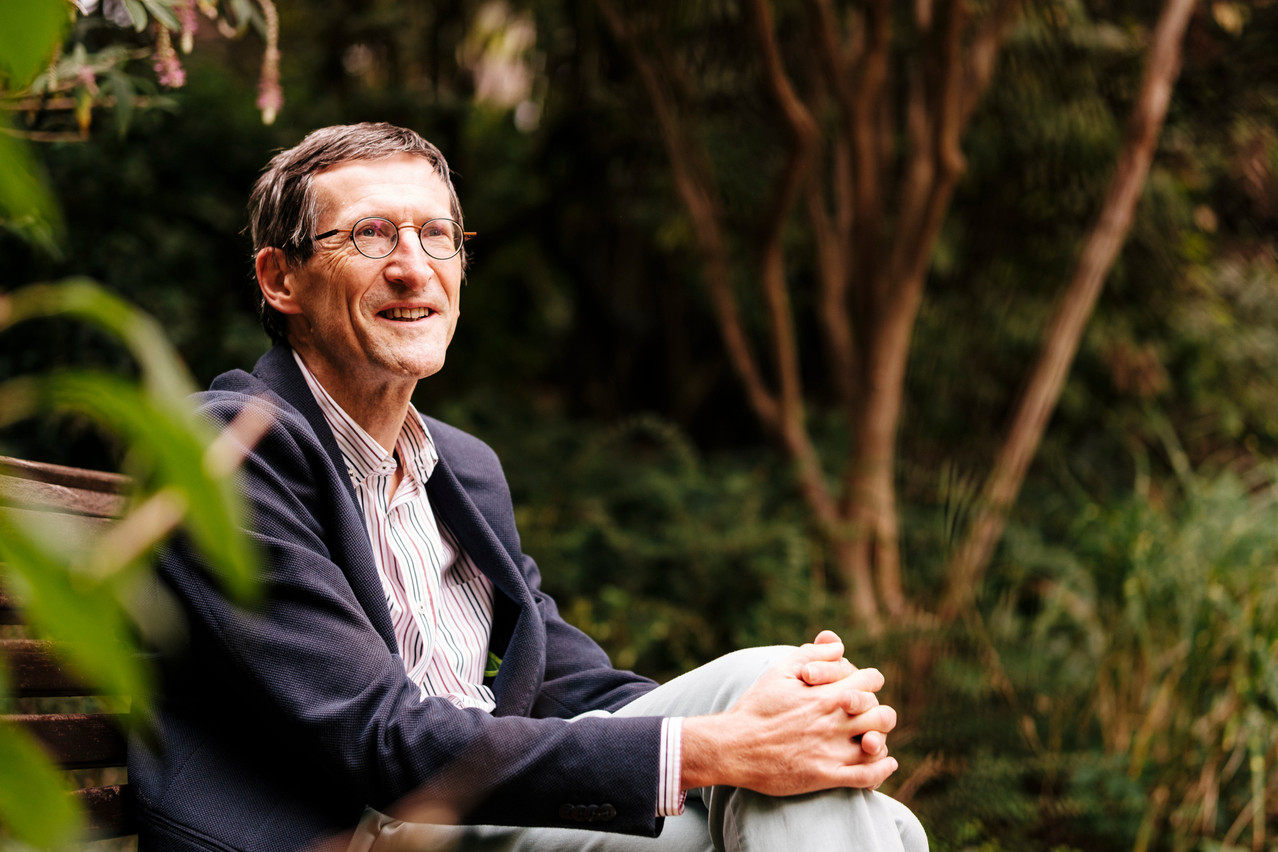
Belgian economist Étienne de Callataÿ, born in 1962, is well known in Luxembourg’s financial centre for having been chief economist and a member of the management committee at Banque Degroof. In 2015, he founded the wealth management company Orcadia Asset Management, where he is chief economist and chair of the board. He holds degrees in economics from the University of Namur and the London School of Economics. He currently teaches macroeconomics and public finance at the University of Namur.
This article was written for the ESG Finance supplement of Paperjam magazine's November 2025 issue, published on 22 October. It is published on the site to contribute to the full Paperjam archive. Click this link to subscribe to the magazine.