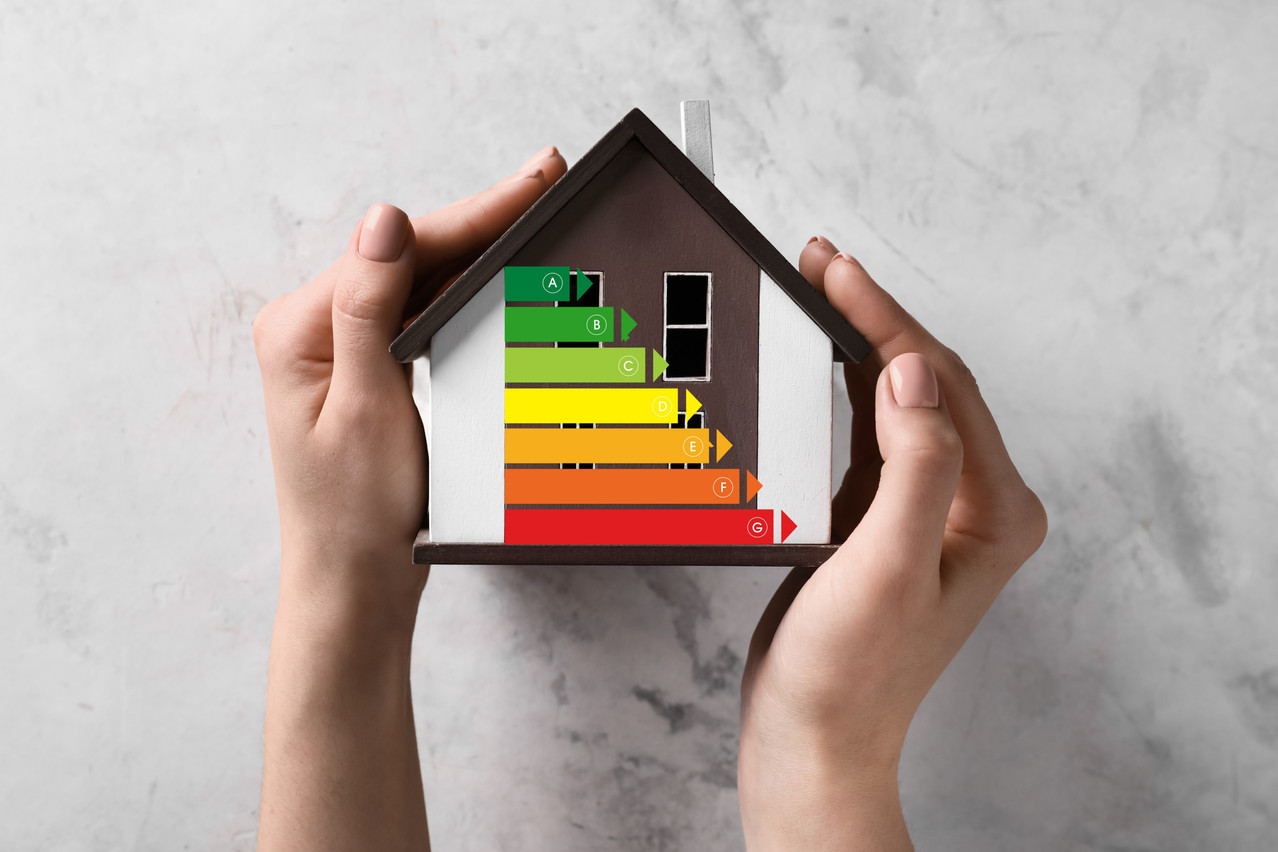
Simplifying the lives of homeowners, tenants and banks, while thoroughly modernising the way in which energy performance certificates (CPE) - known as Energiepass - are managed: that, ultimately, is the promise of a reform that marks a new stage in the digitisation of the energy performance of buildings in Luxembourg.
In application of a European directive, the Ministry of the Economy is preparing to set up a national database of EPCs. This future register will enable any owner or tenant to directly consult the EPCs linked to their property via the state platform MyGuichet.lu.
For private individuals, this database will primarily represent a time-saver. “The future register will make EPCs more available and accessible. At present, EPCs exist mainly on paper. With the future register, the digital version will become the standard”, explains the ministry.
A gain in transparency
Access via MyGuichet.lu will make it easy, for example, to find the EPC for a property when selling, buying or applying for a loan. There will be no need to search for or transmit documents: the information will be available directly to authorised users, i.e. homeowners and tenants. Note that “potential tenants and buyers will still have to go through the lessor, or seller, of the building to find out about its energy performance”.
Saving time, then, but also transparency compared with the information already available - the energy class is via estate agents. “Owners and tenants will have access to all their EPCs. In the case of an existing building, they will be able to see recommendations for measures to improve energy performance, along with their cost-effectiveness. They will therefore not only know the current state of their building, but will also, where appropriate, be able to suggest ways in which it could be improved”, illustrates the ministry.
By centralising the data, the State intends, generally speaking, to improve the reliability and traceability of certificates, which are currently sometimes scattered between design offices, notaries and government departments. Ultimately, this database will also facilitate the energy renovation process, by making it easier to diagnose a property’s performance.
A major challenge for banks
Given the scale of the project, the government has opted for a two-stage implementation: residential buildings first, then functional buildings. According to 
For financial institutions, the reform meets a very concrete challenge. “Institutions with real estate exposures must be transparent with the regulator about the carbon footprint of their assets. To do this, they rely on EPCs”, explains the Luxembourg Association of Banks and Bankers (ABBL), through its sustainability adviser, Thomas Collin.
The new European directive on the energy performance of buildings will profoundly change the situation: “It will profoundly change the structure, the calculation method and above all the accessibility of these certificates. The aim is to make them available for consultation by financial institutions, which is not yet the case in Luxembourg, unlike certain Member States such as France or Denmark.”
The main difficulty concerns the stock of old property loans.

As the Ministry of the Economy points out, “as part of the taxonomy, banks are required to assess their mortgage portfolios in terms of sustainable investment, by means of the energy performance of the buildings concerned”. But old mortgages remain a black mark. “The main difficulty for Luxembourg banks concerns their stock of old mortgages, particularly those taken out before the EPC became compulsory in Luxembourg in 2008 for residential buildings”, points out Thomas Collin. For these assets, “there is a real blind spot: the banks have no data on the energy efficiency and, consequently, the carbon footprint of the properties financed”.
The banks therefore often have to ask their customers directly for the missing information, or resort to estimates. Problem: “Customers often have no incentive to obtain an EPC,” observes the ABBL representative. “Except in the case of sale, rental or renovation, the production of an EPC is not compulsory, and its cost - around €500 - represents a brake.”
For new loans, the situation is simpler: an EPC is systematically required. The challenge then becomes digital: “The certificates are often in PDF or paper format, and the data has to be manually re-entered into the banking systems. This creates a significant administrative burden. The future register should reduce this burden. It will automatically extract information from EPCs, thereby automating some of the banks’ work.
European exchanges, national solution
There remains the question of banks’ direct access to the EPCs in their portfolios. This issue was raised during discussions between the government and the ABBL. “At the moment, we are looking for a technical solution that is compatible with data protection rules”, says the ministry. Indeed, the information contained in the EPC “falls under the protection of personal data, given that the building address makes it possible to identify natural persons and the EPC partially reveals their energy behaviour”.
Is Luxembourg planning to draw inspiration from foreign experiences? The ministry “regularly takes part in exchanges between the various Member States of the European Union, notably as part of the Concerted Action EPBD”, it states. This initiative encourages the sharing of good practice, but each country remains dependent on its own technical and legal specificities.
“The Luxembourg database must be compatible with the national EPC calculation method and with the corresponding software available on the market. It must also be integrated into MyGuichet.lu, the Luxembourg government’s secure interactive platform. And the ministry points out a notable difference: “In France, for example, this question of bank access to CPEs does not arise, because CPEs are public there.”