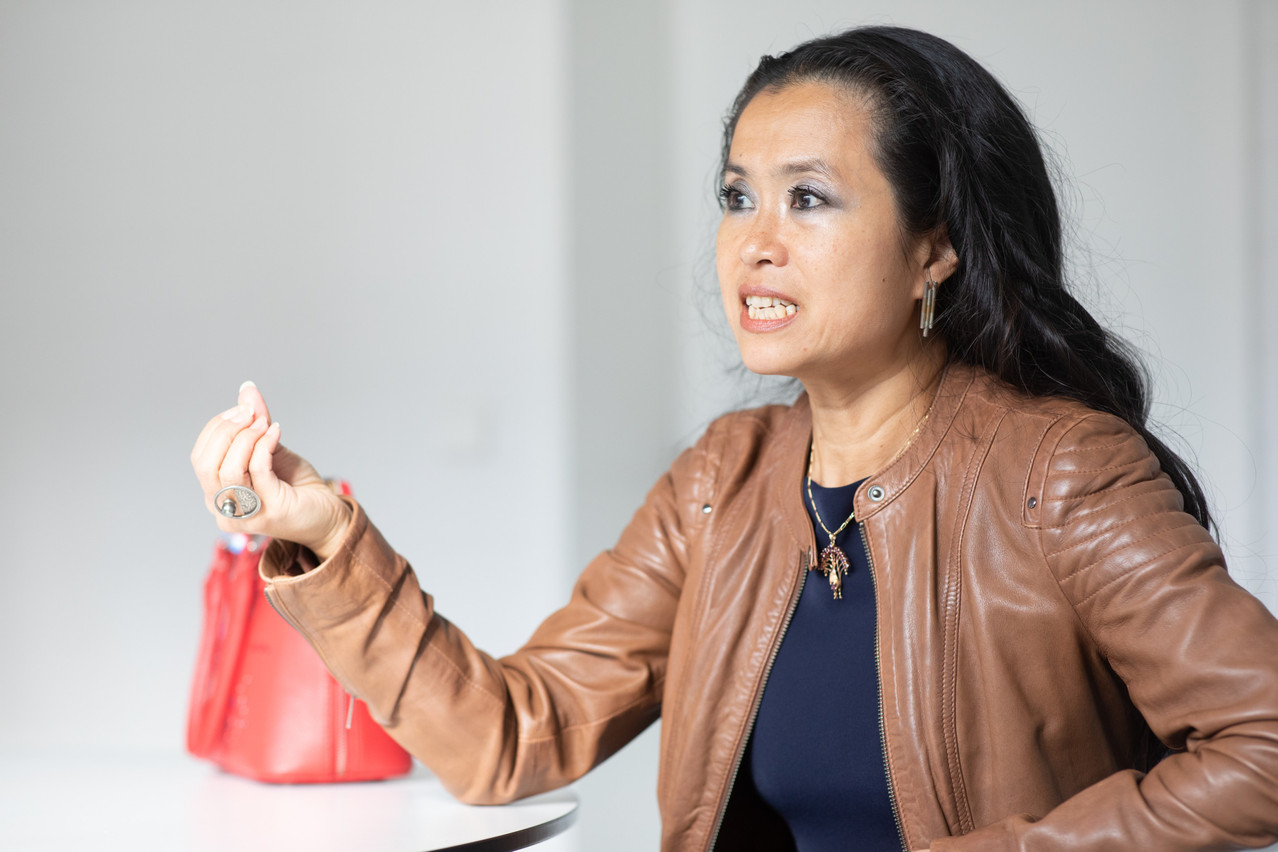
The grand duchy is a popular financial hub, but how can it support a more inclusive economy while leveraging technology?
In today’s world, actually for a long time now, it’s been quite obvious that we can’t live without technology. And even if Luxembourg is a finance hub, finance is based on technology nowadays, and nothing can function without it. It promotes economic inclusion, efficiency and innovation. But at the same time, it can pose some risks that could widen the digital gap between those who can benefit from technology and those who are excluded from it and risk falling behind as the world moves forward.
During the pandemic, we [saw] that technology was what kept businesses, schools, even government supply chains up and running. Some inequities were also revealed. This is where a country like Luxembourg, and similar industrialised countries, can play a role...There are several areas where Luxembourg can support by leveraging technologies to shrink these inequities; however, I would focus on three main areas.
First, support the digital shift. It is crucial to have a resilient business, and we’ve seen that companies and organisations with modernised networks and access to collaboration technologies had the agility to adapt to fast-changing conditions. Despite teleworking, such companies remained productive and competitive.
But what about the others without sufficient funds to embrace and leverage innovation and these technologies? They are left behind. We’ve seen that early adopters of new technologies and innovations can develop a bigger competitive advantage and could even become monopolistic because they have the money to innovate faster and could add between 15% to 20% in profit. I didn’t invent these numbers. These are the statistics observed in the world. This is where public institutions could help strike a balance by developing policies and regulations to enable firms who cannot afford to leverage innovation and embark on a digital shift. A concrete policy example, among many other actions, is the provision of tax credit to allow these organisations to take on the digital shift because it costs money, and not everybody can afford it.
Second, improve on digital literacy and digital skills. Those without access or digital skills would be left behind. Many countries, in Europe and beyond, have tried to adapt the education systems to the world of today and of the future, but it’s not going fast enough. More effort has to be made to accelerate digital literacy, especially with young kids. Studies estimate that around 65% of today’s primary school children will work in future jobs and fields that don’t exist today. Can you imagine if they are not prepared because the education system is not adapted today? They will be left behind, as opposed to other countries with more advanced digital literacy. Let’s take China as an example. For a long time, they have understood that the traditional school system is no longer adapted to the world of today and of the future. Today up to 50% of jobs can be replaced by automation. That’s why it’s so important public institutions do something to accelerate the change in the education system, so that children can gain sufficient digital skills, but also learn about how to use technology and what makes technology. This way, they can acquire sophisticated skills for future jobs.
Third, expand and support more entrepreneurship. This is an area where Luxembourg is already very active, but maybe more could be done. It’s about expanding and supporting entrepreneurship [even further] because the nature of work has changed. Technology is causing and will bring about displacements in the labour market. Jobs will disappear. Therefore, entrepreneurship is crucial for job creation. Today a startup can only survive with technology, or at least some sort of technology integration. For instance, tech startups introduce new products and open new markets, and [in] this way, they make a huge contribution to sustainable economic development and job creation.
What key technology trends do you think will shape the next decade?
Let me start by giving some examples. We know that technology is interfering in even more sectors, not just by automating low-level tasks in manufacturing plants or in back offices, but we see technology interfering in more complex tasks in law firms, health[care], [etc.]. Virtualisation is also becoming more important. It offers an augmented reality that aims to simplify our daily life--whether private or professional--by anticipating our needs and replacing our hands and eyes. Tesla’s autopilot is a concrete example using image processing, placing camera sensors around cars that capture and send millions of images and data in real time to their central supercomputer, which is based on graphics processing unit (GPU) and artificial intelligence (AI). The supercomputer processes the data to determine the best course of actions in real time. In my opinion, the key trends can be classified in four areas.
First, faster network for connectivity with high bandwidth, high speed and low latency. Today 5G is being deployed. 6G, estimated to be 50 times faster than 5G, will come along soon. And maybe 7G and higher [networks] will be developed [in this period]. Second, hardware with higher computing power to deal with mass data while becoming smaller. This includes GPU advancement and electronics miniaturisation. Third, AI advancement, development, research and quantum computing.
Finally, strengthening of cybersecurity for networks, systems and devices. As the world becomes more digital, we may not be able to prevent hackers from breaching systems. This means we need to strengthen cybersecurity. As hackers become more intelligent, we need to always be one step ahead.
With the boom in technology, some people may be concerned about the replacement of jobs…
It is the course of life. Evolution has to happen, and we cannot stop technology from evolving, even if we want to. So it’s better for mankind to adapt to that evolution. Traditional jobs today didn’t exist 1,000 years ago, and humans adapted.
How can the private and public sectors increase the number of women in tech?
Personally, I think there will be even more women in the technology sector. I’m not worried about this because--based on my observation and from my personal experience--women enter the tech space because there’s a need for them to do this. Statistically, in developing countries in southeast Asia and even Turkey… there are more women working in technology sectors. This is because there is a need, and technology offers them access to better jobs and a better life.
In Europe and western countries, this need is arising. [Besides], technology is evolving very fast and interfering in our professional lives, so there is a need anyway for everybody to embrace technology and the education that comes with it to gain digital literacy and sophisticated skills. As this need grows stronger, it will drive a growth in the number of women who will embrace technology and choose to work in the sector. An important point I’d like to make [here] deals with the [perception] of measures taken today. Some of them are seen as punitive because they stigmatise women by excluding men. I believe that any measure taken to incentivise women to embrace technology and work in tech sectors should not differentiate between men and women but rather drive societal change.
Are we leaving the older generation behind? How can they take part in the digital shift?
The aim here should not be to acquire [in-depth] skills or knowledge on how technology works, but how to use simple technology. [For example], the use of social media to stay connected with loved ones. We’ve seen how important it was during the pandemic. A lot of administrative processes today are becoming more digitalised. For example, Payconiq and MyGuichet.lu [are prime examples]. How will seniors cope with this change and digital transformation? In countries like Luxembourg and [other] industrialised countries, baby boomers need to have access to this basic education without having to pay.
How has the tech engineering field changed compared to when you were in school?
Well, I’d say it has evolved. More than 20 years ago, when I was in the engineering school, we were already talking [and learning] about AI. Also, I took telecom engineering [classes], which was fairly new at that time but has [now] become standard. I would say topics have evolved, [although] the topics are still more or less the same.
As someone who has been on the jury of different startup contests, what attributes do tech angel investors look for in a pitch?
I would classify them in five main areas that will apply systematically for any startup and investor. First, a solid vision. This includes the problem the startup aims to address, its value proposition and business model.
Second, the commercial traction. The startup doesn’t have to be profitable and that’s why they are called startups, because they are at the beginning of the journey. Yet, there are achievements--personal financial investments, developed products, existing partners, a first customer, [etc.]--that need to reflect [in a pitch].
Third, the growth potential. This will reflect the potential of your startup to scale up and gives the investor an idea of the return of investment [ROI]. I have seen a few startups who are satisfied with having Luxembourg or the greater region in their reach. This is not sufficient because we all know that the growth potential is very limited, and they could be absorbed by the competition in future.
Fourth, the financials and projections. All that has been achieved in terms of numbers--monetisation, ROI, capital expenditures--needs to be clear.
Finally, the team. [Precisely], how the entrepreneur demonstrates his or her leadership. Talking about the team should include the complementarity between the team members, operating policies, and processes and procedures to support a potential staff growth in the future. Many startups are dying because their growth cannot be sustained. I can give many examples.
What tips can you give to startups looking for funding in Luxembourg?
The challenge of funding is not pertinent to Luxembourg. And I think Luxembourg and public institutions are doing a lot to support startups. The advice I usually give to startups is to step out of the crowd... Come up with a solid pitch to sell the identified value of your business and how it differentiates from the competition. Use today’s technology to gain visibility. Attend networking events… Participate in startup contests [to] gain visibility in the press, and train yourself on how to have an elevated pitch. With a solid pitch, the entrepreneur will be perceived as completely knowing the business.
Finally, build your personal and company branding. As the head of a startup, your personal branding reflects on the company’s brand; [the two] cannot be dissociated. With many products and services to choose from, people tend to buy value. And how to get into the heart of your buyers is through your personal and company branding.
This article first appeared in the Delano Innovation & Digital supplement