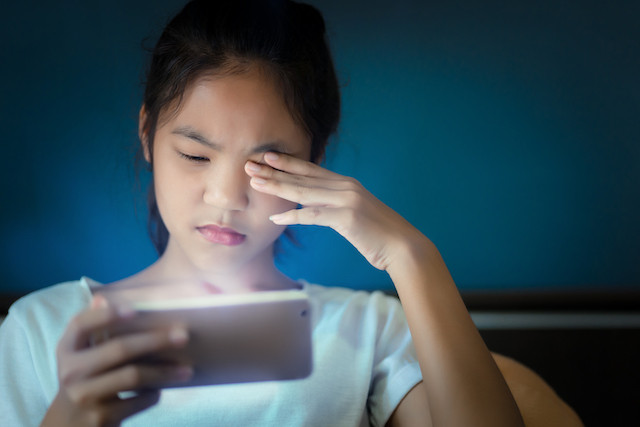
A study by the Royal College of Paediatrics and Child Health (RCPCH) showed that 11- to 24-year-olds spend up to 3 hours on their phones daily, much to the concern of most parents who may worry about their children’s visual development. It is therefore only befitting to put to bed some myths regarding the risks of blue light and screen use.
Is blue light the problem?
With the advent of smartphones and increased screen work at school, children are spending less time outdoors. The incidence of short-sightedness (known as myopia) worldwide has increased, and studies are bringing to light possible correlations between these two phenomena.
Exposure to natural light has been thought to slow the progression of myopic onset and possibly to have a protective effect on children. Alongside the rise of smart phone devices, there has been a wave of overprescribing prescription glasses for so-called digital eye strain and blue lens filters to young children.
The current growing body of evidence highlights the fact that it is not the blue light emitted from screens that is causing visual trouble, but the way children look at screens. Indeed, the prime cause for most symptoms experienced by our generation of screen-children is due to a condition known as dry eyes, as backed by the American Academy of Ophthalmology (AAO). When reading a book your gaze tends to be lower than when focusing on a screen. The latter lies above normal eye gaze, therefore causing the eyelids to widen. A wider aperture creates a larger surface area for evaporation and thus a dry eye.
Studies have also shown that during screen time the average blink rate diminishes considerably therefore reducing the tear film. Children then suffer headaches, blurred vision and complain of painful eyes.
Following an undercover investigation by the BBC’s documentary series Watchdog in 2016, two leading optical brands were investigated for exaggerating unfounded visual symptoms said to be caused by artificial light exposure in order to boost their sales. Their claims that specialised filter lenses would protect one’s visual acuity from blue light were equally false.
What about melatonin?
Blue light emitted from our screens is classified as short wave-length light.
During waking hours this category of wave-length acts by suppressing the hormone melatonin produced by our bodies overnight. Artificial light exposure before sleep from tablets, TV screens and phones, causes a shift in circadian rhythms. In other words, the melatonin released by the body is delayed by 1.5 hours.
It follows that chronic exposure to artificial light late in the evening will lead to a disruption in melatonin production. Children and teenagers using screens before bedtime therefore experience a later sleep-onset, shorter sleep duration, mood changes and fatigue. While poor quality sleep is highly publicised, it is equally important to note that a poor circadian rhythm also impacts one’s blood pressure and glucose levels and, subsequently, both weight and metabolism.
Exposure to natural light
Earlier this year the RCPCH provided clear parental guidance on the topic. No robust evidence exists to suggest that blue light or a particular number of hours spent on screens is harmful to children--that said, it is certain that one’s circadian rhythm is affected.
Research has clearly identified that creativity, memory span and concentration in children is reduced as screen time is on the rise.
Current evidence leans towards the protective effects of outdoor activity and exposure to natural light. Children as adults need frequent screen breaks following the 20-20-20 rule. Remind your children to blink often and take breaks every 20 minutes while focusing at least 20 feet (6m) away for 20 seconds. Ideas for breaks can be in the form of interactive play off-screen.
The NHS initiative to encourage playtime for children offers advice on how to make these breaks enjoyable in the form of “shake-up games”. A safe rule to implement in the home is avoiding screen use 1-2 hours prior to bedtime. When choosing adequate spectacle wear for children complaining of visual symptoms it is important to re-assess their screen use both at school and in the home, to ensure all measures have been taken prior to solving the problem with potentially unnecessary spectacle wear.
Dr Lilani Abeywickrama is a Luxembourgish ophthalmologist currently based in Milan. Her main interest is advocating healthy living and precision technology within her specialty and is pursuing her interests in the field of healthcare management.