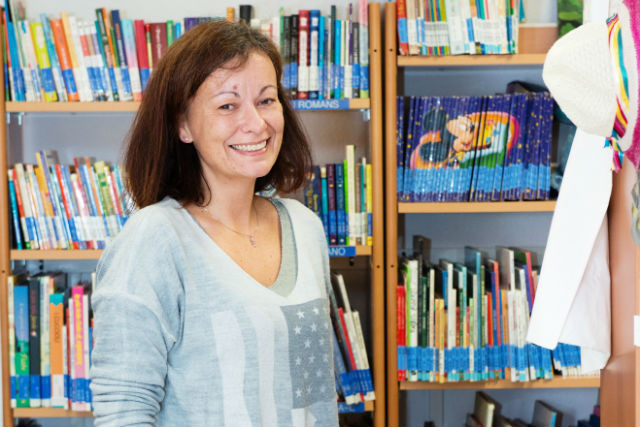
Established in 2004, Il Était Une Fois... (Once Upon a Time...) was created to support the growing number of foreign children living in Luxembourg. It provides storytelling and activities for children under seven in English, Chinese, Spanish, Italian, French, Slovakian, German, Czech and Luxembourgish. It also houses a library that stocks a variety of children’s books in 21 languages.
“We are passionate about literature, culture and education,” says Valérie Georges-van der Schoor, one of the four partners at the non-profit organisation. The team also provides multi-language activities to schools, crèches, foyers and maisons relais in Luxembourg designed to help children practise their mother tongue outside the family circle.
“Our mission is to foster social identity and integration. We believe that all the different languages and cultures represented in Luxembourg have a place and we want to help integrate them in a positive manner,” she explains.
The association’s founding principle is based on established linguistic research, namely that to learn to speak a foreign language well, a solid base in your mother tongue is essential.
In 2010 Il Était Une Fois... opened a “story corner” in Gasperich on premises rented from Clae, another NGO, and paid for by the City of Luxembourg. The amenity provides a library, but also a room dedicated to fun activities, story times and activities.
Rhyme and rhythm
Activities centred around books are an important part of the library. On Tuesdays, Gemma Williams conducts a song and story time for preschoolers. She uses aids such as puppets to bring to life nursery rhymes, and simple actions, colours, counting or even musical instruments to involve youngsters and help them socialise. The toddlers are enrapt.
“I’ve been running the English sing-along since January 2017, and try to follow a pattern. We are currently focusing on autumn themes such as apples, but in winter we’ll cover stories about the dark. Children really notice the change in daylight hours,” says Williams.
A qualified early years teacher, Williams believes nursery rhymes are really important: “They help young children to hear the pattern and rhythm of their native language. Anticipating what words will come next is a first step toward learning to read,” she says. Rhyme and rhythm also allow children to hear the sounds and syllables in a language, in addition to helping with early maths and memorisation.
The English weekly sing-along is attended by a mix of native and bilingual parents, or those who want to expose their children to the English language. It attracts mothers, fathers, nannies and babysitters.
“All languages, not just English, have irregularities. As a native speaker, you learn these at a young age without really noticing, as part of your play, or in stories and songs, rather than through dry grammar or phonic rules,” Williams says.
Eighteen volunteers work for the association, which raises money through membership fees, donations and fees for activities. But the day-to-day running is done by the Czech Klaudia Sauerova, Italian Daniela Trucco, Spaniard Maria de Guadalupe Royan, and Dutch/French Valérie Georges-van der Schoor. “We want children to love books, especially if they speak a minority language. Young readers can be active and noisy here, enrich their imaginations and speak out,” says Sauerova.
They point out that for the most part libraries in Luxembourg offer books for children only in the official languages of the country. Many other languages are barely represented. Although they have children’s section, local libraries often lack staff dedicated to storytelling and activities, and children’s corners are often located close to adult sections. Children are obliged to respect the rules of silence, which inhibits spontaneity and interest in books.
Liven up libraries
“Our challenge is to change the very concept of the library from somewhere quiet and sombre to somewhere that is friendly, open and lively,” says Trucco.
In addition to regular story times and themed seasonal activities, the quartet host six local crèches, although they admit demand for English sessions is limited. During the sessions, children are encouraged to develop not only language and creativity skills, but also motor and social skills.
“We see children becoming self-confident, independent, and able to listen, concentrate, and most importantly, express themselves emotionally,” says Georges-van der Schoor.
Plans are in place to offer books and workshops in Croatian, and to work in collaboration with Luxmama Club & ParentPrep. Il Était Une Fois... will also be running free Christmas story time sessions in a chalet at the place de la Constitution on 2 December, reading stories in English, Italian/Spanish and German/French.