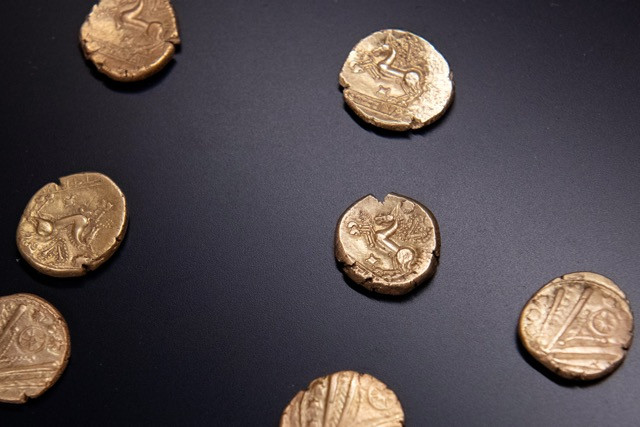
The Celts were a collection of tribes with similar languages, religious beliefs and traditions, who spread through western Europe and the Luxembourg region from 200BC to 50AD.
Early on within the tribes, coins were seen as a sign of wealth and prestige, a gift to the gods, more than monetary exchange.
But, this changed when the Celts came into contact with the Mediterranean economy and Greek colonies such as Masaria, today known as Marseille.
The previous barter system was not appropriate for trade on this scale and “a cow is more difficult to move than a coin,” says conservator at the Musée Nationale d’Histoire et d’Art François Reinert. And so “trade started. They bought metals and wine, especially wine. And they sold other things.”
Gold coins
According to the Musée Nationale d’Histoire et d’Art, the Celts struck copies of golds coins bearing the likeness of Philip of Macedonia in the west of the territory of the Treveri, a Belgic tribe based in the lower Moselle valley, as far back as 200BC. Made from gold, silver or potin, they also copied other symbols from the Greeks, such as the head of Apollo or chariots.

Photo depicts the ruins of the Celtic Titelberg settlement in Luxembourg. Photo: Flickr/Jean & Nathalie
In the first century BC, minting moved to Titelberg, a Celtic settlement near Differdange, which is thought to have been a centre for trade and commerce. Because of their scarcity, Celtic coins never fully replaced barter in the Luxembourg region. But they continued to be used long after the Roman conquest and Titelberg continued to mint coins until 337AD. The Romans, for whom coinage was a way to pay troops and finance the empire’s growth, established one of their most-important mints in Trier in 293, which operated until 394.
The Treveri and wine
The Treveri tribe inhabited a vast area occupaying Luxembourg, southeastern Belgium and western Germany with the centre located in Trier. They had a mixed relationship with the Roman conquerors, famously revolting against Julius Caesar during the Gallic wars but also supplying the Roman army with cavalry.
Among their greatest legacies are Moselle wine, produced after Roman emperor Caesar Augustus introduced vines to the region in 15BC. The Treveri, whose capital as in today’s Trier, had a considerable trade with France for wood and wines of the Moselle. Various amphoric wine flagons have since been found in excavations of tombs in Luxembourg.