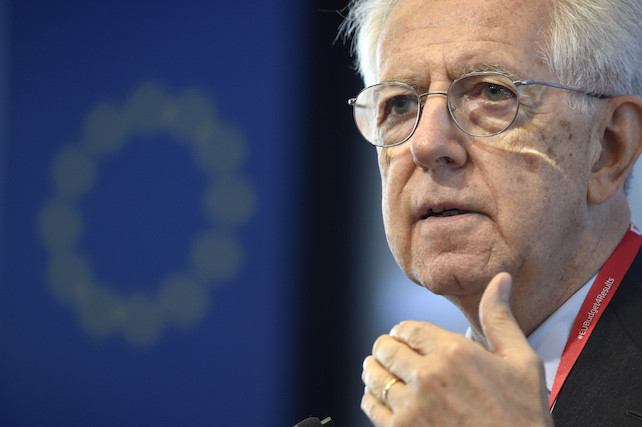
The former Italian prime minister says that the delegates of European Commission, European Council and European Parliament had agreed on these “modest” proposals.
Monti was invited by the Bridge Forum Dialogue to speak at the European Investment Bank on Tuesday to present the report of the high level group on own resources (HLGOR).
The HLGOR was composed of present and past EU commissioners, MEPs, former ministers and experts designated by the European Council. The report proposes new ways to structure both the expenditure and the revenue side of the EU budget.
The EU budget
The plan is to restructure the EU’s Multiannual Financial Framework (MFF). This 7-year budget plan is always subject to intense and acrimonious negotiations both within the Council and between the Council and the EP. The EU budget has several types of “own resources” (such as custom duties on imports, sugar levies and part of VAT) and member state contributions based on the size of their economy (currently 1.02% of GNI). These contributions constitute the biggest part of the Union’s revenue and are hence the biggest bone of contention, because they count as public expenditure.
Member states are divided between net contributors and net recipients, while the EP wants more say over spending and an increased EU budget. The UK receives a rebate, and other net contributors such as Germany, the Netherlands and Austria, receive a rebate on the rebate. The EU has to conform to the principle of equilibrium, meaning there can be no deficits.
The EU budget is small compared to national budgets and the recent crises have shown that funds are inadequate to deal effectively with them. The “satellite” budgets that were set up to help with the migration crisis and others are not included in the budget.
New ideas
During his speech in Kirchberg on 28 February, Monti said:
“we have not come up with one individual technical proposal because otherwise that would have concentrated all the debate, and it would have been too easy to discard it. Then we would remain forever and ever where we are now. We wanted to instil the need to reconsider the budget.”
The report does suggest two new clusters of own resources: one centred on the single market, such as a change in VAT own resources, an EU corporate tax, a tax on financial activities; the other focused on energy, climate or transport, such as a CO2 tax, electricity tax, or fuel tax and others. These would all be levied in member states and they would give a small percentage to the EU automatically.
However, the European budget commissioner, Günther Oettinger, said in an interview with Handelsblatt:
“that is an extremely sensitive political issue. No country freely relinquishes its fiscal sovereignty. So I don’t support a new tax for the EU.”
However, he supported the HLGOR’s idea of a levy on motor fuel and a C02 tax.
The report also includes enhanced cooperation--for example, to further development in the euro area or in defence cooperation--but without jeopardising the budgetary principles of unity and universality. Monti said otherwise it could become “a mess”.
On the expenditure side, Monti said that:
“there are many opportunities to do things that would be consistent with reinforcing the single market, that would be conducive to more effective EU policies against climate change, etc.” He wants to focus spending on achieving higher European added value and corresponding to the nature of the challenges. The added value refers to economies of scale, cross-national externalities and threshold effects which justify spending at the highest governance level.
Lack of political will?
While Monti, who was a European commissioner between 1995 and 2004, and now sits in the Italian senate--suggested the proposals were modest and could be rather easily implemented, some argue that they are rather ambitious.
The Jacques Delors Institute in Berlin has stated that the interests and political orientations of national governments will unfortunately impede such an “ambitious” proposal. Four countries may play a key role:
“Spain and Ireland could join a coalition of net contributors after Brexit, which may shift the balance between the two groups. Italy stands to profit less from cohesion policy and might support a reform in this field, while France is now a large net contributor to the CAP. While net balances do not dictate member states’ stance on budgetary reform, experience shows that they do shape it.”
UK contributions
The UK contributions will fall away after the two-year negotiations on Brexit. The UK will then also stop contributing to the EU budget, bar the legacy costs (any projects they committed to co-finance). The “Brexit gap” will be around €10 billion in the annual budget.
Monti explained why he is cautiously optimistic:
“Certainly the disadvantage is that there will be fewer resources coming in, but on the other hand it will be a trigger that will force a reconsideration of other aspects, including the counter rebates. We believe that fresh thinking is needed in view of the next MFF. Brexit will facilitate this fresh thinking--it will not necessarily facilitate the solutions but it is an additional factor that will force an in-depth reconsideration of the EU budget. Member states will have to decide whether they will be content with smaller expenditures in some areas. We give some direction on how a thorough review of expenditures should be conducted. I am personally convinced that some things can be either eliminated or done at the national level. More room has to be found financially for the provision of European public goods.”
The MFF negotiations would coincide with the Brexit talks, which usually start around two years before- so the next negotiations would have to start in 2018 to be ready for 2021.
However, Commissioner Oettinger said that the draft will be made public before the end of this year:
“Perhaps we’ll change the timetable. If Great Britain exits in the spring of 2019, the start of the new financial framework could be pushed up by a year to 2020. Moreover, there is something to be said for shortening the financial period from seven to five years. The European Parliament has long been calling for the E.U. financial framework to be brought into line with the five-year E.U. legislative period.”
The Commission seems to be open to reforming the MFF. As Monti has said in his speech at the EIB, member states need to stop presenting the budget as a zero-sum game both at home and in negotiations, as the indicators are misleading and difficult to assess.
The president of the EIB, Werner Hoyer, said: “Populists are using the leitmotiv: ‘every man for himself’.”
The EU needs to deliver in a timely manner to counter this trend. Reforming the EU budget is an important part of that.