Claire Thill’s new play, “Two pigeons perching on a Bench”, started as a Talent Lab project at the Grand Théâtre in 2016. A workshopped production then, it was KasemattenTheater director Marc Limpach who liked this novel exploration of internet surveillance and pushed Thill to develop and direct it into something that could fly.
She has had plenty of fodder to work with in the intervening years with the Cambridge Analytica data misuse scandal, among others, and the introduction of the General Data Protection Regulation in May this year. But, as anyone who recognises themselves in the descriptions of smartphone-obsessed passersby in this play knows, consumers still haven’t woken up.
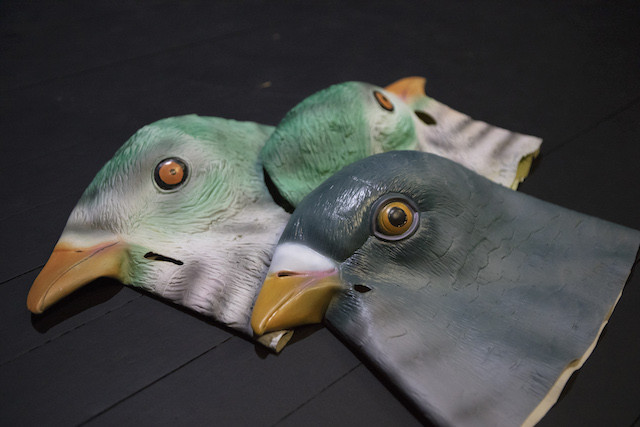
Audiences are reminded of this even before the play starts as cast members dressed in civilian clothing and rubber pigeon masks asked people what they are talking about. In many cases on opening night, they chirpily responded with an honest answer. The play continues in this vein, pecking around issues related to consumers’ over-trusting habits and flitting between ideas like someone with a short attention span flicking through TV channels.
Its central story is that of two pigeons, one played by Catherine Elsen, who wants to break the humans out of their stupor, while the other, played by Feyesa Wakjira, tries to convince her otherwise. The subtle conflict between the whistleblower and watcher are inventively demonstrated through activities that mirror social norms. A memorable one was Wakjira distracting Elsen from her mission by breaking out into a karaoke cover of the Police’s “Every breath you take” (think of the lyric “I’ll be watching you”).

Catherine Elsen and Feyesa Wakjira play two pigeons with conflicting missions. Photo: Patricia Pitsch/Maison Moderne
There are some visually stunning moments in this one-hour performance, notably the scenic aerial video footage of Luxembourg interwoven with striking soundscape by François Martig and Wakjira’s birdlike shape silhouetted on the wall. Presumably, this was to show the sheer exhilaration and freedom the internet provides its users. On the whole, though, Wakjira’s compelling pigeon character seemed to serve as a sort of anti-Brechtian tool to shock viewers out of such moments, if only for them to pursue another distraction so they forget about internet surveillance, much like when one trawls the internet or social media.
Thill also makes some humorous observations in her text, which was delivered with excellent timing by the cast of two, even if at times the masks made their voices less discernible.
Rather than providing a solution to internet surveillance, “Two Pigeons” serves more as an awareness-raiser. Whether viewers changed their behaviour upon leaving the Kasemattentheater, it is hard to say. I partly wonder if the introduction of GDPR has only served to make consumers less vigilant, as we readily tick boxes in order to continue to exercise the freedom to trawl the net. If that is true, then it shows we, the consumer, need to make much more of a flap about internet surveillance. And, in an online setting which is constantly evolving with the internet of things, internet surveillance is a theme which has plenty more scope for theatre exploration.
“Two pigeons perching on a Bench” will be shown in English at Kasemattentheater on 7 and 9 November at 8pm.