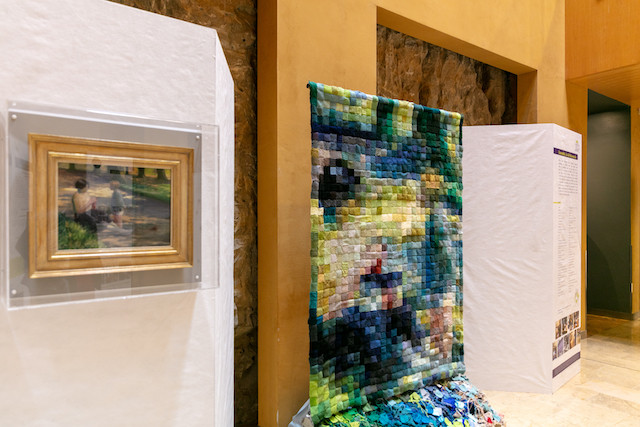
Hung beside Corneille Lentz’s original 1921 impressionist painting “La petite histoire”, the imitation made from knitted squares did not pull the wool over anyone's eyes, however.
A product of not-for-profit Mamie et Moi’s (Granny and me) ambitious collective squares project, launched in October 2020, the goal had been to bring people together during the pandemic by knitting around 5,000 5cmx5cm coloured squares to make a panel 1.5 metres by 2 metres.
“Finally, we got 30,000. It’s a lot!”, said Mamie et Moi co-manager Camille Gouiffes-Alexandre, adding: “The health crisis meant that people needed to collaborate on something collective and really the idea of working as a collective had a lot of meaning, especially during the winter, which was hard for everyone.”
Workshops in schools, after school clubs, care homes and appeals on social media bore fruit. The association received packages from as far as Turkey and Russia containing knitted squares. In all, more than 600 people, aged six and upwards contributed to the effort.

Mamie et Moi received six times more knitted squares than they needed for the project. Photo: Romain Gamba
It quickly became clear there would be a square surplus—the painting is composed of 1,218 squares. So, the Mamie et Moi team composed a message in a second hanging, which is also on display at the museum. The hardest part of the process, besides restrictions on workshop size, was validating the painting,” said Gouiffes-Alexandre. “It must be the same for impressionist painters. We moved things around, changed some squares, to get the right depth effect. That was a very tense moment, but I hope that we managed, and the result will show that.”
The remaining unused squares will be used for cultural projects in cooperation with organisations and communes. Gouiffes-Alexandre said her team is currently in touch with a commune to develop a similar project aimed at its residents.
“This really makes us want to continue to use these remaining squares and go more in a cultural direction. It’s something that brings people together, helps people speak about their heritage and culture in general,” she said.