If you’re looking for a factual insight into the lives of Charlie Chaplin and Stan Laurel, Told by an Idiot’s latest show won’t be your first port of call. If, however, it’s an entertaining, inventive and energising insight into the complexities of ambition and stardom you’re after, “The Strange Tale of Charlie Chaplin and Stan Laurel” is a boat you won’t want to miss.
I say a boat, because that’s how this, non-voiced, devised piece of physical theatre opened, when it was performed at Luxembourg’s Capucins theatre on 9 January, its second venue since opening in Plymouth.
The non-linear plot, told through time-travelling vignettes, charts the relationship between two comedy legends Chaplin and Laurel who, in 1910, shared a cabin as they travelled together by boat to North America as part of Fred Karno’s famous music hall troupe. During the following two years, Laurel was Chaplin’s understudy. Chaplin developed his Little Tramp character and, within three years, became one of the most famous comedy figures in America. But he never acknowledged his connection with Laurel in his autobiography.
The action opens energetically on a multifunctional stage--part ship, part Vaudeville stage, part impoverished Victorian home. A boat is setting sail and characters scrabble aboard hurriedly, with exaggerated pratfalls set to almost constant piano accompaniment, played by Sara Alexander--just as if we were watching a Chaplin movie.
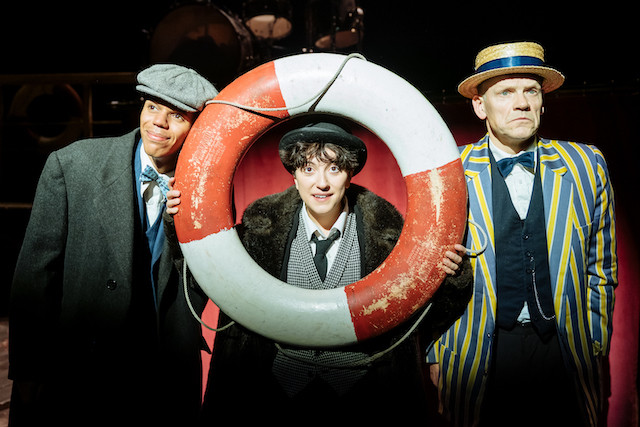
I did a double take when Amalia Vitale as Chaplin entered: the iconic suit, and well-executed gait and gestures say it all. She really comes into her own when confronted by her foil for much of the story, Stan Laurel, played by Jerone Marsh-Reid. His goofy smile, perfect timing for clueless gaffes and unrequited, puppy-eyed devotion to Chaplin are convincing and endearing, making the audience wonder if Chaplin wasn’t such a nice chap after all.

Amalia Vitale is pictured playing Charlie Chaplin in the latest play from Told by an Idiot. Photo: Told by an Idiot
Like the two other cast members Nick Haverson and Alexander, Marsh-Reid plays several characters or functions. Written and directed by Paul Hunter, the play is non-linear, flitting between past, future and even into the realm of dreams, characters pop up from trapdoors all over the stage, giving the impression the cast is much bigger than just four actors. The three switch roles seamlessly and have a strong stage presence, which was even more powerful when they invited audience members to participate in certain scenes.
The scenery, by designer Ioana Curelea, is a rich example of how demonstrative staging can create entire worlds. Spread over several levels, with staircases, trampolines and even a fireman’s pole, it is like a drab fun house. The cast exploit their playroom expertly, as a setting for the pratfalls, which are so numerous, you have to watch closely to keep up. Minimalist props are expertly handled to demonstrate much of the rest of the structure--a rotating table becomes a spiral staircase one moment, and a steering wheel the next. My favourite was how a cloak was used by Alexander playing Chaplin’s mother, and Vitale, to create a grotesque monster, for “the birth of Chaplin”.
These demonstrative props, which are today de rigueur for physical theatre, have the effect of decluttering the stage to leave space for the numerous pieces of luggage--a nod to the emotional baggage that Chaplin carries with him through life.
Lighting, by Aideen Malone, was used sparingly, sometimes to illuminate the auditorium, bringing the audience back to reality, or bathing the stage in nightmarish red to emphasise the more menacing moments.
The musical score, composed by Zoe Rahman, is a character in itself. Punctuating the action: be it humourous or tender, the piano music, drums, ukelele, flute and occasional song place the audience immediately in the appropriate time setting. Combining these elements, the music carries the piece like a wave, avoiding crashing into over-sentimentality.
Indeed, you never feel sad or happy for long, the rapid pace and packed plot which takes twists and turns you would never expect does not give you time to linger on emotions until the play ends in the same hurried tone in which it started. There was so much to absorb in this inventive performance, I feel I will be processing it for weeks to come. For a play with no voiced parts, it had a lot to say, often through the forced mutedness of the characters. I particularly enjoyed Vitale's frustrated silent shouts to the audience, which I imagined was a retribution on the part of Hunter, to Chaplin's version of history, laid out in his autobiography, in which all trace of Laurel vanishes.
What remains is an imaginative warts and all treatment of a comedy hero, to be taken with a substantial pinch of salt. The multi-dimensional character that unravels onstage, which is not endorsed by Chaplin’s estate, is made so real, so lovable and unlikeable. It is a fine example of how physical theatre can engage audiences in complex subjects and examine how ambition can damage human relationships.