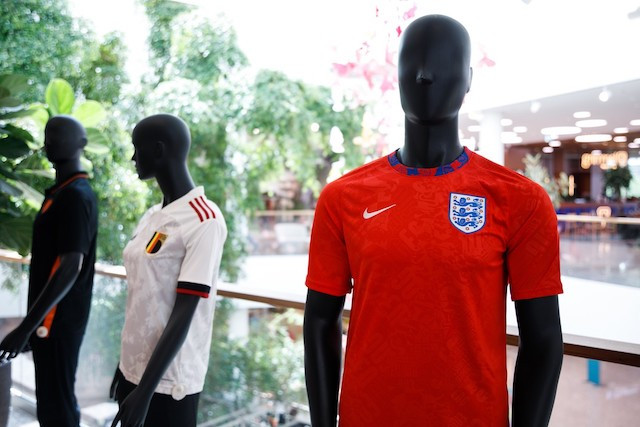
“We had to cancel some jersey deliveries,” says Julien Moca of Intersport in Bertrange about last year’s decision to postpone the championship. Orders and sales have doubled in the run-up to the tournament. “It’s really enormous, it’s a boost.”
Fans will show up at the shop just two hours before a match to get their kit, Moca says. Ahead of the France-Germany match on 15 June, the jerseys of those teams sold fast. Still, “I have the impression that the enthusiasm is weaker because of covid. I think as the bars open, it will increase crescendo,” Moca said.
“France, Portugal and Italy represent 50% of sales,” Moca said. Top teams usually sell more than a hundred jerseys in one shop. Italy jerseys are running low, Moca said, followed by Germany and Belgium. Somewhat further down the list are England, Turkey, Croatia and others.
During the rest of the year, it is mostly club jerseys--such as FC Barcelona, Real Madrid, Bayer Munich, Paris Saint-Germain or Olympique de Marseille--that sell. Luxembourg jerseys are less popular.
At Citabel in Leudelange, the top selling teams are similar to those in Bereldange. Portugal, Germany, Italy, Belgium and France lead sales, said manager Vincent Velfringer. “The teams of border countries, for which there is a big community in Luxembourg, or the big football countries,” he explained.
Sales “grew considerably” roughly three days before the Euros kicked off. “We have already almost sold all the stock for Italy,” he said about the team, with a run on jerseys ahead of the opening match against Turkey.
The shop prefers stocking specific items for the 30 days of the competition and selling out, although it doesn’t rule out “trying to order what is still available from Nike and Adidas.”
The Euros have contributed to sales increasing threefold, Velfringer said. “People want to wear the colour of their team.” Women’s fit jerseys represent only 15% of sales.
Limits on public gatherings and the pandemic have muted the celebrations somewhat this year. Velfringer expects more people to pick up jerseys and fan gear as the competition moves into its final stages. “When the excitement starts to build, sales follow.”
If it was still available, the Luxembourg jerseys would be sold, Velfringer said, whether the country participates in the Euros or not. “It always sell well,” the Citabel manager said. The problem is that the Italian supplier, Macron, has run out of stock. “We don’t have a single jersey left,” Velfringer said.
New models are expected to arrive in July and the store has doubled its usual order.
Regional differences
“Sales have increased but it’s not like the other World or European Cups,” said Johny Silva at Asport. Compared to normal years, sales are down 20-25%, he said, not only for jerseys but also flags and other gear.
The shop ordered 300 to 400 jerseys, as much as for previous competitions. “We will sell everything either way,” Silva said. “But perhaps not at the same price.”
An event like the Euros represents only 5% of yearly sales, Silva said, with more expensive purchases like bicycles or winter sports equipment accounting for more turnover.
In the Asport outlet in Ingeldorf, Belgian and Portuguese jerseys are the most popular. In the south, in Winckrange, it’s Germany and France jerseys. “We are nonetheless astonished to have sold a fair amount of jerseys from Finland and Poland. Mayb there was a Finnish group,” Silva said.
Asport still has some Luxembourg jerseys left, “which sells well.” Even if the team isn’t competing, “people come and buy the jersey of the team they support and take the Luxembourg one, also because it’s very pretty.”
The shop resorted to buying material directly from the federation because of supplier shortages.
The national team to make the most sales will depend on how the Euros continue in the final stages of the tournament.
This story was first published in French on Paperjam. It has been translated and edited for Delano.