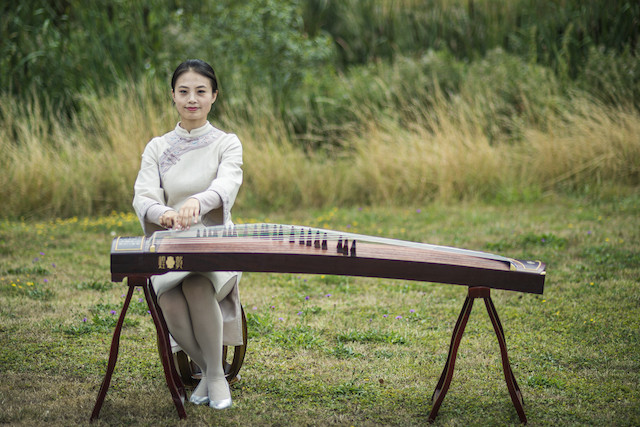
Liu started playing the guzheng at age 5, after her parents introduced her to the traditional Chinese instrument, the origins of which are said to date back well over two millennia. Liu says the instrument is similar to a harp, adding that the guzheng in China bears the same classical importance as the piano in the western classical tradition.
Liu, who studied with guzheng grand master Li Yan at the Shenyang Conservatory of Music, was already winning competitions by the age of 14. From 2007-11, she conducted a folk orchestra at the same time she was studying at the Beijing Institute of Technology. By 2012, she was living in Paris and since 2017 in Luxembourg, and in both locations she has played regular concerts, from Chinese new year gala events to those organised by esteemed brands such as Hermès (where she works part-time) and Chanel (Paris).
“Many people in Europe are interested in Chinese culture and my instrument, and they also enjoy playing,” she says. In the past five or so years, she has noticed the guzheng developing “very fast... most people still play classical pieces. But now composers, also Chinese composers, have their music training and also know western-style music.” Recently, Liu has also been experimenting more in playing western-style music with Luxembourg artists. “It’s really interesting when we cooperate together. We exchange occidental and oriental music. I enjoy playing with them because I can learn new ideas.”
During the confinement period, Liu says she was able to practise more, and it was a pause she says she actually greatly appreciated. It also allowed her to focus more on teaching plans for her students (her other part-time work). When she plays alone, she says some compositions are sad. “I start to think about my childhood, my hometown, or years when I was in China, because [life] really changed a lot when I came to Europe.” She does acknowledge, however, why for others “who live for concerts, it’s a catastrophe for them because they don’t have the chance to play”.
But she encourages others to explore new types of music. “Nowadays, the internet is easy to access, and you can see musicians around the world. They do exchanges... people just enjoy the music. Also for the listeners, they try to listen to new things.”
She currently has three guzhengs, one which she mainly uses for concerts, another smaller one half the normal size, which she can easily transport with her when she goes on holiday. She received another one from an elderly guzheng player in Paris, who told her he wanted to give her the instrument, knowing she would be able to take good care of it. “Normally there are 21 strings, but this one has 25 because it’s an older model, but it’s a special one, with history.”
Liu says she has a special relationship with each instrument, calling each a “friend” with which one develops an emotional bond. “Maybe you first buy a guzheng, it’s very young and hard to play, but [then] it’s like there’s a story, a relationship you build... after that you don’t want to play another one.”
An alternate version of this article originally appeared in the Delano October/November 2020 print edition.