It started out as a small festival in 2005, organised by friends with a desire to get Luxembourg bands together. “It was the peak of the indie dynamic,” Heindrichs recalls. “We didn’t know where it would go, we just wanted to start something.”
In part because Luxembourg artists were bringing their friends, Food For Your Senses (FFYS) quickly gained momentum from a cultural evening to a three-day event, complete with open-air camping. Around 2010-11 FFYS added international artists to the bill and opened the event up to three stages, and the organisation team began thinking about ways the festival could live up to its name. “We brainstormed how to create a multidimensional event, with input for [the other senses]. In a very naïve way, we wanted to do something that was more than a musical festival,” Heindrichs says.
This led to an arts exhibition and a sensory garden, where festival-goers could wander through a variety of plants. There were even osteopaths on site, “so your neck could get some release after a night of headbanging.”
But the music still took centre stage. The team grew, offering a wider range of competencies. “We had a few lucky bookings, where we would have an artist at FFYS which would literally explode just after we’d booked them,” Heindrichs says. This was the case for German rapper Cro (2012), and folk group Milky Chance (2014).
At its peak, the festival drew crowds of around 5,000. Despite the growth, Heindrichs says they wanted to maintain some “philosophical integrity”, for example, when it came to sponsors. They didn’t want ads bombarding concert-goers and refused to name stages after sponsors, preferring to “give the public the view of the sponsor as a useful part of the festival,” for which they were grateful, and to which the sponsors agreed.
But with growth came additional challenges. The festival had taken place in Tuntange until it moved to Bissen, before the data centre works began. Once FFYS had to move away from Bissen, it was difficult to find space for such a crowd, at least one that didn’t have issues with construction, contamination, landowners or local farmers. FFYS moved to Kirchberg, but the team knew construction would eventually happen there as well.
The work, on a volunteer basis, was taking up a lot of time too. “We got older, some started families or got busy with jobs,” Heindrichs says. “We missed the chance to really structure the festival in a way that would have been more sustainable.”
The team was faced with a dilemma, but they decided “to look it in the eye, be open about it and finish the story with a bang.”
A funeral feast for the senses
Heindrichs says the last edition of FFYS will be not just about “gravity and nostalgia”, but also a “moment for flashbacks” over the last nearly 15 years.
But the team is keeping it realistic: half the tickets, half the crowd. That also means half the production, half the bands. “We want to focus on being happy on what had been, while reducing the stress.”
The team is intentionally not releasing the programme until just before the festival so that people attend for the experience itself. “We were never a headliner festival… It was always about giving the public the certainty that they would have a high-quality, discovery moment,” says Heindrichs.
At the time of writing, the open-air camping had already sold out, as had most of the two-day passes. One month before the festival, one-day tickets should be made available, but attendees this year are capped at 2,500.
Heindrichs promises a mix of international and local acts in the line-up, plus artists returning to the festival. There will be a space for an exhibition with photos from FFYS, plus the evolution of graphic design of the posters over the years. No new merchandise will be created--“we have so much left from the last ten years,” Heindrichs says, adding: “But there will be loads of surprises.”
Creating a culture café
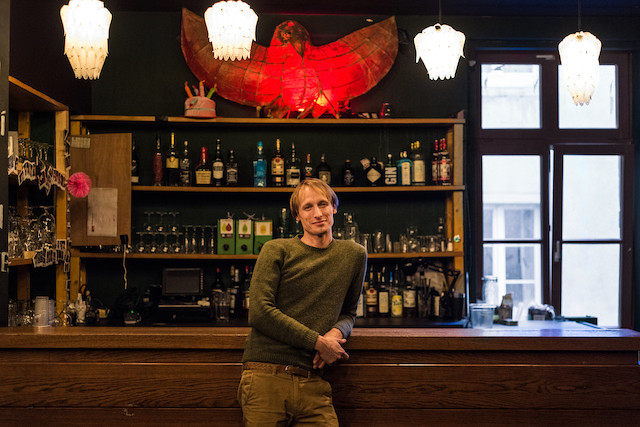
Despite the nostalgic ending for FFYS, the festival led to new beginnings for Heindrichs in 2014. During the festival set-up in summer 2014, Heindrichs and Jaakes Hoffmann were approached about taking over the bar that was in the location where De Gudde Wëllen (DGW) is now. They accepted, opening in December 2014.
“It went really fast,” Heindrichs recalls. “We did a lot of renovation, had some really intense moments with little budget… From the moment we got the keys in September to the moment we opened, we were surrounded by friends, in painting, building, construction, taking stuff to the recycling centre.”
And, just like FFYS, the space grew from a circle of friends. The core staff of eight hasn’t changed much since DGW opened, with Heindrichs, Hoffmann and Ben Thommes, who’s in charge of the bar, as co-owners.

Luka Heindrichs (r.) with local band Say Yes Dog in the upstairs area of De Gudde Wëllen. Photo: Mike Zenari
It was never Heindrich’s ambition to run a nightclub, even if he came from a family with entrepreneurial backgrounds. But the “culture café” now boasts some 100 acts per year, or about two shows per week. DGW’s range of events has grown over the years and now includes improv groups, “choiraoke” (choir karaoke), DJs from abroad and comedy--what Heindrichs wants is a “broad cultural spectrum”.
Heindrichs hopes DGW can serve as a counterpart to other clubs in the city, providing that underground edginess he feels is sometimes lacking in Luxembourg City.
“Our ambition is to create a space where good things can happen. It’s our leitmotif,” he says. “It can be creating a space where there’s an amazing instant of art, like a concert, but also a space to meet people and be shaken a bit in your habits.”
For more information about FFYS or ticketing and programming, visit ffys.eu