There’s the crypt of the Notre Dame cathedral, which is the resting place of John the Blind, who was King of Bohemia and Count of Luxembourg in the early 14th century.
There’s also Jan Palach square, located off the Place d’Armes, which honours the Czech student of the same name who, in 1969, protested against the end of the Prague Spring by self-immolation.
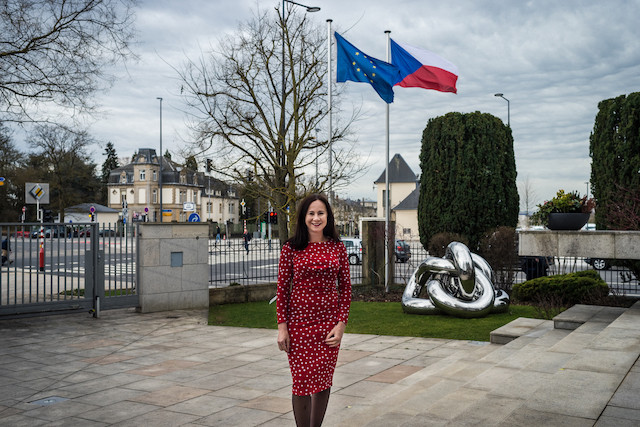
Vacca-Vesela hails from Olomouc in the Czech Republic, not far from the border with Slovakia, although she hasn’t lived there since the age of 14. She has spent most of her life abroad, in places like the UK and Russia, and for the last roughly 20 years, she has called Luxembourg home.
“Luxembourg, for me, represents it all. It is medium-sized, but it has all the advantages of an international city, all the embassies and mixture of communities, without the huge stress of a metropole,” she says, adding that she could never see herself living in a monocultural environment.

The historic centre of Prague, built in the 11th-18th centuries, is also Unesco site. Regular flights operate from Luxembourg. Photo: Czech Tourism
Vacca-Vesela linked up with the Amitiés tchèque et slovaque Luxembourg (ATSL) group when she arrived in the grand duchy, and for the last three years has served as its president. ATSL was founded in 1972, following a wave of Czech and Slovak immigration in the late 1960s following the invasion of Czechoslovakia by Warsaw Pact troops. Today the group has around 200 members, puts on a wide range of events each year, from concerts and theatre shows to the Czech ball, this year in its 12th edition.
Vacca-Vesela says it is estimated that around 2,000-2,500 Czechs are living in Luxembourg. Under her leadership, she has aimed to reunite organisers regularly for better coordination of events, as well as communicate more to the outside. “Our events are not limited to just members, they are open to everybody,” she says. “There are also some events we try to promote in the international community.”
This past winter, a lime tree was planted in the park behind the Grand Théâtre to commemorate the centenary of the founding of Czechoslovakia.
The Czechs and Slovaks regularly work together on events, and it helps that the languages are quite similar, both West Slavic. Peter Balla, president of Slovaks in Luxembourg (Slux) agrees the cooperation is strong. “The connection is very clear. You cannot break it,” he says. “When there is a possibility to cooperate, we always welcome it.”

Peter Balla of Slux, standing near the lime tree which was planted to commemorate the the centenary of the founding of Czechoslovakia. Photo: Mike Zenari
Balla, originally from Nové Zámky (which translates as Newcastle) in Slovakia, near the Hungarian border, created the organisation with Viera Seligova-Hughes in 2010. He had arrived in Luxembourg for work three years prior. “At the beginning, [the organisation was putting on] mainly activities for families and children so they could socialise and keep Slovak traditions,” he says, adding that although members have come and gone over the years, “the core is still intact”.
Balla jokes about the nickname of the group--Slux--saying that at the outset, “some people didn’t like it since it sounded like slugs, which are slow moving, but we still call it that.” Since it started, the organisation has had around 70-100 members and events range from children activities to some events for adults, although Slux focuses on cultural events.
For example, Slux recently held a special event for Carnival, which he says is celebrated slightly differently in Luxemboug compared with Slovakia. During Carnival, Balla says kids walk around in a circle and a jury evaluates which child did the best job, then there is a dance with candy, games and so on. “We wanted to give our children a touch of the homeland, even if they are a thousand kilometres from it.”
Hospitality is one of the key characteristics about Slovaks, according to Balla, so it makes sense that the mission of Slux is also to help serve as a guide for new Slovak arrivals as they navigate their initial settling down phase.
“Once you feel disconnected, and you do feel disconnected because you are far away from home, the idea is to overcome these situations and [provide the] opportunity to come together and recharge a bit,” says Balla. “We try to integrate Slovaks into our organisation immediately so they don’t feel detached from the community…there’s a family they can belong to.”
This article was first published in the April/May 2019 edition of Delano Magazine.