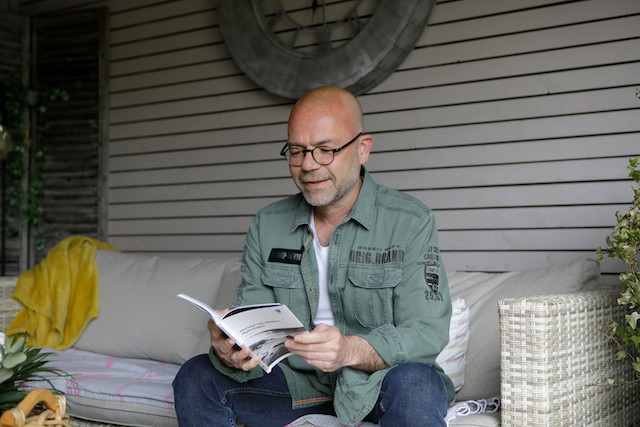
Mythologies is your second anthology after “Explorations in C” was published almost ten years ago. The first anthology came about because you won the 2011 national literature prize. What prompted this edition?
Last summer, a friend of mine and art teacher at my school was bringing out an art book and asked me to write poems for that. So that got me started again and put my mind and art to it. I decided that it was about time I got together the little work that I had already and write some more. So, I got into a kind of rhythm of writing poem a day to have some material really.
A poem a day? For some writers, 2020 was a difficult year to focus on writing. But, that wasn’t the case for you?
I was actually quite fortunate, I go back to Wales [editor’s note: he studied at Aberystwyth in Wales] every year. So I spent two weeks in the National Park in Pembrokeshire and then, coming back, I went with my wife to Greece. I had quite a good time writing, quite inspirational.
What are the themes of Mythologies?
It's divided into three parts: the first part is inspired by Edward Steichen, who curated the Family of Man exhibition. It's called “The Memorable Journey” and because I was writing and travelling last summer, that went into it. The second part is a little more political, it's called “Pirates and Slaves”. But again, that's more a critical kind of journey and stuff that goes in it. And then the third part is "Songs of a Travelling Mind" and that's mostly dedicated to my travels with my son. Because I've been going on a father-son holiday with him since he was three years old--he is 18 now. I took him to the UK, so Wales, Scotland and all of those places. I went to Corsica with him alone.
Where does the whole idea of the mythology come in?
It is the idea of the mythology of fatherhood.
Tell me more about that.
I did my master's in American literature, where the absent father figure is a huge theme. [I was] exploring that and a sense of authority also, and when you're travelling with your son, you develop a different relationship I suppose with him. A closer relationship maybe. Then there is Greek mythology and the attraction of the sea, especially in a landlocked country: the sea, the animal world and all of that. All of that goes into it really.
Your native language is Luxembourgish. What guided you towards the English language to express yourself creatively?
I learned most of it through the lyrics of songs and then I had a teacher who got me interested in poetry, in Walt Whitman and all that stuff. Then, when I went to university in Wales, I had a few key teachers who were into open reading and they asked me to show them the stuff that I was writing. I've done some poems in Luxembourgish, a couple in French, but I don't seem to get the flow as much as I do with English. At least that's what some people tell me [chuckles].

Photo: Matic Zorman/"Journeys..." is the eighth publication from Black Fountain Press, an English-language publishing house based in Luxembourg
Tell me about your journey in writing these poems.
“The Memorable Journey”, the Family of Man poem I started in the mid-90s and worked it over and then rewrote it. I went to visit the exhibition a few times and it was closed for a long time and then when it reopened it had completely changed. That was another reason why I had to rework it. In others, I've explored certain concepts. There's one poem in it, “The Raft of the Medusa”, which is inspired by the painting in the Louvre. “The Pequod”, is the boat from “Moby Dick”.
It sounds like a lot of the prompts were visual.
Yeah, visual and auditory also. Bob Dylan, of course, plays a huge role in my life. I'm a big Dylan fan. And then also the idea of the Walt Whitman songs. The Beat poets, too, and a lot of that is performance writing, so it is writing that's meant to be read. I think that reading it aloud helps the writing process. You see what works and what doesn't work and the rhythm of it all. I like reading aloud. It gives it an additional layer.
What is writing for you? Is it a reward, or a kind of holiday from teaching?
It’s an exhausting one. I mean, sometimes you need to dig deep. There are poems where I sort of had a conversation with my younger self, for example. One person that book is dedicated to is my grandfather and his death had a huge effect on me. So, again, coming to terms with the experience of death also. Some of my friends have died, so I tried to write about that. I've dedicated one poem to a friend in Wales who died. Facing up to those memories and trying to get them onto paper. Digesting and also, I suppose, coming to terms with that kind of experience.
About Tom Hengen
Originally from Dudelange, Tom studied English and American literature from 1993 to 1998 at the Centre Universitaire de Luxembourg and at the University of Aberystwyth in Wales. He became involved in the local poetry scene during his studies in Wales, where he founded a poetry magazine. Tom Hengen has been an English teacher at the Lycée des Garçons in Esch-sur-Alzette since 2005.
Where to meet the poet
15 May: Librairie Diderich, Esch-sur-Alzette, 10:30-1pm (book signings)
16 May: Café Littéraire Le Bovary, Luxembourg-Weimerskirch, 4-6pm
1 July: Echternach Trifolion (reading)
14 September: Centre National Audiovisuel, Dudelange