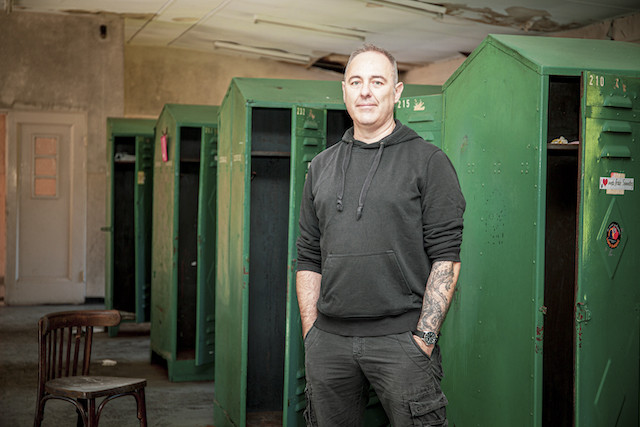
“I like the solitude and the melancholy of these places […] The first thing you notice is the smell. A suspicion of life that’s not there,” the railway technician tells Delano.
Dahn’s hobby emerged when, as an adult, he and others returned to his childhood haunts. He took up photography and then, in 2008, combined the two.
“We met other people who did the same thing and made friends throughout Europe,” he says. The elegant decay depicted in Dahn’s evocative images of art deco factories and sparse salons is spellbinding, especially as it contrasts with Luxembourg’s constant gentrification.
Some of the buildings whose entrails he has photographed have long since been razed, often replaced with new housing. But, if his photos are considered a record of another era or interpreted as a commentary on the housing situation, that is not intentional. “I don’t see my photos as having a role in changing mentalities,” he says. “I returned to these places to take photos because it’s part of my personality. It’s here that I find the serenity, solitude and freedom that I sometimes need.”
Some of the most striking places Dahn recalls visiting include an underground, marble crypt where he discovered love letters. “It was a strange feeling. You become preoccupied with death”. And his eyes light up as he recounts a mine he visited during the summer heatwave: “You enter 300 metres into the tunnel and just where the hot air from outside meets the cool air from inside, it creates a fog in the middle. It’s really magical!”.
As a photographer, Dahn pays close attention to light in the places he visits. Sometimes, however, for example in the mines, there is none. “The absolute darkness makes you feel very small. You have an intense feeling of claustrophobia. That’s when you have to be quite strong and say I’m not afraid of the dark,” he says.
For Dahn, urban exploring is also a social activity, with an added element of danger and excitement that one rarely finds in professional life.
“I’ve been arrested by police and gendarmes […] A neighbour in Belgium released a dog on us. It’s definitely a sport!” he says with glee.
Dahn says that what he does is neither legal nor illegal. He never uses force to enter a place he is exploring. He takes nothing but photos and leaves places as he found them. One could argue that his urban exploring activities are an issue for site owners if someone becomes injured.
And it does happen. In moments of carelessness, Dahn has suffered some cuts and grazes, but, he says, nothing serious: “You have to have a certain amount of respect for the environment and for danger, because it’s dangerous to do this. Some houses were abandoned 30 years ago and they’re not stable.”
Before setting out, he researches the site, checking records of other urban explorers. But, even then, he says you never know what to expect until you arrive. And when I ask what advice he has for would-be urban explorers, Dahn is quick to respond: “There’s a real risk you could kill yourself. I wouldn’t encourage people to do it.”