
Findings from a Luxembourg Institute of Socio-Economic Research (Liser) study reveal that women’s employment dropped at the onset of the crisis. The crisis also triggered changes in the behaviour of individuals and households to the disadvantage of employed women, who allocated more hours per day to non-remunerated care and domestic activities. Men reverted to pre-pandemic levels in these areas.
Gender inequalities in time use
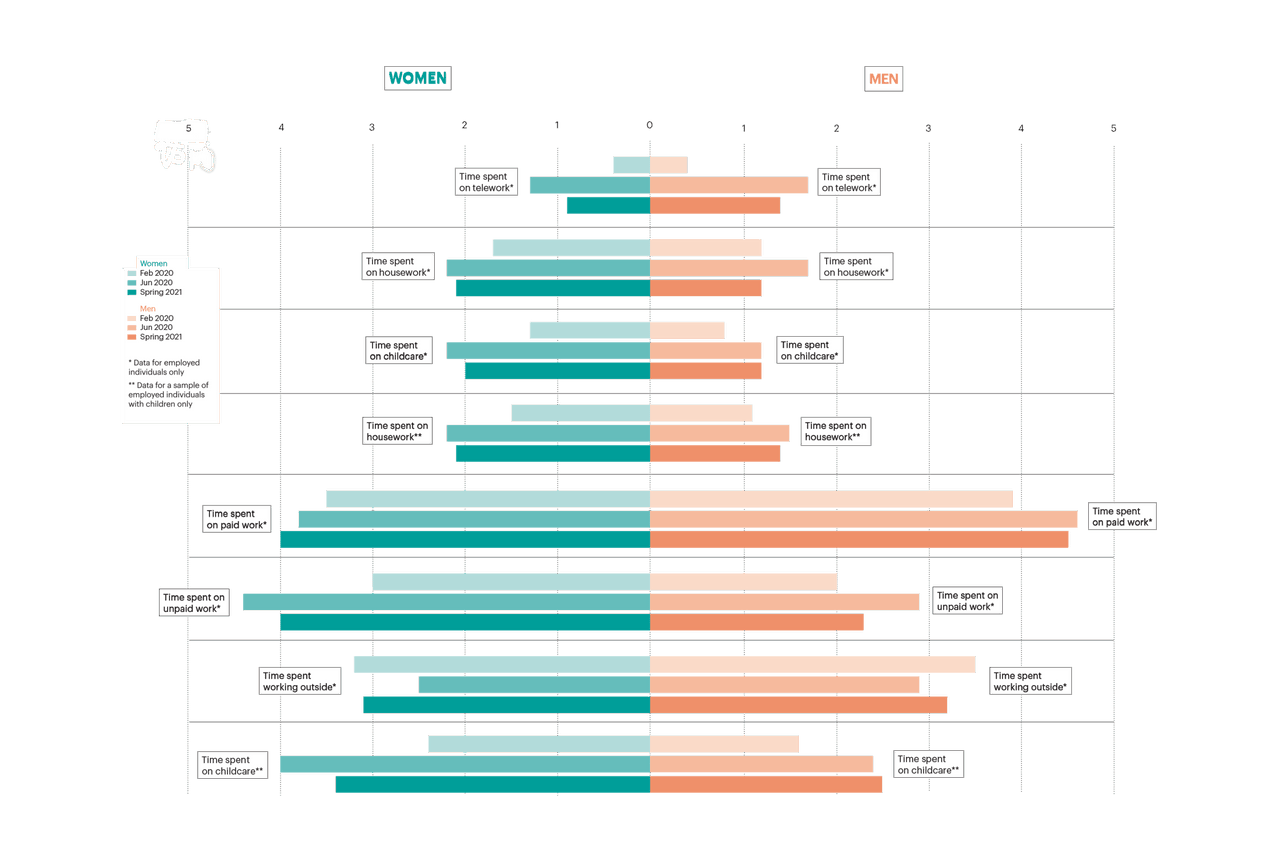
* Data for employed individuals only. ** Data for a sample of employed individuals with children only. Source: LISER. Graphic: Maison Moderne.
The chart below shows the percentage of board seats held by women in a sample of EU member states--only member states included in the data set covering 10,493 companies in 51 countries--in countries with and without an established quota. Data as of March 2021.
EU women on boards
4 questions to: prof. Skerdilajda Zanaj
Do quotas strengthen or reduce gender-based discrimination?
S.Z: Quotas are an effective policy instrument to favour gender equality and they do not come to the detriment of the quality of the candidates. It is often argued that gender inequality in representation is only the result of women choices, related to fertility and motherhood. Thus, gender quotas do not necessarily follow meritocracy, and thus the average quality of candidates (Politicians, Board members, university professors, …) may decrease. High quality research (Baltrunaite et al., 2014; Gertsberg et al. 2021), among others) has shown that actually quotas do not reduce the quality of candidates. As long as, implicit biases and organisational discriminations are ubiquitous, quotas improve gender equality reducing discrimination.
Three practical ways to break implicit bias in the workplace.
Listen, slow down, and study. At the individual point of view, I believe that we should listen more and speak less. Listening allows you to consider experiences from the point of view of the person being stereotyped. To do this carefully, one needs to slow down. It has been shown that when hiring jury members do not take their decision in a hurry then decisions suffer less from biases. Finally, we need to get trainings to fight unconscious shortcuts that our brain does automatically. These individual actions can turn into institutional policies.
Greatest obstacle facing gender equality goals today?
Before the Covid-19 pandemic, it was estimated that we will need 100 years to close the gender gap (Global Gender Pay, 2019). After 2 years of pandemic, it is now estimated that we will need nearly 136 years to reach gender equality. Hence, in two years we lost 36 years to the target. This shows not only that we far from living in a gender equal society but also that all progressions are very instable and shocks backlash gender roles in the household and in the society, massively.
One way to reduce the care burden on employed women in Luxembourg.
Care burden is still unequal and care work is in large majority done by women. We shall increase awareness so that an equal sharing of care tasks between women and men becomes the norm, for instance by offering further incentives to fathers to take parental leaves. And in addition, make quality care even more accessible.
My take: quota legislation
To ensure women reach their full potential, change is required at both household level and in the workplace. After an almost 10-year impasse, the proposed EU legislation to promote gender diversity on company boards will finally move on to trilogues in the legislative process.
A first EU interinstitutional meeting (trilogue) on the women on boards directive--that aims to improve the gender balance among non-executive directors of companies listed on stock exchanges and apply other related measures--took place earlier this week on 30 March.
If the directive comes into force, listed companies will need to ensure gender parity on their boards by 2027 by meeting the 40% target for non-executive directors or 33% target for all board members, a choice to be made at the national level. Luxembourg, which supported the directive, already surpassed its 40% target for female state representatives on the boards of public institutions.
In the context of the pandemic, the impact of the quota legislation in Luxembourg will depend on the number of listed companies subject to the rules--but it will also require those companies to take a critical look on how the care burden may hold back qualified women from reaping the benefits of the legislative progress made.
A version of this article originally appeared in Delano’s April 2022 print edition. More information has been included.