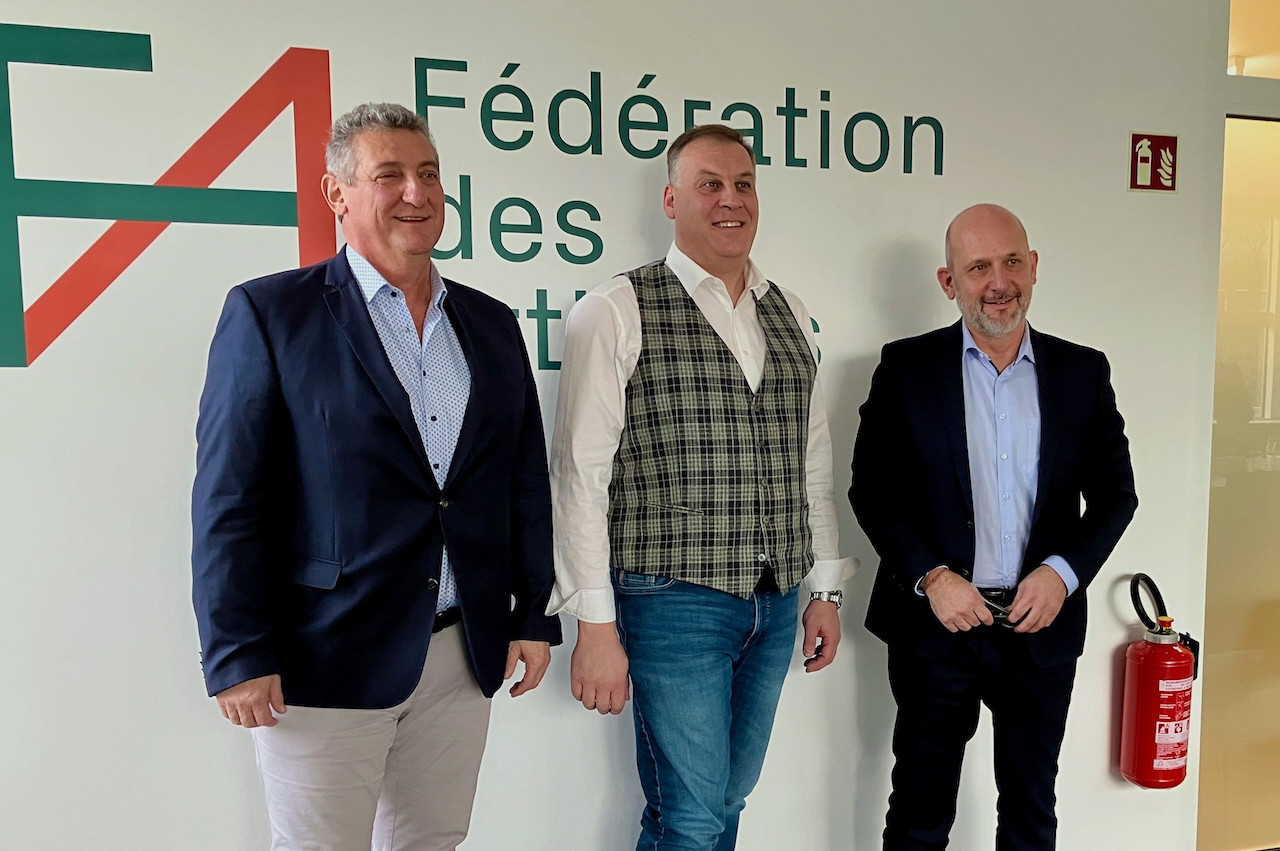
In an interview given to Paperjam on 3 March, the Labour Minister, 

At present, 9% of employees are on the minimum social wage (SSM) and 11% on the qualified SSM, which is a flat-rate amount 320% higher than the SSM. Isn't this a marginal battle? No, according to the federation's deputy general secretary, 
Luc Meyer is calling on the government to "work urgently on competitiveness and have the political courage to take concrete measures to promote business profitability". "Unfortunately, profitability in craft businesses and in the economy in general - leaving aside the financial sector – is almost non-existent in the European Union today", he continues. "Even the minimum social wage is the counterpart of a work service that the company must make profitable for its customers", he insists. "Any increase would be reflected in prices or job creation."
For a balance between social protection and economic survival
For the federation's general secretary, 
For him, the priority is to adopt a wage-setting methodology that preserves "the balance between social protection and economic survival".
How? Firstly, by putting an end to "political increases in the SSM". In other words, making the bi-annual adjustment dependent on a purely mathematical formula. As for the thorny question of the appropriate level of the SSM, the artisans want to create a tripartite evaluation commission. This commission would base its work on productivity and the economic situation.
More room for collective agreements
What about the second S of "SSM" - in other words, the social component? For the Fédération des artisans, it is up to the government to take responsibility for this aspect through targeted social or fiscal measures. Such as a tax credit for categories of employees with incomes close to those of the SSM. Or a tax credit for bonuses and gratuities.
The federation also wants to make it more attractive for employers to negotiate collective agreements, which, according to Romain Schmit, would make it possible to reform the organisation of work to improve productivity and promote training. "Christian Reuter explains: "If companies are recruiting more and more unskilled workers, it's mainly because of the difficulty of finding skilled workers. In his view, people need to be encouraged to train. How can this be done? By introducing pay scales in companies that reward this commitment. This would make the qualified social minimum wage (SSMQ) obsolete. SSMQ, which the FDA would like to see abolished.