European Commission investigations into multinational corporate tax arrangements will, moreover, “undermine” global collaboration, Washington argued this week.
Starting in June 2014, the commission opened a series of inquiries into the tax rulings issued by several EU member states. These include the cases of Apple in Ireland; Starbucks in the Netherlands; and Amazon, Fiat Chrysler and McDonald’s in Luxembourg. The commission suspects the national tax deals amount to state aid which is illegal under EU law.
The US government suspects American outfits are being disproportionately targeted. In a white paper issued on Tuesday, “The European Commission’s recent state aid investigations of transfer pricing rulings” (PDF), the US Treasury accused Brussels of rewriting EU law and eroding international tax cooperation.
Shift expands role
Because tax “rulings are generally available to any taxpayer”, the commission had not previously considered them to be an “advantage”, amounting to illicit state aid, according to the US Treasury white paper. That changed with the recent investigations. “Now, the commission can find advantage if it disagrees with the member state’s application of the arm’s length principle to particular, and often highly complicated, facts and circumstances.”

Margrethe Vestager, the European competition commissioner, during testimony to a European Parliament tax committee, in Brussels, on 4 April 2016. Photo: European Parliament
“This shift in approach appears to expand the role of the [commission’s competition authority] beyond enforcement of competition and state aid law under [EU treaties] into that of a supra-national tax authority that reviews member state transfer price determinations,” the report stated.
The commission could potentially tell Amazon to pay €400m and Apple $8bn in back taxes, for example. But, “imposing retroactive recoveries” would “undermine the progress made under the OECD/G20 Base Erosion and Profit Shifting (‘BEPS’) project”, Washington contended.
It “also sets an undesirable precedent that could lead to other tax authorities, particularly those in developing countries that look to the EU as a model, to seek large and punitive retroactive recoveries from both US and EU companies.”

The Apple store on Fifth Avenue in New York City, taken on 30 July 2007. Photo: Joe Flood/Creative Commons
Targeting US firms
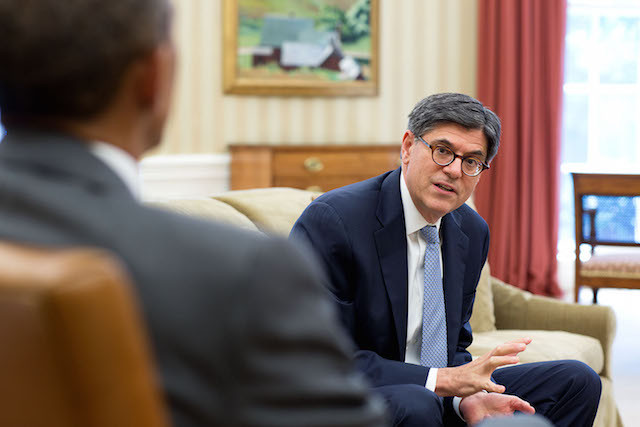
The report echoed a letter sent from Jack Lew, the US treasury secretary, to Jean-Claude Juncker, the European Commission president, in February (PDF) as part of a so-far unsuccessful lobbying campaign for Brussels to roll back its inquiries. Washington said that American firms were being unjustly scrutinised.
“While we recognize that state aid is a longstanding concept, pursuing civil investigations--predominantly against U.S. companies--under this new interpretation creates disturbing international tax policy precedents,” Lew wrote.
“It could undermine the well-established basis of mutual cooperation and respect that many countries have worked so hard to develop and preserve,” he stated.

Tim Cook, CEO of Apple (foreground, left), meets Martin Schulz, president of the European Parliament, in Brussels on 21 January 2016. Photo: European Parliament
Rejected arguments
Margrethe Vestager, the European competition commission, later dismissed the criticism. She said the investigations were not unfairly targeting US firms and the commission was merely applying EU rules.
The commission is expected to publish its finding in the Apple/Ireland case in September or October. The decision can then be contested at the EU General Court and appealed to the European Court of Justice, both in Kirchberg.
