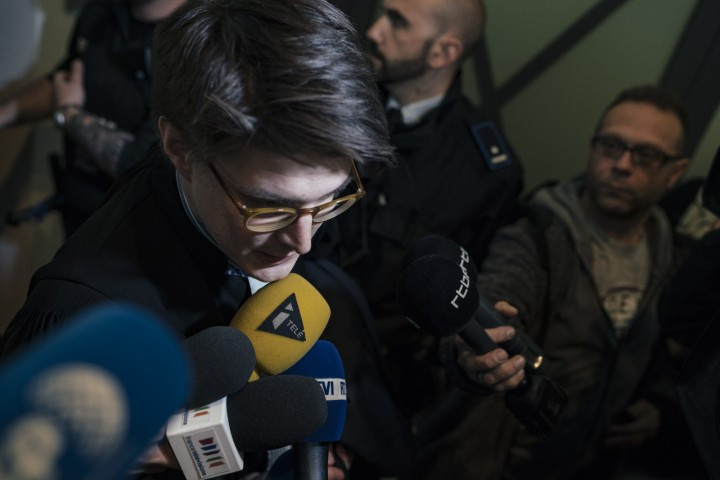
Antoine Deltour and Raphaël Halet, ex-employees of the accounting firm PwC, stand accused of pilfering and leaking confidential tax documents to Édouard Perrin, a journalist charged as an accomplice.
On Wednesday attorneys for PwC argued that Halet and Deltour only claimed to be whistleblowers “ex post facto”. According to the company, Halet did not occupy a “stressful” position; he had worked part-time since 2008 and took a part-time parental leave in 2013. (Halet left PwC at the end of 2014.) “He became a turncoat in the course of the procedure”.
“Stealing his employer’s knowhow”
By copying internal training material, Deltour, in the firm’s view, was “stealing his employer’s knowhow, which had considerable commercial value”. If he had been a true whistleblower, he would have provided the papers to the press much sooner. (Deltour left the firm in October 2010 and gave the documents to Perrin during the summer of 2011.)
The consultancy claimed a symbolic euro in compensation for the affair, but “in no case should that give the impression that PwC has not suffered damages and the incriminating cases are not serious,” said one of its lawyers.
Halet’s defence then argued that he should not have been bound over for trial under European public interest law and jurisprudence established by the European Court of Human Rights, in Strasbourg. In response to PwC’s allegations, one of his lawyers stated that “Mr. Halet has not adorned whisteblower’s garb to try to fool anyone.”
Another noted the testimony of the MEP Sven Giegold, who said a European Parliament committee found three breaches of European rules in the inquiry launched following the publication of the LuxLeaks cache. He also attacked PwC for signing an exit agreement with Halet--after the firm found that Halet was a source of leaks--stating that Halet would not be subject to criminal charges. Except 10 days later an investigating magistrate appeared to have information about the matter.
Not “remote controlled”
An attorney for the investigative reporter claimed that PwC delayed disclosing information to the investigating magistrate “which shows that Édouard Perrin treated his source in a conventional manner” and had not “remote controlled” Halet.
The counsel also argued that the human rights court in Strasbourg had ruled that professional secrecy--in the medical, legal and tax fields--could be breached based on the “legitimate need to inform the public”.
The trial continues Tuesday.
Reported by Camille Frati; edited by Aaron Grunwald