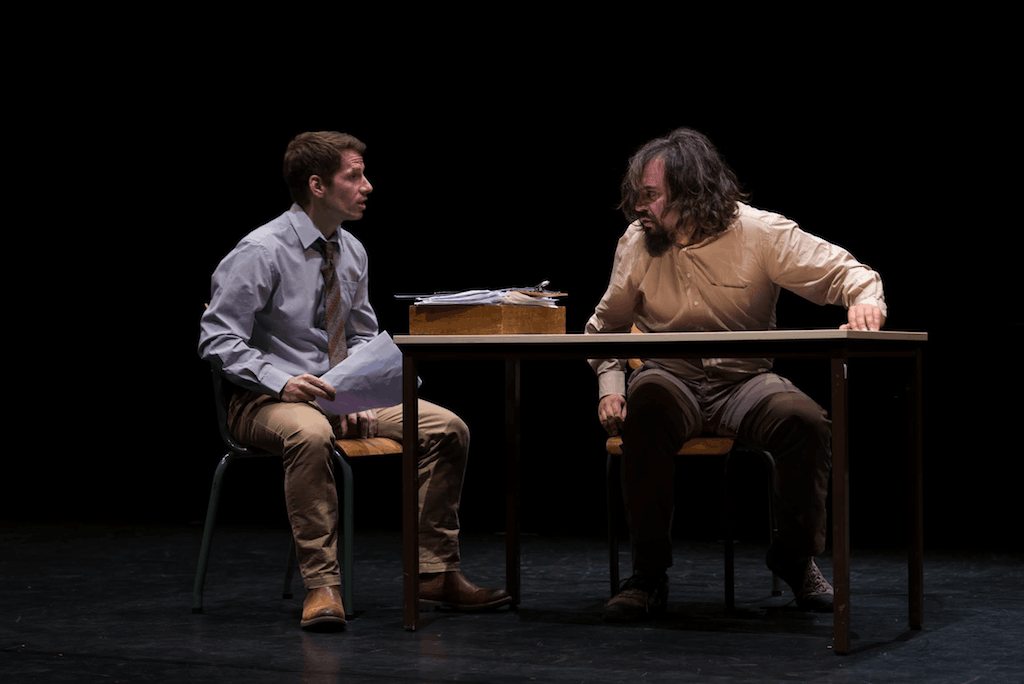
Much like the decoration and the cast, the play, with four main roles and three sets, does not gorge itself on unnecessary accessories: the action relies on dialogue and individual storytelling.
With less emphasis on physical action, body language and enunciation take the fore, at times soft and muffled, others drenched in anger and frustration.
It’s a deliberately dark framework, cradling even darker content. Covering themes of betrayal, the evils of the world, and children led astray, it is, quite literally, the stuff of fairy tales. In this regard, much of the focus of the play concerns the act of storytelling and individual responsibility.
Taken in for questioning
Enter Katurian Katurian (you read correctly), writer of stories. Born into a twisted home, he owes his talent to his parents’ “slightly peculiar” upbringing, a development that takes place to the mental and physical detriment of his brother, Michal. Following a number of killings that imitate the author’s very specific murder fantasies, Katurian and his brother Michal are arrested and taken in for questioning. As the play goes on and delves deeper into both the content and context of these stories, certain ethical questions are jumped upon the audience: who is responsible for the final deaths of the children?
With his very existence woven into the fabric of his work, Katurian argues for the significance of stories over life. Opposing this stance are officers Tupolski and Ariel, each struggling with their own personal histories, and Michal, who repeatedly challenges the world his brother paints for him. Tragically and blissfully detached from the real-time consequences of his actions, his remains the voice questioning the potential of Katurian’s influence, an influence that goes beyond literary legacies and into the depths of a rather macabre catalyst.
Emotional spectrum
Martin Campion’s success in the role of Michal relies on a comfortable ability to cross the emotional spectrum and to hit the tone of the moment: irony, comedy, or anger. However, it’s also his ease at the English language that facilitates the quality of his performance. And while d’Hérouël definitely impresses as Katurian, the intermittent inaccuracies sometimes take away from the power a certain word or expression can have.
Similarly, Ostretsova, and to a lesser extent, Hermans, divert from the momentum. Whether it’s a missed emphasis, a word swallowed or interrupted, it distracts from the flow of the play that relies completely on the act of storytelling. And in the end, it’s the stories that matter. They are numerous, horrifying and sometimes strangely comforting; fundamental to every character on and off stage. It’s evident throughout the play how important personal “his-story” is to the understanding and assessment of the stories in question.
The strong undercurrent of nihilism is consistent throughout with comedy that is both cleverly interspersed and gladly received. A delicately disturbing experience, “The Pillowman” excels at omitting the excessive while remaining simply gripping, a theatrical piece that definitely warrants watching.
New World Theatre Club Luxembourg’s “The Pillowman” continues its run at Mierscher Kulturhaus 6-9 October