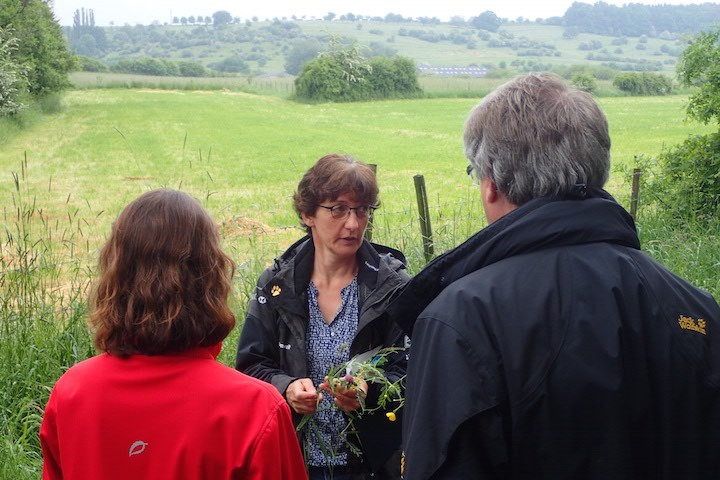
She explained the biodiversity in the area surrounding Oberanven, including the Aarnescht Nature Reserve, which is the oldest nature reserve in Luxembourg and an important site for habitat and birds in the Natura 2000 network.
Our tour started along the fields and between hedges of blackthorn, or sloe (Prunus spinosa). The use of fertilizers on the fields encourages the growth of thick and lush grass that crowds out the diversity of flora that would otherwise be present. SIAS works with farmers to encourage them to sign an agreement whereby the farmer is incentivised to not use fertilizer and to cut the field later in the season in order to increase biodiversity in the grasslands and to allow the flora to go to seed.

A fly orchid (Ophrys insectifera) found in the Aarnescht Nature Reserve. Photo: SIAS/Bee Together/Rafael Gonzalez
Further along our walk, we came across a mixed landscape with fields, hedgerows and old orchards that are favoured by birds such as the great grey shrike (Lanius excubitor), the red-backed shrike (Lanius collurio) and the little owl (Athene noctua).
Ten years ago there were 100 breeding pairs of shrike and two years ago only 10 were left. The exact cause of their decline is not yet known. The little owl needs pasture land grazed by domestic animals, such as cows, to find insects, its primary food source, and cavities in trees in which to nest.

A hornet orchid (Ophrys fuciflora) found in the Aarnescht Nature Reserve. Photo: SIAS/Bee Together/Rafael Gonzalez
We climbed up the hillock to find some black pine (Pinus nigra). The pine was imported about 100 years ago and planted in Luxembourg to use its lumber as support to the walls and roofs in the mines in Luxembourg.
With its nutrient poor soil, the area was rich with orchids and other flora. There are 36 species of orchid in Luxembourg, with 60% of them present on the site.

A common blue butterfly (Polyommatus icarus) found in the Aarnescht Nature Reserve. Photo: SIAS/Bee Together/Rafael Gonzalez
After a short descent, we arrived in the open, farmed fields, accompanied by pouring rain that stayed with us for the remaining 15 minute walk. With this inclement weather, three topics were skipped that nevertheless warrant our attention:
- Non-indigenous Asian hornet: The Asian hornet (Vespa velutina) is an invasive species that was first reported in France in 2006. In July 2015, it was reported in Lorraine, France. It poses a threat not only to our honeybees, but also to our wild pollinators. It should not be confused with our native European hornet (Vespa crabro). Page 2 of this flyer in German (PDF) shows the differences between the European hornet (Gewöhnliche Hornisse) and the Asian hornet (Asiatische Hornisse). If you identify the Asian hornet and/or its nest, please call +352 40 22 01 528 or email vespa@neobiota.lu.
- Non-endemic plants: Among other rivers in Luxembourg, the Syre river ecosystem suffers from the proliferation of non-endemic plants which is explained in this document and this one in German and French (PDFs).
- Pesticide-free plants and flowers: Starting in 2016, pesticide-free plants and flowers can be purchased from the organisations listed in the middle of this page.
Like these two solitary bee beauties (alfalfa leafcutter bee Megachile rotundata) sheltering in a bellflower (Campanula) in the photo below, out of the pouring rain and in the comfort of our own homes, we can enjoy the above reading!
During the summer months, Bee Together will be organising events to observe wild and solitary bees and to explain their lifecycle and what actions we can take to improve their sources of food and habitat (some of which are explained on our website). If you would like to be informed of these events, please register online.
John Park is a volunteer with Bee Together, an environmental preservation group in Luxembourg