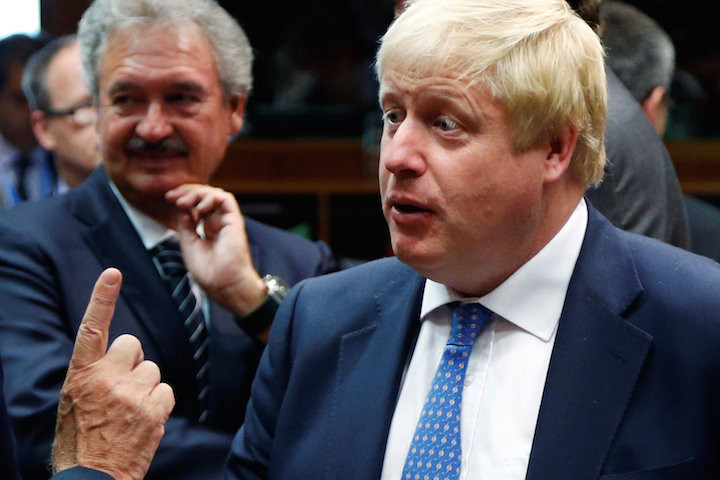
The mop-haired politician, who led last month’s referendum campaign to take Britain out of the European Union, was on his best behaviour at his first EU foreign ministers’ meeting.
“We have to give effect to the will of the people and leave the European Union, but that in no sense means that we are leaving Europe,” Britain’s newly minted foreign secretary said.

Britain’s foreign secretary, Boris Johnson, talks to the media as he arrives for an EU foreign ministers meeting in Brussels on 18 July 2016. Photo: REUTERS/Francois Lenoir
“We are not going to be in any way abandoning our leading role in European cooperation and participation of all kinds,” Johnson told reporters on arrival. He took no questions.
Ten hours later, he said on his way out that Britain wanted to see the EU develop and go forward, “and all we would say is that to make sure there are docking stations and doors for future UK involvement down the track”.
For most of the day Johnson, a Daily Telegraph journalist in Brussels in 1989-94 and longtime scourge of EU integration and regulation, was a man more talked-about than talking.
Pooled television pictures showed him chatting animatedly in a group with his Dutch, Belgian, Luxembourg, Spanish and Maltese counterparts before the meeting, occasionally stuffing his hands awkwardly into the jacket pockets of an ill-fitting suit.
The bigger beasts of the EU jungle avoided that huddle.

Jean-Marc Ayrault and Jean Asselborn, the French and Luxembourg foreign ministers, respectively, during EU foreign ministers meeting that took place in Brussels on 18 July 2016. Photo: European Council
French Foreign Minister Jean-Marc Ayrault, who had called Johnson a liar on his appointment last week, sat stony-faced in his seat while Germany’s Frank-Walter Steinmeier, who had branded the Leave campaigner irresponsible, looked away.
Johnson’s first words to the official session were in French to honour the victims of last Friday’s truck attack in Nice, switching to English to express sorrow and finishing with the French word “solidarite”, officials present said.
It fell to visiting U.S. Secretary of State John Kerry to give Johnson, who relished verbal jousts with then European Commission President Jacques Delors, a veiled lesson in the benefits of the EU.

John Kerry, the US secretary of state, speaking at press conference held during the EU foreign ministers meeting in Brussels, 18 July 2016. Photo: European Council
“I ask anyone who questions the importance of the EU or its relationship with the United States, (to consider) not just the history that I articulated, but the increase of prosperity, the rise in the standard of living ... the better protection of rights for individuals in the EU, as a consequence of what we have done together,” Kerry said.
NO APOLOGY
Asked if the former mayor of London had apologised for having compared the EU’s goals to those of Hitler and Napoleon during the referendum campaign, Ayrault said: “No he did not apologise ... Boris Johnson came to the council and behaved with a certain modesty.
“For me the essential thing is clarity, not making snide remarks or snap judgments. But what matters is the relationship that we’ll now have to construct between the EU and Britain,” the French minister said.
Steinmeier said Johnson had distinguished between “Europe” and “the EU”, and “tried to make clear the UK will still engage in conflicts like Syria even if it will leave the EU”.
The German minister dodged a question on the suitability of Johnson as foreign secretary, telling reporters: “This is a British decision that we don’t want to criticise... Boris Johnson... said today he was taking this task seriously.”

Jean Asselborn of Luxembourg, José Manuel García-Margallo of Spain, Didier Reynders of Belgium, Bert Koenders of the Netherlands, Boris Johnson of the UK, and George Vella of Malta during the EU foreign affairs ministers meeting in Brussels, 18 July 2016. Photo: European Council
One EU colleague had warm words for the newcomer. His Polish counterpart, whose conservative nationalist government has defied Brussels in a drive to shackle the constitutional court, said Johnson had made some “conciliatory gestures”.
“He was positive, asked a lot of questions as some of the terminology and procedures are new to him, but he was showing interest, was engaged,” Witold Waszczykowski said.
“At the same time he does have this easy-going style so that makes the meeting a bit more colourful.”
(Additional reporting by Manon Jacob and Tom Korkemeier; Writing by Paul Taylor; Editing by Pravin Char)