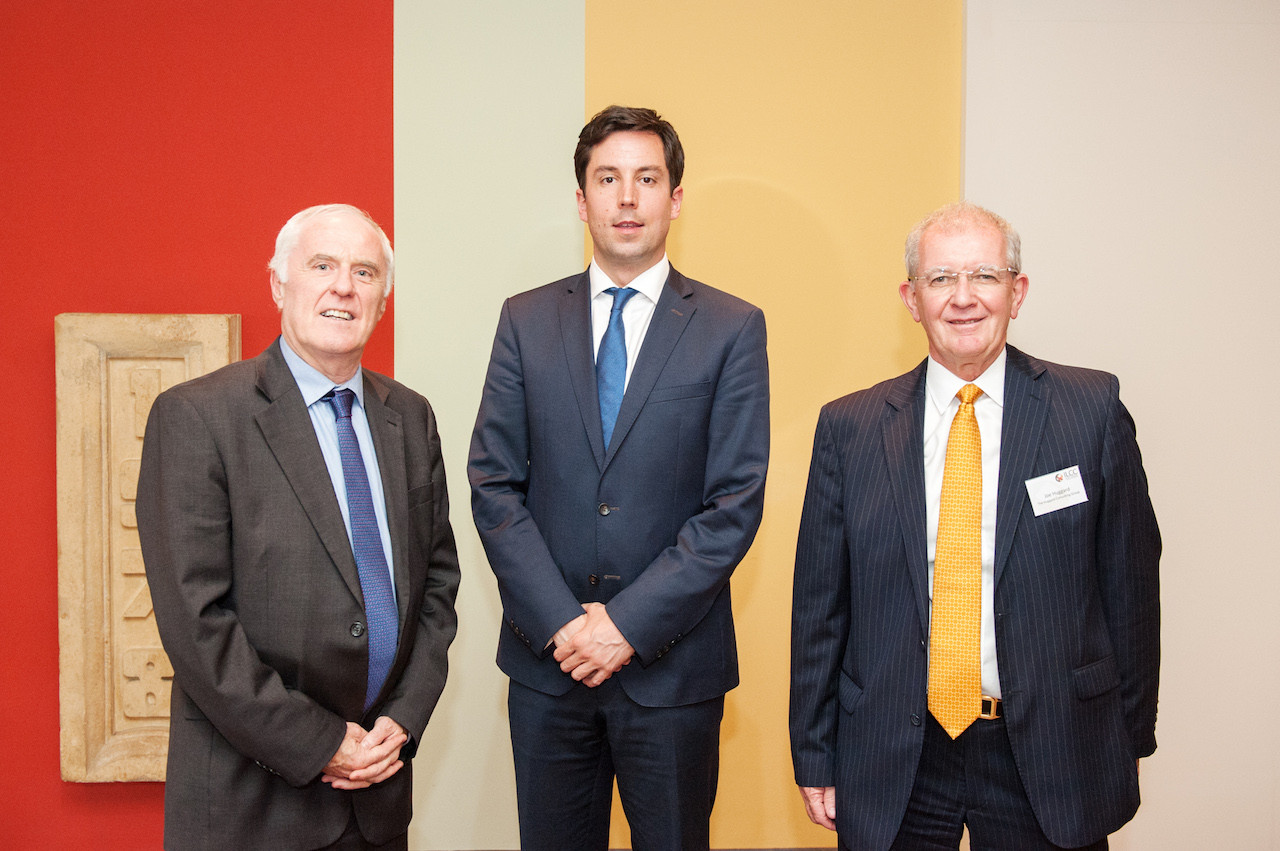
The relationship between Ireland and the United Kingdom was the subject of a large chunk of an address given to a gathering of the Irish Luxembourg Chamber of Commerce by Eoghan Murphy, whose official title is minister of state at the Irish Department of Finance, Public Expenditure and Reform, with special responsibility for financial services, e-government and public procurement.
Introduced by ILCC chairman Joe Huggard, who recalled the old saying that “if England sneezed, Ireland caught a cold”, the minister was keen to concur with the chairman’s assessment that Irish economic recovery since 2008 had been remarkable--even if Huggard also acknowledged that some social challenges still have to be faced. Murphy said that the recovery, which was down to good planning, was “real and robust”.
Just 34, Murphy was appointed to the Irish government some seven weeks ago, just before the UK referendum on remaining or leaving the European Union. He said it was truly fascinating to witness an event like Brexit and the media reports that it has generated. Noting how quickly the political landscape has been changing since the result was announced on 24 June, Murphy cited Lenin’s maxim that “there are decades in which nothing happens, and there are weeks in which decades happen.”
Contingency plans
Huggard said in his opening remarks that Ireland and Luxembourg are two small, open economies that are particularly vulnerable to headwinds caused by global events. Murphy acknowledged the similarities, but also talked about the close relationship between the UK and Ireland. He said that inside the European Union the two countries were complementary and worked well together to prevent a shift of power to one or two other countries.
“I think that was important for respecting the idea of a union of member states.” So, Murphy said, it would be an “understatement” to say that the Brexit result was not what Ireland wanted. He mentioned the significant amount of trade between the two countries, the common travel area and the fear that a hard border may return within Ireland as real concerns.
But even if the UK government and many of the Brexit campaigners seem to have been ill prepared for the leave result, Murphy explained that the Irish government actually had in place contingency plans for a Brexit vote, including analysis of the impact on GDP, plans to ensure liquidity and the setting up of what he called a “rainy day” fund to protect the economy as of 2018. Even ratings agencies were saying that “Ireland can withstand this Brexit crisis,” Murphy explained.
Furthermore, the government was spreading the message to countries further afield that Ireland is remaining in the EU, while inside Ireland the message was to remain calm. But while Murphy said that Ireland was seeking to maintain good relations with the UK, it would not pass up opportunities, where they make sense, to take advantage of changes in the financial services sector.