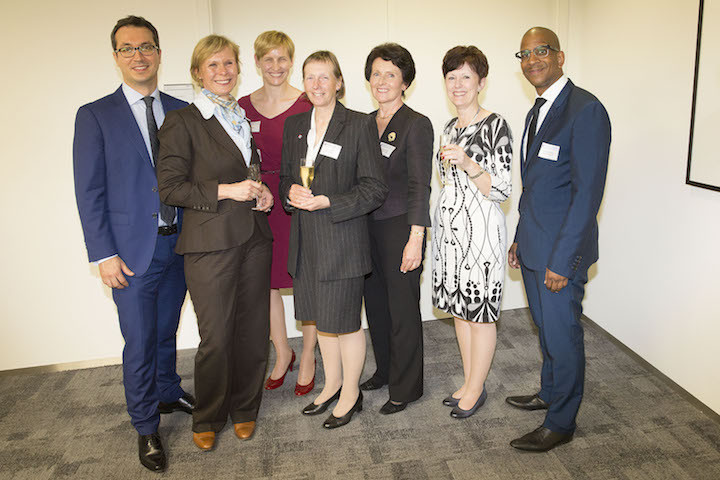
On Tuesday, the British Chamber of Commerce held their latest HR event which focused on unconscious bias (UB). This impacts diversity in the workplace and is a key issue for many organisations today. It was always going to be a challenge to cover UB in two hours but judging from the energy at the end of the evening, the chamber pulled it off.
Sarah Battey, a coach and trainer in positive psychology, began with a confession: that she was biased; that we were all biased (take a test here) and because biases are mostly unconscious, we needed to approach this by educating not blaming, to find ways to mitigate negative effects.
In an engaging presentation, she explained some of the main UBs and said: “the business case for diversity is simple: diversity at every level in the organisation leads to increased perspective-taking, reducing the effects of “groupthink” and leading to more innovation and creativity”.
Three workshops followed with other expert coaches and trainers: on hiring, moderated by Claudia Neumeister; talent development, by Jill Saville; and on leadership, by Yvonne O’Reilly.
Neumeister observed: “UB sets in a lot earlier than the face to face interview and a wrongly worded job description can quickly exclude some candidates. As decisions are made by different people in different stages of the hiring process, there is a complex set of biases which needs to be addressed.” The participants of her workshop agreed that excellence and diversity are not mutually exclusive.
In our careers, UBs appear daily, from who is asked their opinion in a meeting to who gets promoted, producing an imbalanced top team. Saville said: “As individuals are unable to recognise they are biased in that moment, organisations must develop systems to mitigate the effect. One interesting discussion we had was how the similarity bias has produced whole teams of one nationality in some businesses”.
Leadership was by far the most popular discussion and O’Reilly noted: “It is clear that UB plays a role in holding leadership back, not just at an individual level but also at an organisational level so we looked at UB from both perspectives. One common theme was that there was a clear gap between the ‘talk and walk’ of some of the leaders today”.
As usual, people enjoyed the interactive nature of the event, the exchange of ideas and were very complimentary about the standard of the speakers. One participant mentioned that he had imagined that an hour would be a long time on this topic, but in fact it flew by! Everyone appreciated coming together at the end to share information with the whole group.
It seems that our biases are deeply ingrained and the path to increased inclusion will be a long one. However, on a positive note, Battey expressed the hope that when her 6 year old daughter is building her own career she will have the same opportunities as her two brothers.
Jill Saville is a Luxembourg-based executive coach and leadership trainer, and a member of the British Chamber of Commerce for Luxembourg’s board.