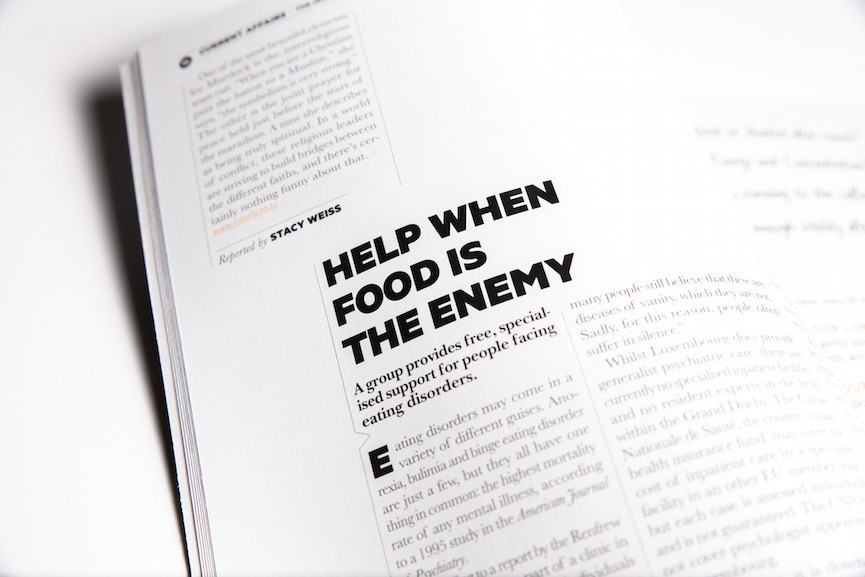
Eating disorders may come in a variety of different guises. Anorexia, bulimia and binge eating disorder are just a few, but they all have one thing in common: the highest mortality rate of any mental illness, according to a 1995 study in the American Journal of Psychiatry.
According to a report by the Renfrew Center Foundation, part of a clinic in Philadelphia, up to 70m individuals worldwide are affected by an eating disorder at sometime during their lifetime. Whilst there are no precise figures currently available for Luxembourg, if the 70m figure was extrapolated, it would mean that approximately 8,000 people in the Grand Duchy have or will live with an eating disorder.
“There is still a lot of stigmatism regarding eating disorders in society,” says Anna (like all the patients quoted in this article, it is not her real name). She has suffered from bulimia for much of her adult life. “Eating disorders are not about the desire to be thin and many people still believe that these are diseases of vanity, which they are not. Sadly, for this reason, people often suffer in silence.”
Whilst Luxembourg does provide generalist psychiatric care, there are currently no specialised inpatient facilities and no resident experts in the field within the Grand Duchy. The Caisse Nationale de Santé, the country’s main health insurance fund, may cover the cost of inpatient care in a specialist facility in an other EU member state, but each case is assessed individually and is not guaranteed. The CNS does not cover psychologist appointments in Luxembourg.
“Sometimes, it is down to how knowledgeable your own doctor is,” states Sarah, a recovering anorexic. “At one point I was 170cm tall and weighed only 40kg, but I was told by my doctor that this was fine. Evidently it would be beneficial if medical professionals in Luxembourg had a clear understanding of what constitutes an eating disorder.”
Luxembourg may not have any specialist care for those affected, but the local branch of Anorexics and Bulimics Anonymous provides individuals with a free support network for anyone who wishes to recover healthy eating practices. “There are no fees at ABA,” explains Florence, who helps to coordinate the group. “Nor are we affiliated with any other organisation, institution or religion. It is a completely confidential group open to anyone who wants to recover.”
"The most important thing I learnt in ABA… is that I am not alone and that there is hope."
Florence
ABA was founded in Alberta, Canada, in 1993 by three women. They took the same, twelve-step programme used by Alcoholics Anonymous and adapted it to address the specific mental, emotional and spiritual components of eating disorders.
“Many people who identify themselves with an eating disorder have found recovery through the programme.”
For Florence, the group has been key to her own recovery. “The most important thing I learnt in ABA from the beginning is that I am not alone and that there is hope. The suggestion we make to newcomers after the meeting is to keep coming back.”
Anorexics and Bulimics Anonymous Luxembourg meets every Friday evening. Meetings are held in English, but translation in French and German is available.