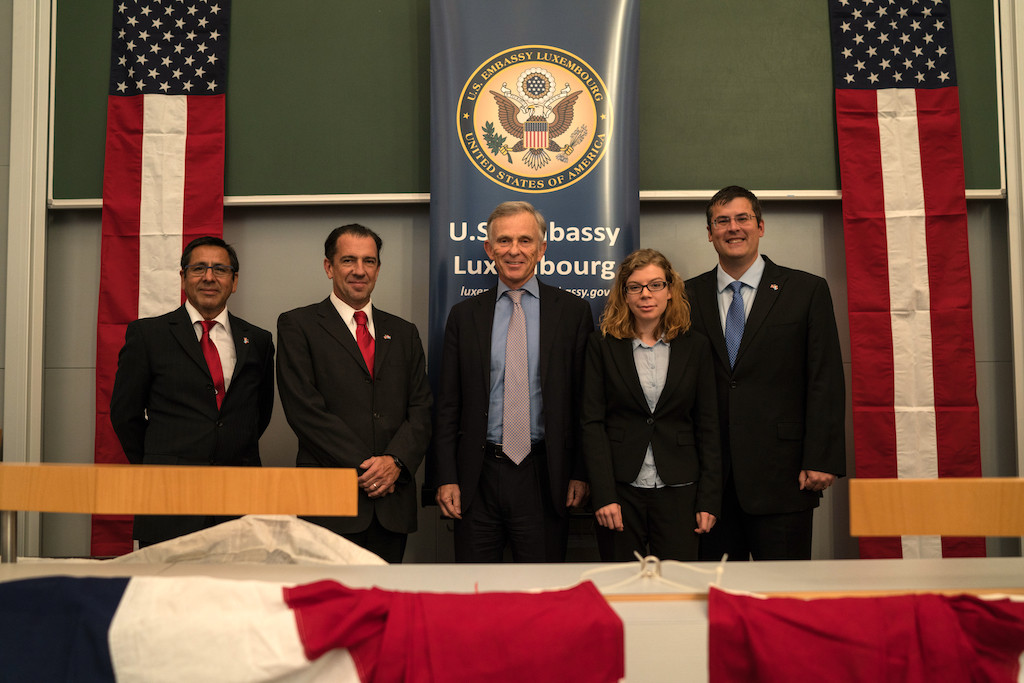
Organised in association with the Democrats Abroad Luxembourg and Republicans Overseas Luxembourg, the debate was moderated by US Ambassador to Luxembourg, David McKean. In his opening remarks, the ambassador briefly looked ahead at the hype surrounding the first presidential debate between Donald Trump and Hillary Clinton on Monday 26 September. He predicted that the candidates would spend much time insulting each other and questioning the other’s fitness for office. “What I don’t think they’ll do enough of, but what I hope we will do tonight, is to discuss the issues…This debate will be about substance. Imagine that.”
McKean’s questions to the four panellists--Democrats Will Bakker and Eva Moynihan and Republicans James O’Neal and William Abundes--were specific and often detailed and included some submitted by the audience ahead of the debate. They covered some of the key issues that the two candidates have addressed in their campaigns, from immigration and terrorism to the economy, race relations and gun control.
Immigration
While the ambassador had said he did not expect the panellists to channel the candidates, some of the answers provided could not fail but to parrot the stated policy plans of Clinton and Trump. Bakker and Moynihan, for example, extolled the cultural virtues and economic benefits of continuing president Obama’s immigration policy and attracting some of the best talent from around the world to America. O’Neal and Abundes criticised Obama for failing to change immigration law and said that the president was allowing dangerous criminals to be released back into the country, but also said that Trump was all in favour of legal immigration. However, the Democrats were quick to point out that immigration contributed around 3.5% to the economy and criticised Trump’s plans to halt the H1B visa programme that allows specialist talent to be employed. And on the most contentious issue, Trump’s plan to build a wall on the US-Mexico border and getting the Mexicans to pay for it, O’Neal admitted he had not yet heard details of how Trump would force the Mexicans to pay for the wall, he said it was high on his priority and added that the wall would also help curb the heroin epidemic that currently blights the US.
Race and gun control
Unsurprisingly, the panellists failed to agree on the question of whether race relations in the US had improved or declined during Obama’s presidency, and were passionately divided on the merits or faults of the Black Lives Matter movement. And the issue of gun control also elicited fervent arguments on both sides, with Moynihan arguing for an improvement to the background checks system and questioning whether individuals should be allowed to own military assault weapons. The Republicans said that the right to bear arms did not specify what type of gun citizens could own and that it included the right to oppose government oppression—Abundes cited the Waco siege as evidence that citizens should be allowed military style assault weapons to defend themselves against the government. He also argued that if teachers were allowed to carry guns, fewer incidents like the Sandy Hook school massacre would happen.
The economy
On the economy, which was what once mattered most in US elections, James O’Neal pointed to Trump’s three key policy promise to help “unleash economy”, namely cutting taxes to encourage investment, loosening up regulation, and renegotiating trade deals. “Trump is saying let’s open up the economy and restore entrepreneurial spirit. If Mr. Trump is elected president, the economy is going to boom.” For the Democrats, Moynihan argued that what businesses need to prosper is a predictable regulatory environment and expressed concern that Trump and his vice-presidential candidate Mike Pence had quite opposing views on economic policies. “Pence is all for free trade, and considering he is supposed to be the policy wonk we have no idea what the policy will be.” Bakker said that the recovery under president Obama had restored the economy to levels that he inherited, and added that he was pleased to see that both Clinton and Trump have said they want to spend money on infrastructure.
Conclusions
Closing the debate, Bakker said he was shocked that the Republican representatives had been completely captured by right wing media like Breitbart, The Drudge Report and the radical fringe of AM radio. “We need a reasonable, thoughtful opposition to the Democratic Party in the United States…I want to trade ideas and argue about principles and whether they lead to shared goals for the public good. But we’re not doing that this year.” Moynihan argued that Trump is “a big government Republican who seems to respect none of the conservative values, or holding up our alliances around the work which is what makes America a superpower.”
James O’Neal concluded that the most important factor was the economy. “Unleash the economy. Trump is a businessman and he has a vision for making America boom again, just as it did under Regan and JFK.” As for alliances, he cited Obama’s support for the Muslim brotherhood and his abandonment of allies in the Middle East. “Trump is all in favour of keeping our alliances, but we are 20 trillion dollars in debt, folks. We are broke. If we are going to have world police status, we are going to need some co-pay from our allies.” Abundes said he wanted more spending on the military and also more support for veterans.
Peaceful transition
McKean wrapped up proceedings by reminding the audience that freedom of expression is a cornerstone of civil society in the United States. “No matter who wins the election, the American people will accept the outcome. The reigns of power will pass peacefully from one president to another. There are very few countries in the world where this happens. In the end, the greatness of our country has less to do with individual leaders than with its institutions, and thanks to genius of our founding fathers, those institutions have stood the test of time.”
More debates
A second debate is scheduled to take place on 20 October, details of which will be announced on this website. Meanwhile, on Wednesday 28 September American journalist, best-selling author, and television producer Jonathan Alter and Michael Meehan, President & CEO of Squared Communications, will talk on the subject of “Clinton versus Trump: Perspectives on the 2016 US Presidential Campaign and Election”. This event starts at 6 p.m. with opening remarks by David McKean. Again, advance reservation is required and can be made via email to: LuxembourgRSVP@state.gov