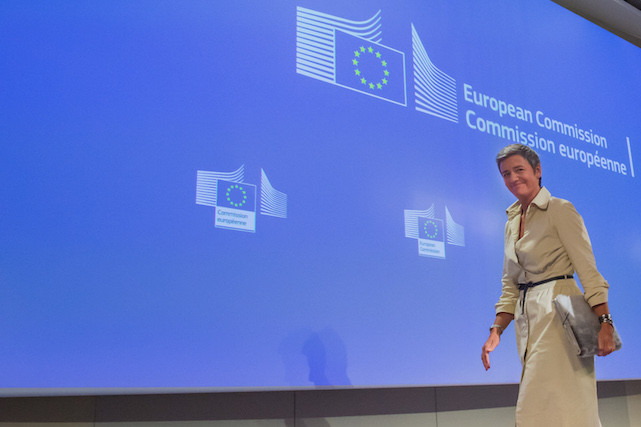
So wrote Margrethe Vestager, the European competition commission, on her Twitter feed Wednesday at 12noon Brussels time.
An EU source had previously told Reuters news agency the figure would be €1bn.
The commission started investigating the tax arrangements between Dublin and the American electronics giant in 2014. In a press release on Wednesday, the commission said that a pair of tax rulings issued in 1991: “endorsed a way to establish the taxable profits for two Irish incorporated companies of the Apple group (Apple Sales International and Apple Operations Europe), which did not correspond to economic reality”.
“The commission’s assessment showed that these ‘head offices’ existed only on paper and could not have generated such profits”, according to the statement.
Ireland has one of the lowest corporate tax rates in the world, according to studies by the consultancy KPMG and OECD thinktank.
“I disagree profoundly with the commission’s decision,” Ireland’s finance minister said in a statement. “Our tax system is founded on the strict application of the law”, Michael Noonan commented shortly after Vestager’s press conference.
“The decision leaves me with no choice but to seek cabinet approval to appeal the decision before the European courts. This is necessary to defend the integrity of our tax system; to provide tax certainty to business; and to challenge the encroachment of EU state aid rules into the sovereign member state competence of taxation,” stated Noonen.
In a statement to Politico, Apple said it too would contest the commission’s decision, was “confident the decision will be overturned”.
“We never asked for, nor did we receive, any special deals,” Tim Cook, Apple CEO’s, wrote in a “customer letter” posted on the company’s website on Wednesday. “We now find ourselves in the unusual position of being ordered to retroactively pay additional taxes to a government that says we don’t owe them any more than we’ve already paid.”
Cook also noted that Apple opened its facility in Cork, Ireland, in 1980, with 60 employees; and “today we employ nearly 6,000 people across Ireland.”
The amount in back taxes represents less than a quarter of the firm’s net income last year.
Apple reported net income of $13.6bn (about €12.2bn) for the second fiscal quarter of 2016, which ended on 26 March 2016). For the 2015 fiscal year, it reported net income of $53.4bn (around €47.8bn).