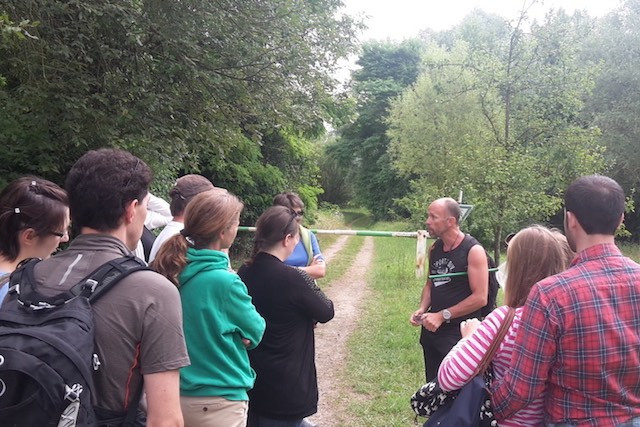
Many other insects intervene in this very important process. This is part of the things we learned on Sunday 31 July, walking among the ponds at the nature reserve Haff Réimech.
Before our arrival, Fernand Feitz from the natur&ëmwelt Remich section, our guide for the afternoon, had captured different types of insects in empty plastic bottles so that we could have a very close look at them; of course, he freed them afterwards!
Pollination, a complex process
We discovered several different types of solitary bees and wasps, some of them very small. They are not to be feared; their stinger is so small that it can’t go through human skin. Therefore, we should not kill them when we see them or find their nest, because there are fewer and fewer of them, and they play an important role in pollination. So do other insects such as the enormous Longhorn beetle (Aromia moschata) found by Fernand, a variety quite rare nowadays.

Fernand Feitz of the natur&ëmwelt Remich Section uses a net to collect insects during a tour of the Haff Réimech nature reserve on 31 July 2016. Photo: Bee Together/Vladi Yankova
Each type of insect is responsible for the pollination of a particular type of flower. After spending years observing them, Fernand knows exactly on which flower he will find what kind of pollinators.
Wild flowers are actually a better source of nutriments for pollinators than the flowers we usually plant in our gardens. In order to have flowers that are more beautiful, humans created new species that have fewer stamens and, therefore, less pollen. That is why it’s important to have some ancient varieties of flowers and wild flowers in our garden, in addition to avoiding the use of pesticides.

European hoverfly (Eristalis pertinax) on Queen Anne’s lace (Daucus carota) as seen during a tour of the Haff Réimech nature reserve on 31 July 2016. Photo: Bee Together/Lauranne Chavel
We took a walk around the ponds looking for other insects. Unfortunately, the weather changed and the insects disappeared along with the sun. They fear the rain, especially the ones with wings because they can’t fly if they get wet, so they go home when it gets too cloudy.
Observing nature
Fernand took us to an observatory, a little house with a view upon one of the ponds. Through binoculars, we were able to watch the birds. Swans, cormorants, kingfishers, great crested grebes, and different types of ducks cohabit there. They all have their own space and they all participate in the local biodiversity in their way.
Near another pond, a wall has been created as a nesting location to welcome wild bees and sand martins. They both create their nests in holes preferably situated on cliffs to avoid predators.

A dragonfly (Aeshna) as seen during a tour of the Haff Réimech nature reserve on 31 July 2016. Photo: natur&ëmwelt/Fernand Feitz
If wild bees can survive by living closer to the ground, sand martins need a very specific environment for their nests. It has become really hard for them to find cliffs to live in, especially in a country like Luxembourg. Thanks to the work that has been done in Remerschen, they can survive.
At the end of the afternoon, the sun returned. And, as Fernand had promised, nature swarmed again with insects. We could see them everywhere: on every flower, flying around us…. Being attentive to our surroundings, our eyes caught a giant dragonfly--so big that we actually understood where their name comes from--hooked in a tree. It was grey and was camouflaged with the colour of the branches.

A visit of the Haff Réimech nature reserve, located between Remich and Schengen, which was organised by the environmental groups Bee Together and natur&ëmwelt on 31 July 2016. Photo: Bee Together/Lauranne Chavel
Fernand caught it with his net, and then held it between his fingers. From grey, the dragonfly started to get green and blue. It seemed completely magical and was a wonderful thing to witness. Our dragonfly had probably just hatched; it had to dry in the sun to get its beautiful colours and to be able to fly.
Lauranne Chavel is a volunteer with Bee Together, an environmental preservation group in Luxembourg. In the coming weeks, Bee Together will be organising events to observe wild and solitary bees and to explain their lifecycle and what actions can be taken to improve their sources of food and habitat. For more details, register for the group’s email list online.