Marc Thiel, our guide, on a warm and only slightly overcast Sunday 10 July, shared his wisdom on these mysterious little creatures that are so important to our environment, but sadly the populations of which are rapidly declining. All 21 species of bat native to Luxembourg are under protection.
This led us nicely to the next stop on our biodiversity walk, an orchard nestled between the village and the countryside, providing the perfect food source, especially if combined with cattle grazing, to attract insects for these charming furry little creatures. Marc described the essential work for the environment that is carried out by an organisation of which he is a part, Naturpark Mëllerdall (NPM).

A picture taken during the biodiversity walk organised by Naturpark Mëllerdall and Bee Together around the village of Bech on 10 July. Photo: NPM/Bee Together
One of the projects that they have adopted is to reintroduce a variety of fruit trees back into the landscape to, at least, maintain the diversity that is left. It is estimated that varieties of trees have declined from over a million to just over 200,000 in half a century.
Given the interrelations between flora and fauna perhaps we haven’t yet fully experienced the impact that this will have on our environment. The topography in Bech, with its undulating landscape, lends itself particularly well to orchards. Government programmes exist to encourage farmers to use this land to graph heirloom fruit trees rather than plant crops and to avoid using fertilisers and herbicides.
Fertiliser and herbicides
The avoidance of fertiliser and herbicides is of particular importance in Bech; rain water drains off the porous sandstone area until it reaches the impermeable clay ground, providing a natural source of drinking water. However, the use of fertiliser and herbicides on crops contaminates the water, making it unfit for drinking, obliging the commune to buy water from other regions.
Herbicides also impact plants that are native to the area. Marc pointed out the only field left in Luxembourg where the bright violet crop flower larkspur (Delphinium consolida) can be found!

A little owl (Athene noctua) photographed by Marc Thiel of Naturpark Mëllerdall
Reaching the top of the hill overlooking a field of cherry and plum trees is home to the little owl (Athene noctua). This beautiful little creature is unfortunately also in decline due to loss of habitat and farming practices. NPM, in an effort to conserve these species, identifies nests and introduces boxes in favourable environments to encourage breeding.
Speaking of conservationism, Marc, I discovered, is a bit of a rarity himself in that he studied agricultural science in Luxembourg and environmental studies in Germany, giving him the unique position of understanding the concerns of the farming community and the threat that biologists identify by certain practices.
This understanding is essential when collaborating with the various parties involved to conserve our ever-dwindling biodiversity.
There was a welcome stop at the Maison Jäger, where we were warmly greeted by its manager, André Speicher, with refreshments, before making the final descent through the woods back to Bech.

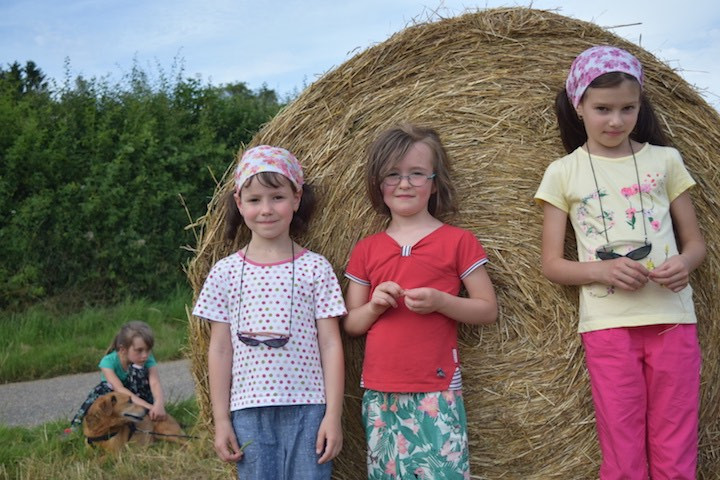
Participants in the biodiversity walk organised by Naturpark Mëllerdall and Bee Together around the village of Bech on 10 July. Photo: NPM/Bee Together
As the sun went down, the children were still playing on the newly bailed hay, and one could not help but wonder whether our beautiful surroundings with these nocturnal creatures will not be the stuff of myth for future generations. On a positive note, participants in the event were able to contribute to donations to purchase heirloom fruit trees for the orchard being coordinated by NPM.
Upcoming events
During the summer months, Bee Together will be organising events to observe wild and solitary bees and to explain their lifecycle and what actions we can take to improve their sources of food and habitat (some of which are explained in our brochure).
The first event will be held on 31 July from 2:30pm to 4:30pm in the Wintrange area.
Cathy Walshe is a volunteer with Bee Together, an environmental preservation group in Luxembourg