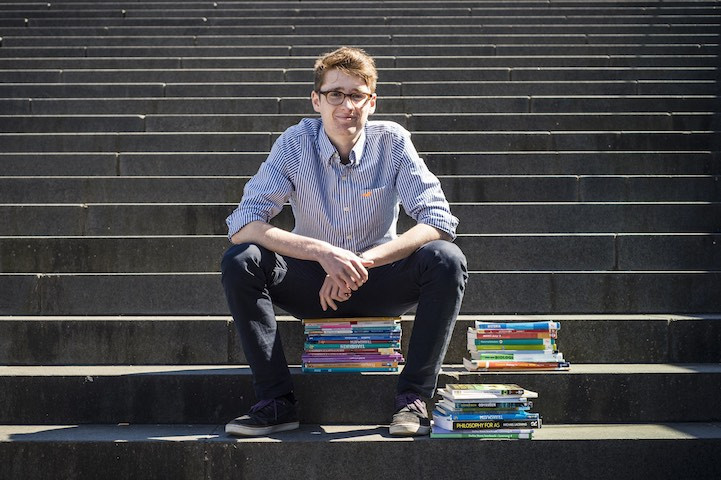
Nuri Moseinco says of his part-time startup: “It was more of a friend’s idea.” He and his pal--then students at the European School Luxembourg, in Kirchberg--“were complaining” about the lack of used schoolbook options in the Grand Duchy “and he mentioned that ‘there should be a website’”. After thinking it over, Moseinco launched Eurobooks, now in its third year.
The idea is deceivingly simple. At the end of the school year, students and their families drop off used textbooks (and calculators) on consignment. “You can come by my shop, which is my living room, really, and I store all the books there for the whole summer holidays. Then at the end of the year, you can come pick up the books which weren’t sold, and pick up the money for the books which we did sell,” he explains.
At the same time, shoppers “can buy their books online. During checkout they select a pick up date on which they can come pick up their order at my place. Otherwise, people can just come during the opening times and buy books on the spot.”
Eurobooks is not affiliated with the European schools, but “they have helped me many times”. He receives copies of the official book lists that are released in June for the autumn term, checks titles against the publisher’s official website, and then “I take a percentage off of that,” says Moseinco, who was born and raised in Luxembourg and holds a Belgian passport.
“I took a lot of time to find the best balance, pricewise, to find something that is not too expensive to buy secondhand, but is not too cheap that you don’t get any money back from selling it.”
Naturally he keeps a small margin, which is “not much at all, really. I’m not really doing this for money. Obviously money’s great to have, but if I [only] wanted money, I could have gotten a summer job for a couple months and gotten paid five times as much” as he makes running Eurobooks, states Moseinco, who just finished his second year studying film in London.
Word of mouth
Out of the 15 different language groups at the Bertrange and Kirchberg campuses, “I do notice that there are some sections that are much more popular than some. I’m not really sure why that is. For example, the Dutch speaking section, they are quite into using Eurobooks. Maybe it’s because I was in the Dutch section, so I got access to people more easily.”
He likewise has a loyal following among Swedes, following a positive review from members of the Swedish women’s club. “The Swedish community is relatively small in Luxembourg, so I guess news travelled fast.”
The English, French and German sections are also “quite popular,” “but then you’ve got sections like the Hungarian section that’s very small, so then it’s very difficult to be able to sell things,” he explains. “If two or three students [enrolled in each year] don’t sell their books, then it’s end of story; there’s no books to sell.”
He hopes the virtuous circle continues to grow. “The European schools have about 4,000 students, so if all of them sold their books, there’d be more books to sell, so there’d be more books for other students to buy,” Moseinco reckons.
“I hate telling people, ‘I’ve got this one, but I don’t have this one, I’m really sorry’. I’d love to be able to have every book for everybody but unfortunately that’s not always the case.”
Eurobooks, in Uebersyren, will be open most Wednesdays and Sundays between 5 p.m. and 8 p.m. through the beginning of September.
This article was first published in the Summer 2016 issue of Delano magazine. Be the first to read Delano articles on paper before they’re posted online, plus read exclusive features and interviews that only appear in the print edition, by subscribing online.
CORRECTION: A previous version of this article incorrectly stated that Moseinco had just finished his first year at university; he recently completed his second. The opening times were also updated.