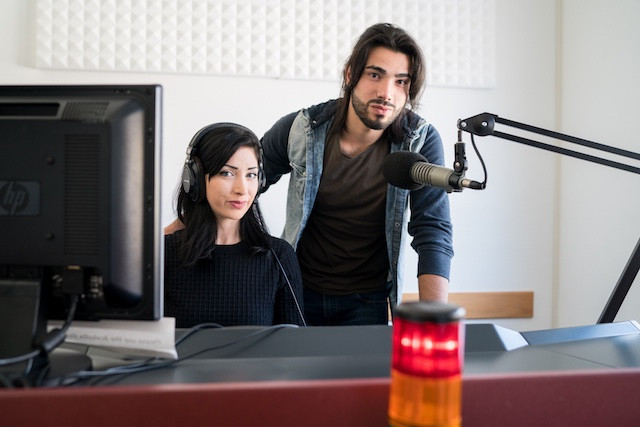
“Salam”, broadcast on Graffiti (Ara Radio’s youth programming), is the first Arabic and English radio show in the Grand Duchy. Its aim is to help Arabic speaking newcomers, predominantly asylum seekers, integrate into life in Luxembourg whilst also sharing Arabic culture and heritage with the local population.
Lama Alogli, a Syrian national studying at the University of Luxembourg, came up with the idea of a radio show to help the two societies integrate. “I thought it was important to explain in Arabic how things work in Luxembourg, the rules and processes,” she explained. “At the same time, I wanted to share Syrian and Iraqi culture with the local population so they know more about our countries’ rich heritage.”
In order to fund the project and buy necessary equipment, Alogli approached a major foundation, the Œuvre Nationale de Secours Grande-Duchesse Charlotte, and was awarded the money needed to launch the programme in September. In fact, Salam was recently selected as one of ten of the charity’s initiatives to be formally presented to the grand duke and prime minister.
Ehab Ghandour, originally from Damascus, co-hosts the show with Alogli. A former teacher, he traveled across six countries to find asylum in Luxembourg. “I think many people associate Syrian society with negative images like war and terrorism, but Syria has a very diverse ethnicity and history. Damascus, for example, is widely known as one of the oldest continually inhabited cities in the world, even older than Jerusalem. It is important to share this information and provide a fuller picture of our society.”
In addition to providing news and cultural information, the Salam show interviews local organisations that offer assistance to asylum seekers. “So far we have interviewed members of Asti, Amnesty International and Hariko,” says Alogli. “However, we have also approached politicians and members of the civil service, such as the Adem [jobs bureau], who can provide important information to newcomers.”
Amidst the discussions on culture and news, “Salam” plays an eclectic range of Arabic music. “We play different types of Arabic music to represent our broad society and all the different dialects,” she explains. “Some of the music is based on the traditional Arabic nasheeds, which are a form of poetry or story telling in our culture,” adds Ghandour. “However, we also play more popular music, even though we are yet to play Fairuz, one of the most popular Arabic singers.”
Although at the time of publication “Salam” is still in its infancy, its popularity is growing. “I have had many Luxembourgish people contact me to say how much they like the show and the music,” says Alogli. “They are welcome to contact us either through the studio, our website or our Facebook page to ask questions or make suggestions.” Likewise, she and Ghandour encourage asylum seekers and refugees to use the website to propose questions and subjects about living in Luxembourg that they would like to know the answer to. “We are here to exchange information and bridge the gap between our societies, so that we can live and work together in peace,” he states.
“There has been a lot of negative press regarding asylum seekers recently,” Alogli points out. “However, that is not the purpose of our show. The show aims to combine our societies together so that we can live together in peace, hence the title… Salam!”
This article was first published in the October 2016 issue of Delano magazine. Be the first to read Delano articles on paper before they’re posted online, plus read exclusive features and interviews that only appear in the print edition, by subscribing online.