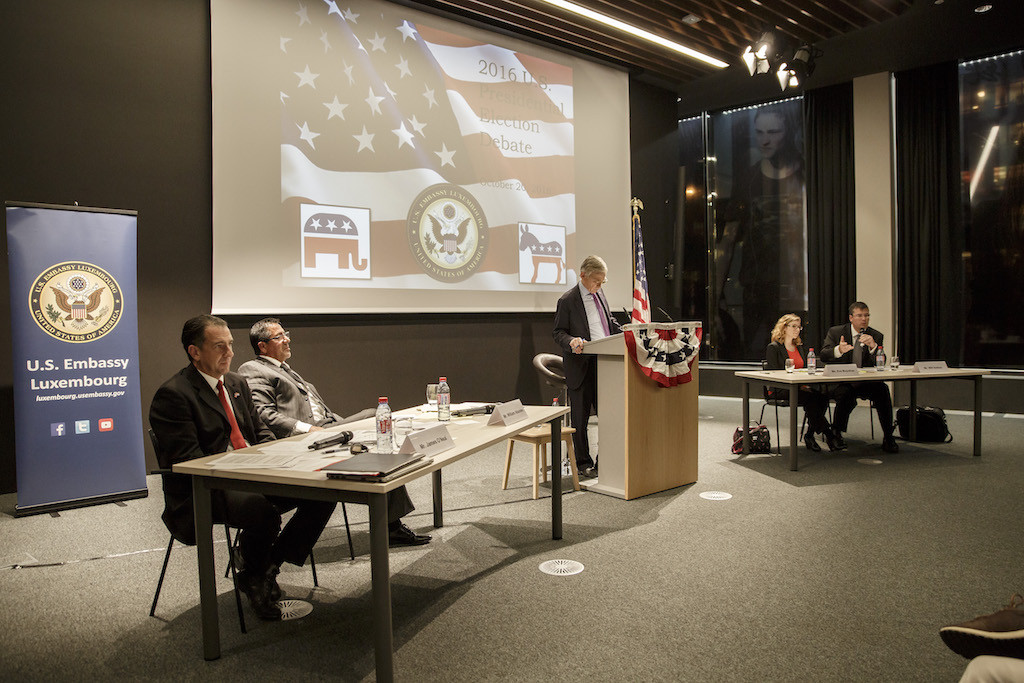
Billed as the “2016 U.S. Presidential Election Debate - Second Round”, the event at the headquarters of Arendt & Medernach in Kirchberg was attended by over 200 guests, including a number of ambassadors to Luxembourg, local politicians and students.
Following a welcome address by Marc Elvinger, partner at Arendt & Medernach, and an introduction by the embassy’s public affairs officer Daniel Pattarini, ambassador David McKean explained the rules of engagement for the debate. The ambassador reflected on his assertion from the first debate, held in September, that the 2016 presidential election campaign would rapidly evolve into a very nasty affair with the candidates insulting each other and questioning each other’s fitness for office had come true. “I predicted that there would bot be an especially robust discussion of the issues. Unfortunately, I have proven to be correct, although I am not sure it was a particularly difficult predication to make.”
What followed was an attempt, as the first debate in Luxembourg had been, to redress that balance and to discuss in as much detail as possible given the time constraints, the major issues facing the United States as it goes to the polls on 8 November. The four panellists were the same representatives as in the first debate in September--Will Bakker and Eva Moynihan from Democrats Abroad Luxembourg and James O’Neal and William Abundes from Republicans Overseas Luxembourg.
McKean, who was involved in the campaign of Democratic candidate John Kerry in 2004 (for whom he served as chief of staff between 1999 and 2008), once again managed to be well-balanced in his questions to the panellists. He grilled Bakker and Moynihan on the email scandal surrounding Hillary Clinton with the same vigour with which he pressed O’Neal and Abundes on the furore over Donald Trump’s attitude to women.
Although the ambassador did focus many of his questions on the presidential candidates’ policy stands--from the economy to foreign affairs and the question of how they would unite the country--there was no getting away from the question of the fitness to serve of the two candidates. Statements in support of their candidate, or more frequently against the character of their opponents’ candidate, sparked an unprecedented number of diversions and rebuttals from the panellists as the debate became more and more heated.
Eventually the debate did return to the salient points. Asked to deliver closing statements, O’Neal said that the most important thing on Americans’ minds is the economy and jobs. “Secretary Clinton’s economic plan, she’s even said so herself, is a modified version of president Obama’s plan. Stimulation, increased taxes, increased government spending, not a word about reducing corporate taxes. The United States is supposed to be the home for business, yet we have the highest corporate tax rate in the world…you’re not gong to create jobs by, as Mr. Trump puts it, choking on taxes.” America needs to reduce tax rates and renegotiate trade deals, O’Neal argued. “We need to make America prosperous again. Mr. Trump, despite all his character defects, that will happen if he is elected president.”
But Bakker countered that Trump’s tax cut plans would chiefly benefit the top one percent. “Secretary Clinton thinks that we should have a tax scheme that gives everybody what they need to succeed. She believes that out of 325 million people there are a whole lot more who could contribute a whole lot more to the American economy if we give them a hand up.”