A truck dumping soil in front of the Chamber of Deputies is the striking image used by construction industry groups in an ad published in the national media to put construction waste management in the spotlight.
“The aim of this publication is indeed to show how fed up companies are with this problem, which has been going on for years now and which got worse at the beginning of 2022,” says Pol Faber, secretary general of the Groupement des entreprises, which created and placed the ads together with the Fédération des entreprises de construction et de génie civil.
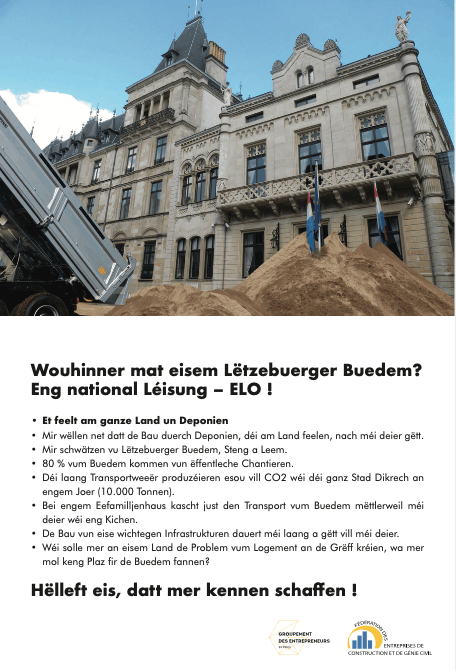
The Groupement des entreprises and the Fédération des entreprises de construction et de génie civil have signed the publication. (Image: DR)
Luxembourg's landfills for construction waste are beginning to be saturated. Long queues of lorries are forming at their access points, causing companies to lose precious time and money. The problem is also environmental, as trucks from a construction site in the south of the country have to travel about 80 kilometres to a landfill in the north. As the network of landfills is not adapted to the geographical density of building sites, industry groups estimate that the level of CO2 emissions emitted by the trucks simply delivering to the landfill sites is equivalent to that produced by a town the size of Diekirch.
The issue of landfills for construction waste is complex, as are the solutions. To open new landfills, owners must be found who are willing to sell agricultural land and then develop it. “The government should have taken measures 20 years ago to anticipate this situation,” says Faber.
It is also a consequence of the rapid growth of Luxembourg in recent years. According to the advertisement, “80% of the soil evacuated to landfills comes from public works sites”.
"We have the impression that no one cares about this problem, which is not a very sexy subject. There is a real sense that contractors are fed up with this situation and we have to fight tooth and nail to find solutions. The aim of the publication [of the ad] is to raise awareness of the issue. We do not want to point the finger of blame for this situation, which is the result of an accumulation of problems. Responsibility is shared, but today we all have to make an effort to find solutions quickly,” concludes Faber.
This story was first published in French on Paperjam. It has been translated and edited for Delano.