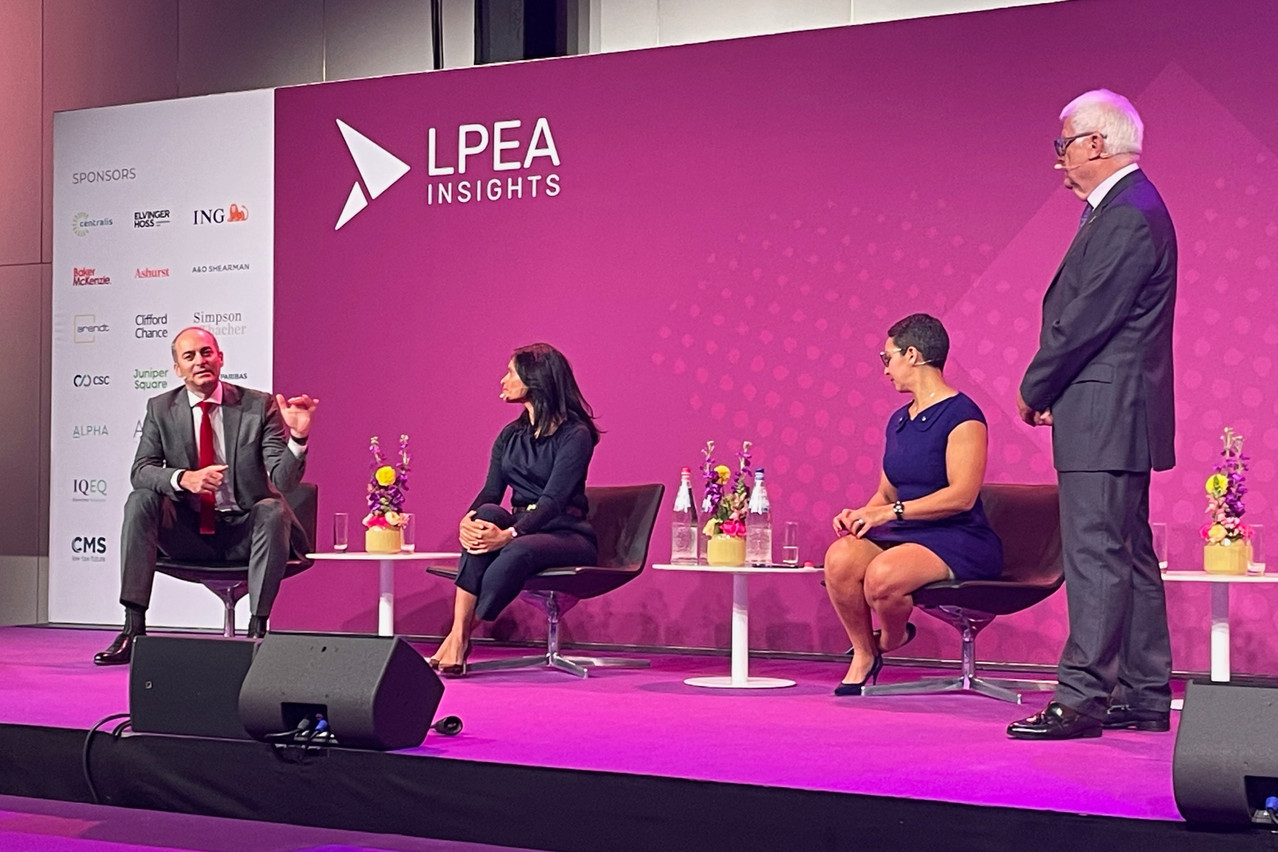
The first two panels (“Competitiveness: How Top PE Firms Stay Ahead” and “Outlook: The PE World Today”) set the scenes of the LPEA Insights Conference 2025 on 23 October 202 in Luxembourg. Despite the turbulent first half in 2025, “markets are generally holding up well,” said Raphael de Botton, senior managing director at Blackstone. “Liberation Day was mainly a pause, not so much a stop,” stated Sara Huda, managing director and global head of investment services at EQT Group.
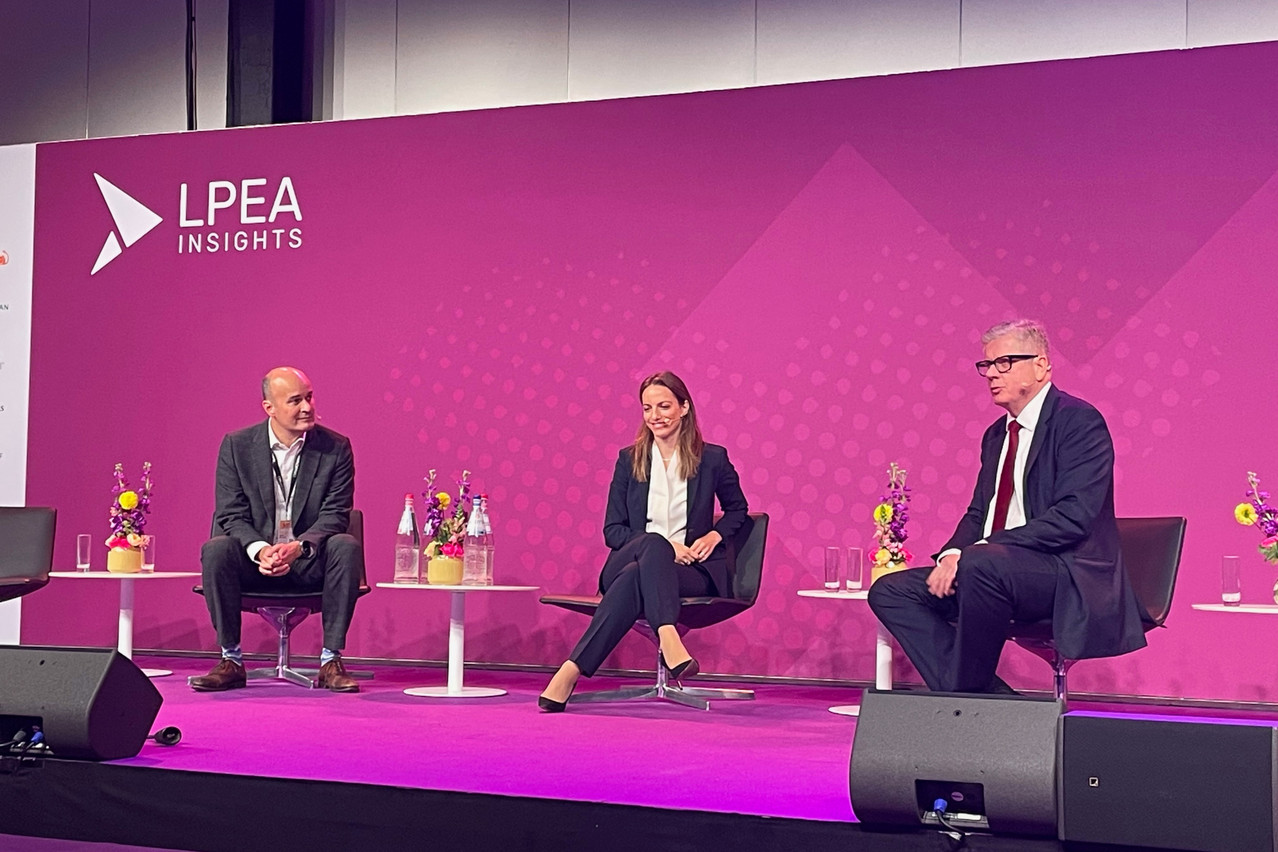
Jerome Bertrand (L-GAM), Claudia Scarico (Apollo Global Management) and Claus Mansfeldt, moderator (Swancap Investment Management), debated on the panel “Outlook: The PE World Today” at the LPEA Insights Conference 2025 on 23 October 2025. Sylvain Barrette
Consequently, the overall market temperature was characterised by “cautious optimism” by Hind El Gaidi, head of Luxembourg at ICG. Despite confusing headlines, with the underlying economic fundamentals is still seen by de Botton as "pretty good" with a market reopening for exits
[competitiveness] is a rigorous focus on fundamentals, primarily driving portfolio value creation rather than resorting to financial engineering
However, Huda and El Gaidi noted there is a distinct bifurcation in the market, where firms with a huge amount of scale and track records have bounced back quicker than mid- or lower-market General Partners (GPs), influencing their ability to raise funds, secure deals, and execute exits.
How to keep your edge?
Huda defined competitiveness as “a rigorous focus on fundamentals, primarily driving portfolio value creation rather than resorting to financial engineering.” For de Botton, consistency in delivering good returns and service is paramount—likening the business to a restaurant where failure to serve good food means customers (investors) won't return.
Scale is acknowledged as a significant competitive advantage, enabling access to data and resources needed to build portfolio operations groups. De Botton stressed that their key performance indicators (KPIs) centre on generating returns by delivering growth, improved margins, and finding strategic exits.
Investment strategies are heavily influenced by thematic trends. “Everything fossil fuel related is something that we are moving away from,” said de Botton. It is driven by ESG principles towards renewable energy (Blackstone) and medical technology (EQT), for instance.
Operational challenges and innovation
Regulation is perceived by panellists as a significant operational burden, especially in Europe/Luxembourg. The proliferation of various regulations (like SFDR) makes running funds costly, heavy and with “multiple cost effects.” “Who are we actually trying to protect here?” questioned Huda. She thinks that investors may often pay higher costs for protections they may not need. “This heavy regulatory environment complicates business and risks making product returns less competitive,” said El Gaidi. Paradoxically, this pressure sometimes forces firms to look at efficiency and automation, potentially driving innovation.
Financial innovation and liquidity challenges
Continuation vehicles (CVs) are seen as powerful new tools, addressing the fact that many private equity firms are sitting on assets they have held for a long time, particularly evidenced by low “distributed to paid-in” (DPI) statistics for recent vintage funds (e.g., 2019 vintage DPI average of 0.2). In other words, “only 20% of the money collected in 2019 was returned to investors,” stated Jerome Bertrand, partner at L-GAM. He argued that “[CVs are] a relevant solution to provide liquidity, but I think it will only work on great-performing assets.” He thinks that concerns about conflicts of interest must be mitigated by bringing in a substantial amount of third-party money or another sponsor to set the price.
Talent and technology
Talent acquisition is viewed as a major focus, contradicting the perception that it might be easy for large firms. Panellists’ emphasis is on culture, hiring "nice people," and fostering a collaborative and positive environment. “[Newcomers] need to be entrepreneurial because they will be the leaders of tomorrow, driving innovation,” stated de Botton.
Artificial Intelligence (AI) is at the forefront of strategic consideration. Claudia Scarico, a private equity partner at Apollo Global Management, explained that her firm is using AI across three dimensions: “identifying new investment opportunities, deploying AI to increase efficiency within portfolio companies and using it internally to improve investment decision-making and research, effectively freeing up time for critical thinking.”
Industry future
Panellists expect limited partners (LPs) to increasingly allocate capital to a few successful companies, moving away from less successful managers. While scale provides inherent advantages, there will always be a space for successful mid-market private equity firms that demonstrate strong performance, alignment, and commitment to their niche. “We live from the management fees, the success of our investments. the ability to raise the next fund. And I think that creates a world of greater alignment,” said Bertrand.
The industry relies on an entire ecosystem—including councils, service providers, and auditors—working together with transparency, creativity, and openness to grow and upskill in the same direction, reflecting the sentiment expressed by John Holloway, Senior Adviser at INED, Former European Investment Fund, that "no man is an island."