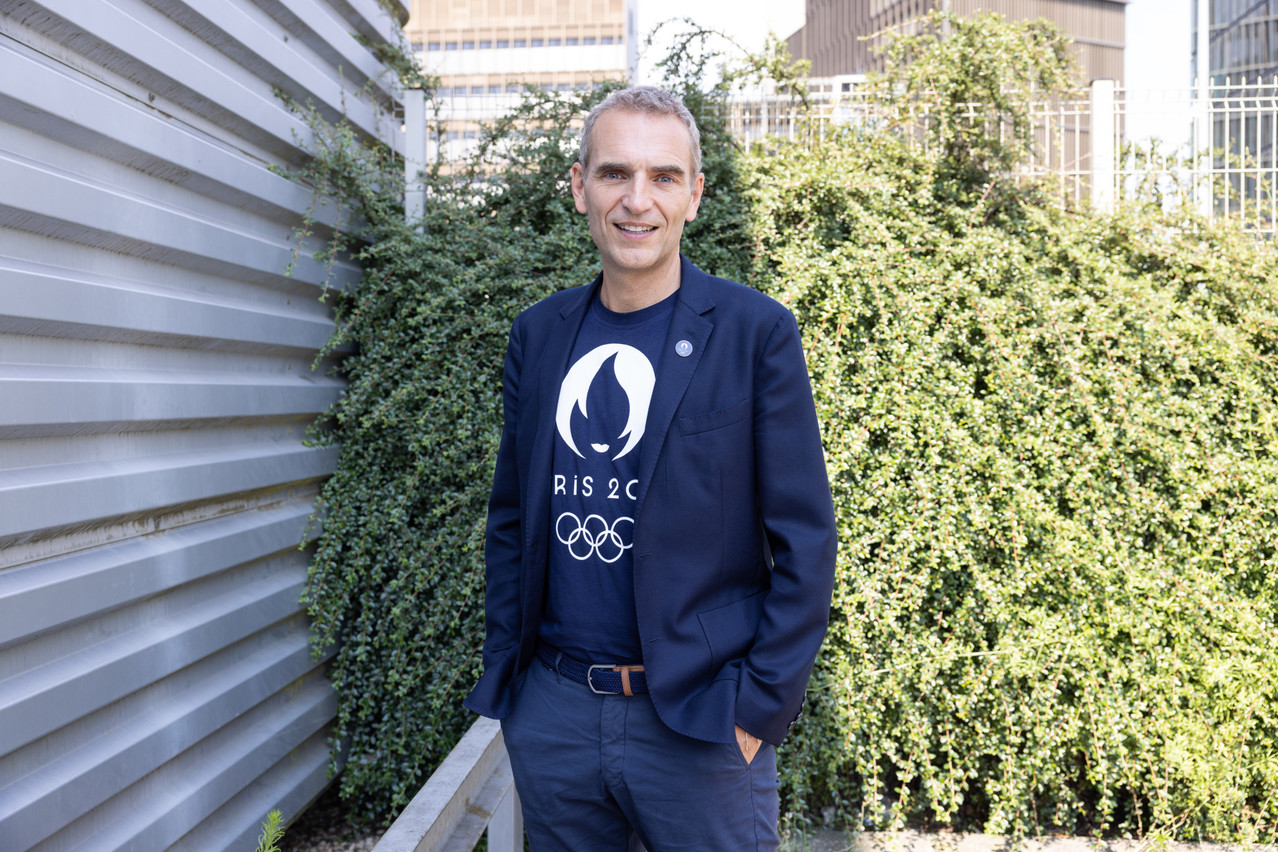
Alexandre Mars began his entrepreneurial career at the age of 17. His successes gave him the financial security he needed to fuel his social ambition: to be useful. He first created Epic, a global foundation that helps empower and protect children, young people and the planet by bridging the gap between impactful non-profits and individuals and businesses looking to enact positive change. He has also set up Infinite, a social edtech that supports students from disadvantaged backgrounds in gaining access to top schools, universities and the professional world through an innovative student loan offering. Loans that these students repay by financing other students. A “virtuous Ponzi scheme,” as he describes it. His passion for sport and his commitment to greater social justice have also led him to become an ambassador and member of the board of directors of the Paris 2024 Olympic and Paralympic Games. He has also written several books. For Vanity Fair, he is one of the 50 most influential French people.
How does an entrepreneur become a philanthropist?
Alexandre Mars: I don’t think there’s necessarily a logical link between the two. The question is rather how a citizen, whether entrepreneur, employee or intrapreneur, becomes a philanthropist. You just have to open your eyes and realise that the private sector has to do a lot of things for other people, quite simply. You can’t expect the public sector to do everything.
You use the expression “open your eyes.” What made you open your eyes?
My mum. A long time ago. I grew up with an extremely altruistic mum who often looked after people. In fact, that’s the way I was brought up and helping people is something that comes very naturally to me. Education plays a big role, that’s for sure. And then your entourage, your wife, your best friends... It’s the people around you who sometimes help you to find that path in life.
You’re also known as a successful entrepreneur. How do you turn a philanthropic activity into a business case?
It’s true that Epic, a not-for-profit start-up whose aim is to amplify the ability of people and companies to make an impact through giving, has become a business case. In 2019, the Harvard Kennedy School published a study on Epic, highlighting its innovative new social impact model.
That said, we are a not-for-profit organisation, meaning we have no business model. This proves that it can be done. We all grew up with a very ‘Milton Friedman’ vision, the great economist who said that a company’s social responsibility was to make a profit. Today, we realise that we can certainly have an impact in a different way than just thinking purely in terms of the bottom line in our profit and loss account. It is possible to have a positive impact on society and on employees. We can talk about social issues and business issues at the same time.
So what are the KPIs of a social organisation?
Overall, the KPIs will be the number of life trajectories you can positively influence. How are you going to compensate for a birth in a city that wasn’t supposed to be this one, in a country that isn’t a democracy, or in a family that doesn’t have the means? For me, my KPI in my life will be the number of people who, thanks to the innovations and platforms that I have been able to develop, will have had a different life, a life trajectory that was not the one they were predestined for, a more positive life trajectory.
Based on your own experience, what messages would you give to apprentice entrepreneurs?
I talk about this in my book ‘Pause.’ I think there comes a time when you have to take a risk. I still often see entrepreneurs who hesitate because there’s inevitably a risk of failure. Mandela had this wonderful phrase to explain that there was never any real failure: ‘I never failed. Either I won or I learned.’ You have to have that mentality, which is a mentality of resilience.
And you have to be able to work hard. You’re going to have to put other things aside. So sometimes it’s going to be evenings out with your friends, sometimes it’s going to be sports evenings, sometimes it’s going to be Netflix evenings. At one time or another, it’s difficult to be able to do everything. You have to accept that, just as you have to accept your failures. I accept my failures. I’ve had failures every day. When I arrived here earlier, someone said to me: ‘No, I'm not going to do this project.’ That’s life. My life is having people say no to me. And why is that? Because I asked. You have to accept the fact that when you ask, not everyone is necessarily totally in tune.
You have to accept that. Resilience is a subject.
While we’re on the subject of success and failure, what is your greatest success?
My greatest success is my family. Success also means being able to align your values with your actions, which is a very complicated thing to do. It’s a day-to-day job.
Following on from the previous question, what is your worst memory, the failure that has marked you?
Losing my brother. That was my biggest failure. Faced with the loss of someone you love very much, you say to yourself that you could have done things differently.
Apart from Epic and Infinite, what are the projects that are currently closest to your heart and on which you want to mobilise people?
Demonstrating that positive finance is not an oxymoron. It’s a subject I’ve been working on for years, a subject that makes me get up in the morning, that makes me challenge myself, that makes me try to convince people on a daily basis. And it makes me work harder than I should. For me, we live in an ultraliberal world. So it has to be super social too. There’s no other choice.
And then this summer there are the Paris 2024 Olympic Games, for which I am ambassador and administrator. Eight years ago, I joined a committee called Sport and Society, the aim of which was to demonstrate that sport had a considerable leverage effect, not only on disability but also on women, young people and the conversion of athletes. We’re going to see different games, much more aligned games, in tune with today’s social challenges.
This article was first published in French on Paperjam. It has been translated and edited for Delano.