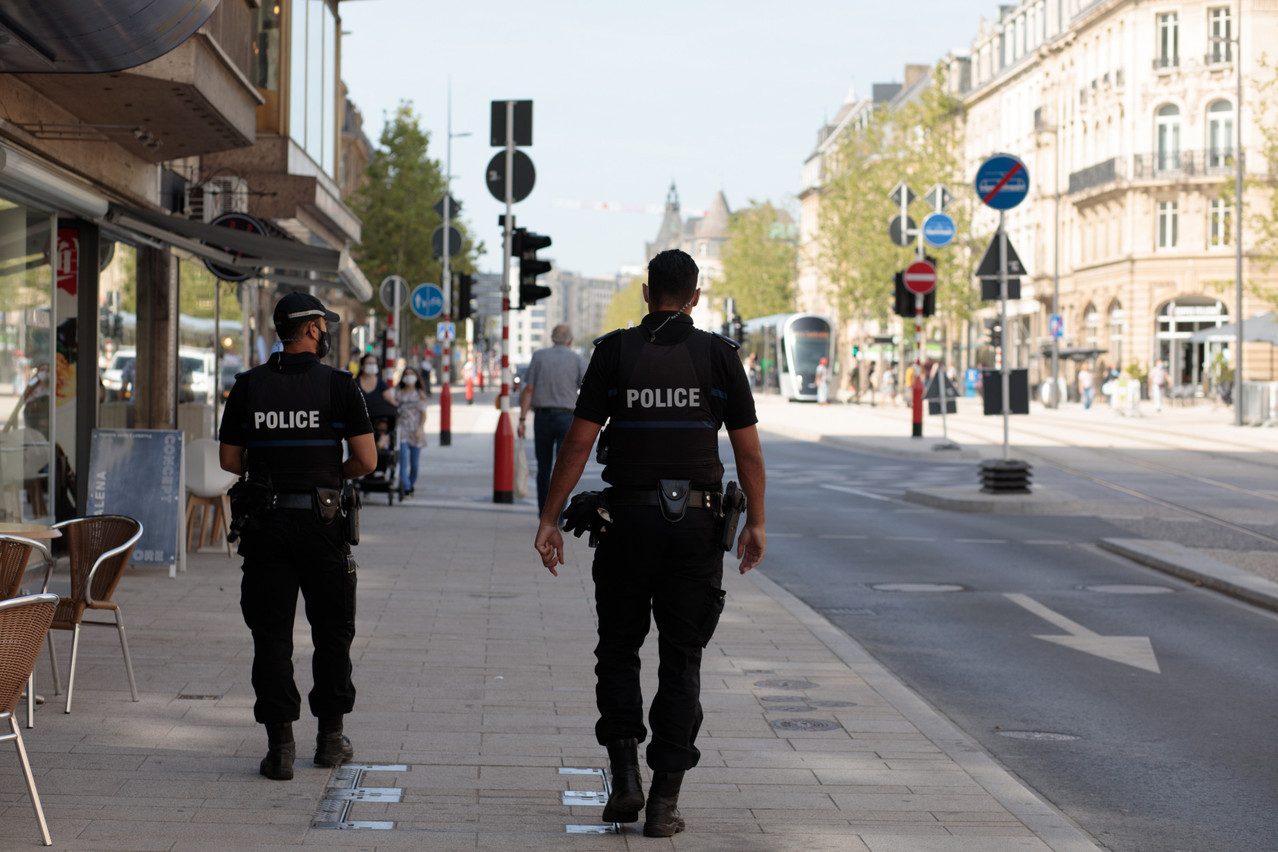
The legislation focuses on guaranteeing access and freedom of movement. Thus, the mere presence of a person, if it hinders the freedom of movement of others wishing to use the access to a building, is sufficient to justify their removal by the police, by force if the person does not comply.
The aim of the ministry of internal security is to respect the principle of proportionality: "Even if it restricts the freedom of movement of some people, it does so in the least intrusive way possible in order to guarantee the freedom of movement of others,” the ministry explains in the bill.
The CSV abstains
The news did not go down well with the main opposition party, the CSV, whose members abstained from the vote. It "doesn't go far enough for us", explained 
The CSV wanted the police to be able to intervene when people are, for example, located under the window of a shop. Under the new legislation, since they are not blocking access, they cannot be removed. The same goes for when people have broken into a private building, into an area "not accessible to the public". The conservative party also demanded that, after two warnings, the police should be able to place the persons concerned in administrative detention at the police station.
Two opposing views
The law's rapporteur, 
Taking the people concerned back to the police station would not solve the problem, she says. Because what do you do with them once they are at the police station? And the next day, once they are released? "There is no miracle solution" for people who are so marginalised that they are no longer receptive to the provided assistance,” according to Empain.
Automatic failure
As for the areas not accessible to the public, the green MP is surprised: “We are talking about administrative police to keep people away from the public space. Inside, this is a matter for criminal law. This would therefore require a completely different piece of legislation.”
Gloden foresees an "ex officio failure", as these measures are not, "in practice, transposable", according to him. "And what the government forgets is to consider this feeling of insecurity," he adds. "We see that appointing a green minister to the police ministry (the minister of internal security, 
This article was first published in French on Paperjam. It was translated and edited for Delano.