A treasure, according to the national anthem. An asset for the economy and nation branding, according to agriculture minister 
The Luxembourg wine sector has earned its spurs over the past 20 years by producing wines whose quality has gone from strength to strength--and which have been internationally recognised. As the harvest approaches and the 2025 vintage looks set to be a great one--barring any last-minute weather woes--Paperjam went to meet some young independent winegrowers. (“Independent” in the sense that they do not work for a cooperative, which is the case for more than half of the country's winegrowers, but that they vinify their own production.)
Passionate people with varied backgrounds, but who have in common a passion for their profession. At a time when the average age of professionals is rising and the issue of farm takeovers is beginning to take shape, they represent the future of the profession--a profession that reinvented itself in 1991 with the launch of the Crémant label. This label has turned a production dating back to the 18th century into a flagship product for Luxembourg’s vineyards and has become a serious growth driver.
A shrinking vineyard
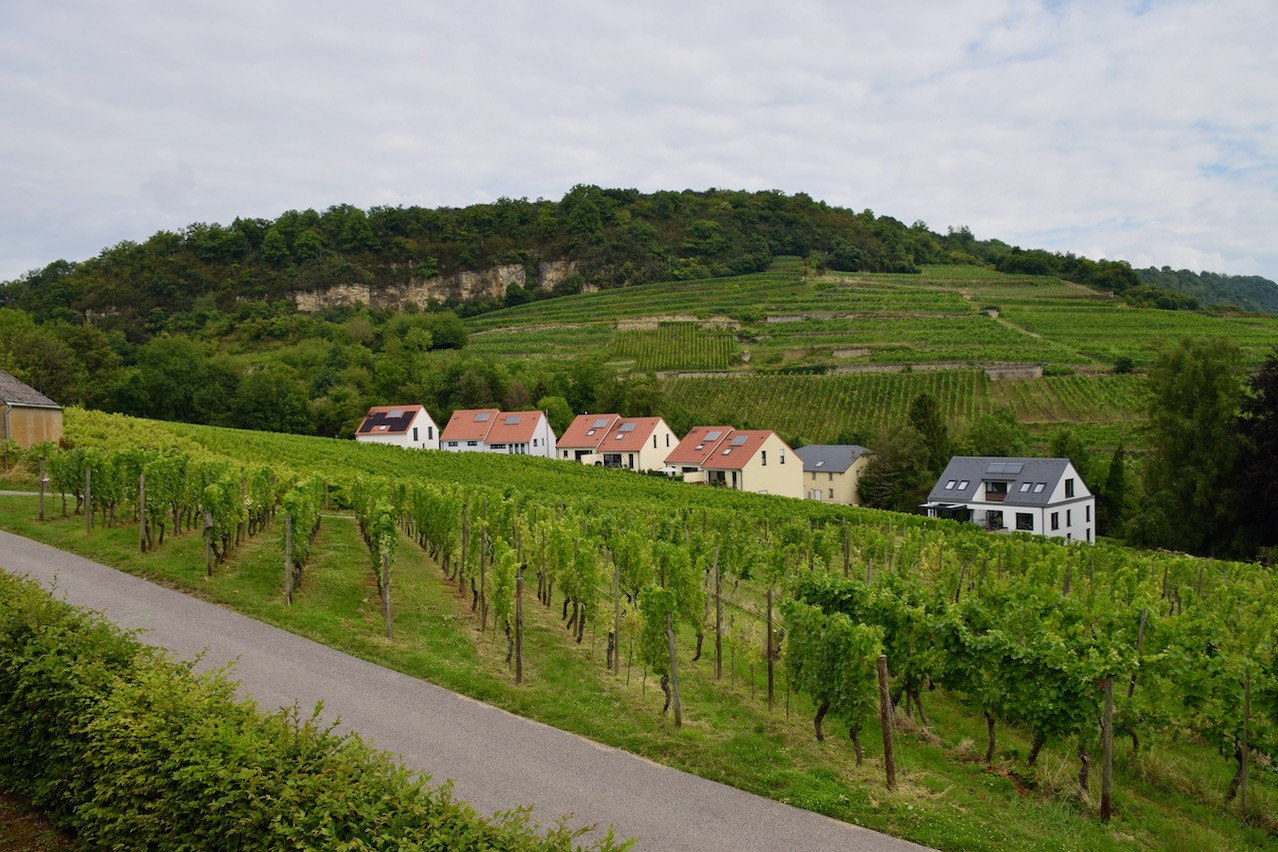
How are the vineyards doing? According to data in the 2024 activity report from the Institut Viti-Vinicole (IVV)--the administration responsible for training winegrowers, monitoring the Luxembourg protected designation of origin, managing the Luxembourg State winegrowing estate (six hectares located in Remich, Stadtbredimus, Ehnen and Dreiborn) and conducting research--in 2024 the country had 244 vineyards, representing 1,213 hectares of vines, of which 1,191 hectares were in production. In 2005, the vineyards in the Luxembourg Moselle still totalled 1,300 hectares.
This decrease can be explained in part by the loss of wine-growing areas as a result of urbanisation and plots left to fall into disuse. Some 25 hectares are currently affected, a figure that could quadruple according to Hansen, who announced, at the end of the last Wäibaudësch, an action plan for generational renewal in agriculture and viticulture for the end of the year and the creation of a one-stop shop for young people wishing to take over a farm or create a new one.
While the surface area of abandoned vines may seem modest, it poses a major health problem for the surrounding vineyards by encouraging the development of diseases and parasites. It is not uncommon for neighbours of such plots to take it upon themselves to clean them up. The possibility of compulsory grubbing-up for owners who neglect to maintain their plots will be examined, the minister said.
Ageing and restructuring
Over 100 winegrowers--106 to be exact--are over 60, representing 43.4% of Luxembourg’s winegrowers. They farm 24.1% of the national wine-growing area. Another 100 are aged between 40 and 60, while 38 are under 40. The oldest farmers can no longer work their fields, and are also having difficulty finding tenants. Some 71% of plots are farmed on a freehold basis, 24% on a tenant basis and 6% in some other way. Ensuring the succession of farms and guaranteeing that winegrowing areas remain in production will be the challenges facing the profession over the next few years.
As in the banking sector, the time has come to restructure towards larger production units. In 20 years, the number of Luxembourg winegrowers has fallen from 460 to 244, a decline of 47%. This decline has been accompanied by an increase in the average size of farms, from 2.8 hectares to 5 hectares. Over the same period, the number of plots fell by 1,000 to 4,497, with the average size rising from 24 ares to 27 ares. This makes them easier to farm.
Currently, 122 farms with an area of less than three hectares together farm just 9% of the total area, while 45 farms with an area of more than 10 hectares together manage 748 hectares, or 62% of the total area. “There is a clear move towards estates farming more than 10 hectares,” says the IVV.
This decline in surface area has been accompanied by a fall in production over the past 20 years. In 2025, 110,694 hectolitres were produced, giving a yield of 89 hectolitres per hectare. In 2024, 76,504 hectolitres were produced, giving a yield of 60 hectolitres per hectare. A lower production than the 10-year average of 92,704 hectolitres for a yield of 60 hectolitres per hectare.
A drop mainly due, according to the IVV, to a shift in grape growing towards more quality, which is reflected in the volume produced per hectare. This trend is due to the changing habits of consumers, who may be consuming less, but want higher quality products, even if it means increasing their drinks budget. It is in this quest for quality that the future of the wine sector lies. This is an opinion shared by all the winegrowers we came across in the field.
The onslaught of Burgundy grape varieties
This reorientation is claiming collateral victims. The main one is Rivaner and, to a lesser extent, Elbling. Just a few decades ago, these two grape varieties were favourites with Luxembourgers. They are now losing ground. Although Rivaner is still the most widely grown grape variety, accounting for 19% of the national wine-growing area, it is steadily giving way to Burgundian varieties such as Auxerrois, Pinot Blanc, Pinot Gris, Pinot Noir and Chardonnay. Elbling accounts for 4.1% of the surface area, compared with 10% in 2005. Pinot noir made its appearance in the Grand Duchy in 1991 thanks to the boom in crémant, of which it is one of the central components along with chardonnay.
For some years now, winegrowers have been trying out new grape varieties alongside the traditional ones. These include the so-called “Piwi” varieties (Pilzwiderstandsfähige Sorten). These are interspecific grape varieties resulting from a natural cross between a vitis vinifera and an American strain, providing natural resistance to fungi.
The climate effect
The drop in yields can also be blamed on climate change. The 2024 harvest was below the historical average, it being a year of rain and late frosts, which led to many losses. But the vintage was of high quality. Meanwhile, 2023 was a year of disease and 2022 a year of drought. Climate change is complicating matters for winegrowers. It’s not so much global warming that worries them, but the recurrence of extreme events. Faced with this, everyone is adapting. Increased vigilance, testing of new grape varieties or cloning of existing varieties to make them more resistant. (A grape variety is a vine variety, while clones are individuals genetically identical to a selected “mother vine” obtained by successive cuttings. The aim of cloning a grape variety is to select and reproduce specific characteristics within that grape variety, such as better resistance to disease or improved fruit quality, without altering the overall varietal identity.)
While climate change is a challenge for young winegrowers, it is not the one cited first. Nor is the question of the difficulty of getting started. First comes the growing administrative burden. It’s a reality that also affects the vine, and one that’s causing the profession to lose “a lot of its romanticism.”
Disenchanted winegrowers
The second major challenge is linked to policies to combat alcoholism. While no one questions the merits of these policies, everyone is critical of what they readily perceive as the “criminalisation” of drinking. Particularly the “first drink.” They would prefer the health authorities to communicate more about responsible drinking.
Changes in consumption are the third major challenge put forward by our winegrowers. Tastes are changing and so are buying practices.
Over 2023 and 2024, the average per capita consumption was 36.2 litres, including 8.7 litres of Luxembourg wine products. Over 2020 and 2021, consumption was 40.2 litres, including nine litres of local products. Faced with competition from abroad, local producers have one advantage: their skill. There are many grape varieties on the market and many winegrowers who work in different ways, trying out different things. This diversity goes hand in hand with the country’s multiculturalism, and it’s paying off. Most of the winegrowers interviewed say they are proud of the fact that expatriates are becoming advocates for their production in their home countries.
This article was originally published in French.